

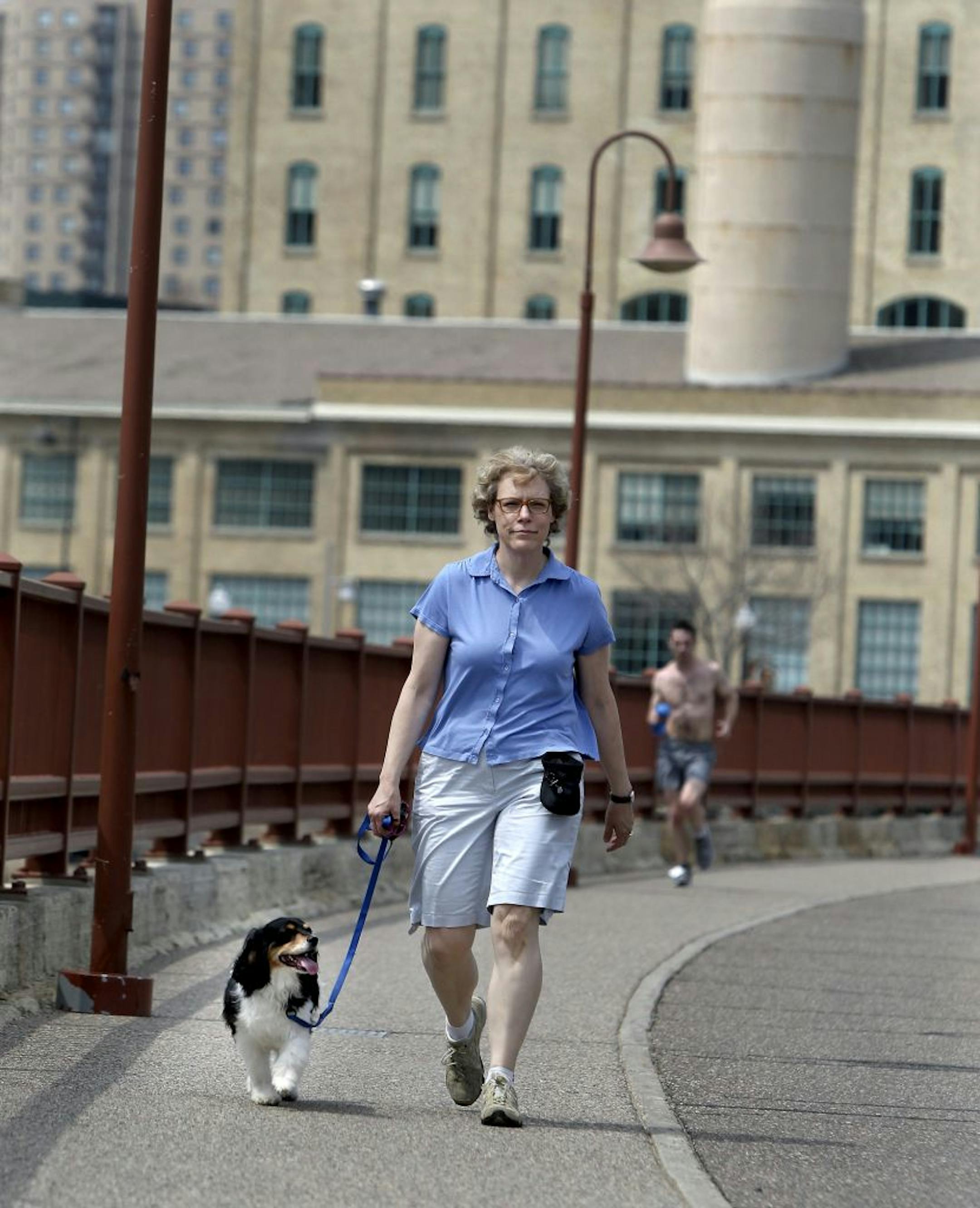
Mary Shore doesn't have to worry about getting so distracted that she forgets to take her daily walk. Kaylee will never allow it.
Shore, a professor at Luther Seminary, takes a 40-minute walk every day with her spaniel-sheltie mix. Depending on her schedule, sometimes they walk in the morning and sometimes at lunch. But if they haven't done it by late afternoon, Kaylee "starts running up and down the stairs looking for me."
Once they get outside, "Kaylee sets the pace, and it's a brisk one," Shore said during one of the twosome's daily treks across the Stone Arch Bridge in Minneapolis. "But that's fine. It's good for both of us."
She's far from the only one exercising with her dog these days. There have been a flood of recent studies confirming that people who own dogs exercise more than people who don't.
A recent Michigan State University study found that dog walkers exercise an average of 30 minutes a week more than non-dog-owners. And a University of Calgary study released in May said dog walkers keep walking even when it's cold, although they might shorten the length of their trips.
The benefits carry beyond just the time the walkers are with Fido. A California study found that dog walkers spend an extra 19 minutes a week walking without their four-legged companions. And a University of Missouri project of residents of an assisted-living center who volunteered to walk dogs at a nearby shelter found that their overall walking speed increased 28 percent over the 12 weeks of the study, said Rebecca Johnson, lead author of the study.
"They also developed a more confident stride and better balance," said Johnson, who is also co-author of the book "Walk a Hound, Lose a Pound" ($16.95, Purdue University Press).
Getting an exercise buddy is a long-proven way to maintain a workout regimen. And when it comes to exercise buddies, man's best friend is always ready for the job.


