

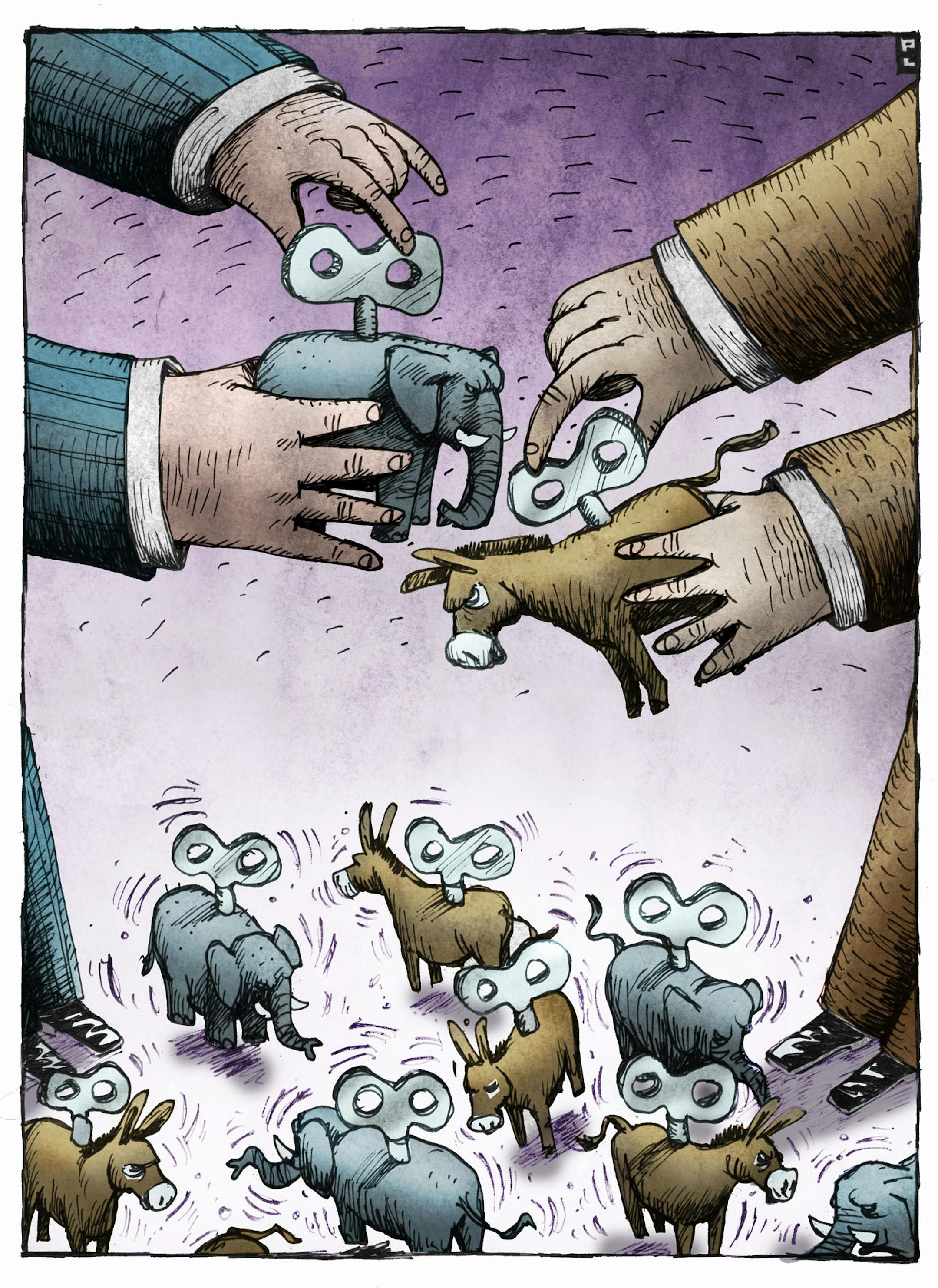
Donald Trump is reminding Americans — Democrats and Republicans alike — about the cost of weak political parties.
The Republican Party is nearly powerless to pull back from anointing Trump its presidential nominee, even as he continues to repudiate America's commitments to racial and religious tolerance and multilateral national security and economic policy. Although there are efforts to block Trump at the GOP convention and through a legal challenge, here is the reality: Party rules dictate that the nomination is decided by a majority of delegates who are selected through the primaries and caucuses. Trump secured a majority weeks ago.
The Democratic Party had its brush with a similar political disaster in 1972, when Alabama Gov. George Wallace fought to a three-way tie in the race for the party's nomination. Famous for his racist crusade for "segregation now, segregation tomorrow, segregation forever," Wallace stirred intense emotions and was riding high when his threat to become the nominee was cut short by a would-be assassin's bullet.
The potential for candidates like Trump and Wallace to hijack major-party nominations raises a difficult question: Should political parties operate as pure democratic vessels that mirror the wishes of those participating in primaries and caucuses? That's Trump's position, of course — and Bernie Sanders'.
Thinking-cap time. Three issues:
1) The idea that political parties should be purely democratic is a peculiarly American obsession. In Britain — and other European countries — national and local party leaders choose nominees. Democracy remains vibrant in these countries but is defined as the battle among the political parties — not within them, as in America.
The general-election showdown pitting Hillary Clinton against Trump (or, if lightning strikes, one of his conservative Republican rivals) poses a clear, stark choice for voters. That contest of dueling parties, platforms and visions constitutes the practical expression of representative democracy that we see in Europe and elsewhere.
2) It is absurd to equate democracy with deference to primary and caucus voters. This year, only about one-quarter of all eligible voters participated in selecting the nominees. Twice that many (or more) are likely to vote in the fall. Today's champions of making nominations "democratic" are perversely advocating for a small minority to choose the candidates from which the majority will be forced to select. What kind of "democracy" is that?


