

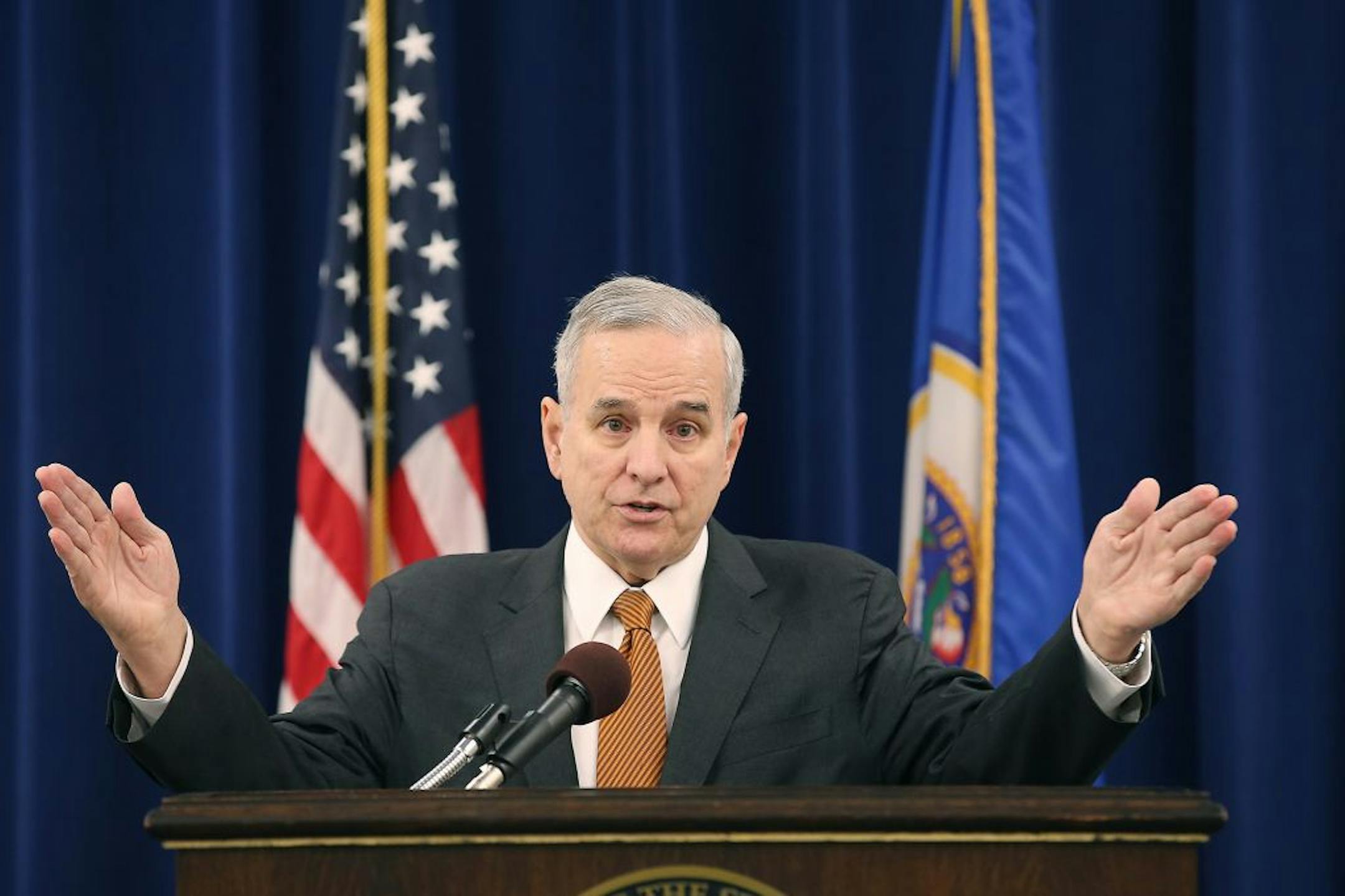
Gov. Mark Dayton proposed Friday that the state borrow $1.4 billion to pay for more than 100 public projects around the state, arguing that an overflowing state treasury and low interest rates make it a good time to invest in unmet needs and create construction jobs.
"This is a tremendous opportunity to make the kind of significant investment in the future of Minnesota — in our infrastructure, in our higher education buildings — that we need, and that we are seriously behind in accomplishing," Dayton said.
Several leading Republican legislators immediately labeled it too pricey.
"Gov. Dayton's historically large borrowing proposal should be cut in half," said Senate Minority Leader David Hann, R-Eden Prairie.
The DFL governor's bonding request to the Legislature includes $343 million for construction at public college campuses. He wants $32 million to renovate the 10th Avenue Bridge in Minneapolis and another $42 million to replace the Kellogg Boulevard Bridge over I-94 in St. Paul.
Dayton also proposed $70 million to renovate and add on to the Minnesota Security Hospital in St. Peter, $26 million to improve housing and treatment facilities in the state's legally imperiled sex offender treatment program, $34 million for a new visitor center at Fort Snelling in time for its 2020 bicentennial, and millions more for affordable housing, state prisons, economic development initiatives and other projects around the state.
A day earlier, Dayton laid out in more detail one of his bonding proposal's centerpieces: $220 million to improve water quality in the state, with $167 million to help cities update water treatment systems and $53 million for water protection measures.
Citing an academic study, the Dayton administration said fully enacting his bonding proposal would generate 39,000 jobs around the state, mostly in construction. Anticipating the kind of regional political jockeying that inevitably accompanies a bonding bill, Dayton's team noted that 35 percent of the projects are in the Twin Cities, 35 percent are in the rest of Minnesota and 30 percent are projects of statewide impact.


