
D.B. Cooper may have unwittingly left clues to his identity, scientists say

The Washington Post
January 17, 2017 at 11:01PM
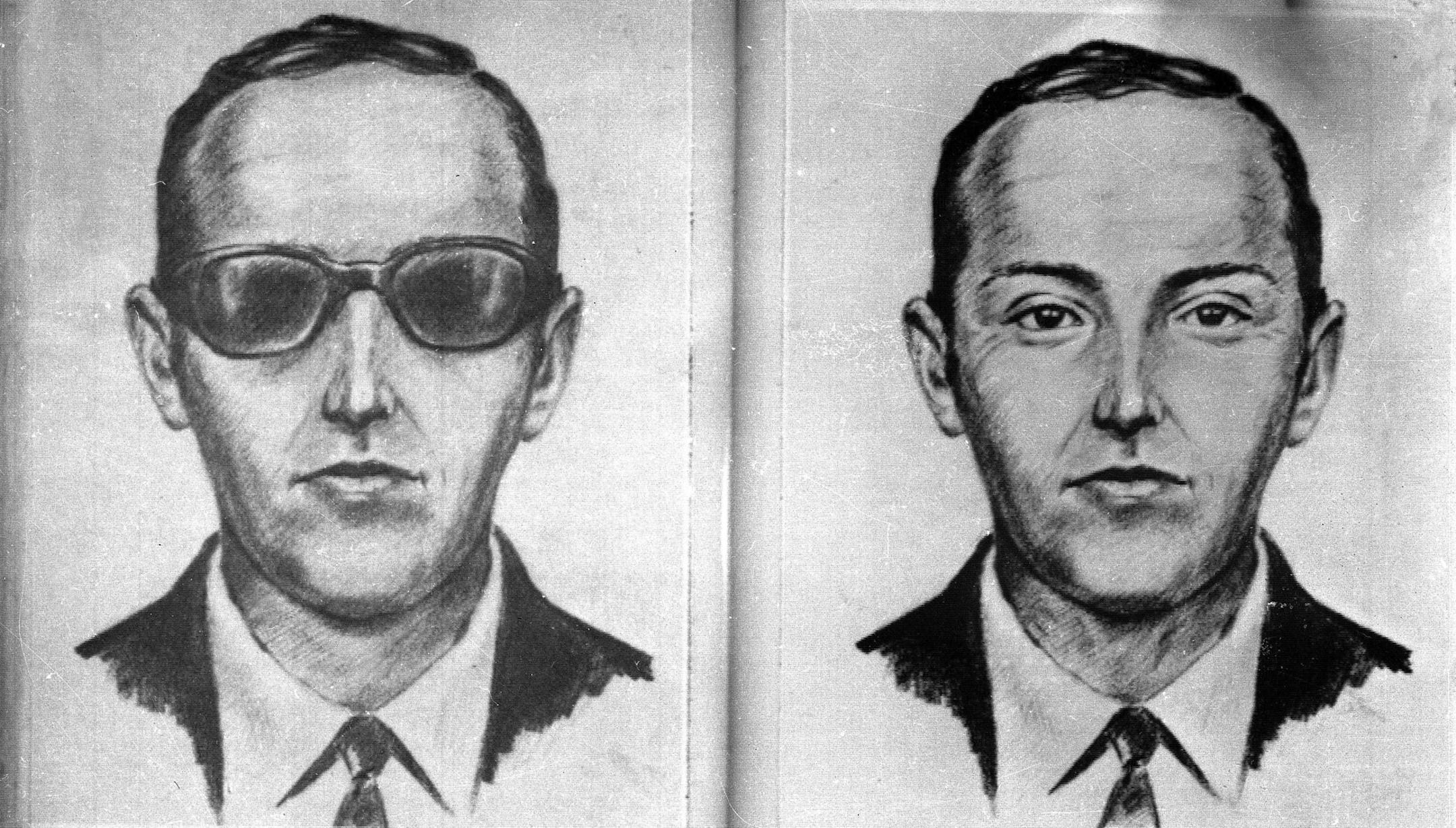
An image provided by the Federal Bureau of Investigation shows an artistís rendering of the hijacker known as ìD.B. Cooper,î which was made from the recollections of passengers and crew of an airplane hijacked between Portland,Ore., and Seattle in 1971. A more aggressive global response to the attacks of Sept. 11, 2001, is one reason that fewer airline hijackers have attempted what was once relatively commonplace. (Federal Bureau of Investigation via The New York Times) -- FOR EDI
The D.B. Cooper case has baffled the FBI for 45 years and the man’s fate remains a mystery. (The Minnesota Star Tribune)

It was "one of the longest and most exhaustive investigations" in FBI history — and to this day remains the only unsolved skyjacking in the United States.

In 1971, a well-dressed passenger hijacked a Northwest Orient flight, demanded $200,000 and later escaped by parachuting out of the back of the plane with the ransom money.

But who exactly was "D.B. Cooper," the mysterious man who managed to pull off the heist and disappear without a trace?

More than four decades later, three amateur scientists think they may have found evidence that would narrow down Cooper's identity to that of an aerospace engineer or a manager.

The scientists, working for a group called Citizen Sleuths, said they have been analyzing particles found on a clip-on necktie that Cooper left on his seat — 18E — before jumping out of the plane.

To the naked eye, the piece of fabric was a nondescript black tie from J.C. Penney. But to the modern-day scientists, the tie was an "incredibly fortunate" piece of evidence in the investigation.

"A tie is one of the only articles of clothing that isn't washed on a regular basis," reads a section on the Citizen Sleuths website devoted solely to the tie. "It picks up dirt and grime just like any other piece of clothing, but that accumulation never truly gets 'reset' in the washing machine. Each of those particles comes from something and somewhere and can tell a story if the proper instruments like electron microscopes are used."

Using a powerful electron microscope, the scientists say, they have identified more than 100,000 particles of "rare earth elements" on the tie, including Cerium, Strontium sulfide and pure titanium, according to the Associated Press. Of those, titanium was the most notable.

"Titanium was a rare metal in 1971 and this makes it extremely unlikely it is a post-event contamination," Citizen Sleuths notes on its site, which lays out in painstaking detail all of the findings from the case. "Its presence constrains Cooper to a limited number of managers or engineers in the titanium field that would wear ties to work."

At the time, they noted, the element was used extensively by the military in aircraft and helicopters.

Scientists think he may have worked at Boeing, which at the time happened to be developing a Super Sonic Transport plane that used those elements, Tom Kaye, a lead researcher with Citizen Sleuths, told King 5 News.

"The tie went with him into these manufacturing environments, for sure, so he was not one of the people running these [manufacturing machines]," Kaye told the news station. "He was either an engineer or a manager in one of the plants."

He added that the group was asking anyone from the public with information to contact researchers through the Citizen Sleuths website.

"Someone may be able to look at those particles and say, 'Oh my gosh, I know what that means having those particles on the tie,' " Kaye told the news station.

The mystery began on Nov. 24, 1971, when a nondescript man going by the name of Dan Cooper purchased a one-way ticket from Portland, Ore., to Seattle directly from the Northwest Orient Airlines counter on the day of the flight.

He used cash to pay for his ticket, then boarded the plane. Authorities later described him as someone in his mid-40s, dressed as an "executive" in a suit, a white shirt and what probably is the now-infamous black tie.

The agency's official summary of how the hijacking unfolded reads like the plot of a Hollywood thriller from another era:

"He ordered a drink — bourbon and soda — while the flight was waiting to take off. A short time after 3:00 p.m., he handed the stewardess a note indicating that he had a bomb in his briefcase and wanted her to sit with him.

"The stunned stewardess did as she was told. Opening a cheap attaché case, Cooper showed her a glimpse of a mass of wires and red colored sticks and demanded that she write down what he told her. Soon, she was walking a new note to the captain of the plane that demanded four parachutes and $200,000 in twenty-dollar bills.

"When the flight landed in Seattle, the hijacker exchanged the flight's 36 passengers for the money and parachutes. Cooper kept several crew members, and the plane took off again, ordered to set a course for Mexico City.

"Somewhere between Seattle and Reno, a little after 8:00 p.m., the hijacker did the incredible: He jumped out of the back of the plane with a parachute and the ransom money. The pilots landed safely, but Cooper had disappeared into the night and his ultimate fate remains a mystery to this day."

The FBI pursued hundreds of leads. No body or parachute was ever found, but in 1980, a boy digging near the Columbia River found three bundles of $20 bills whose serial numbers matched the money Cooper had demanded.

The Cooper case baffled the FBI for 45 years, and in July, the agency announced it would no longer actively pursue the "NORJAK investigation," or Northwest hijacking.

Over the decades, hundreds of tips had poured in, but none that could help prove culpability beyond reasonable doubt, the agency said.

"Every time the FBI assesses additional tips for the NORJAK case, investigative resources and manpower are diverted from programs that more urgently need attention," the FBI said.

Soon after the FBI dropped the case, Geoffrey Gray, the author of "Skyjack," announced that he would make available hundreds of FBI files related to the Cooper case on True Ink, an online magazine Gray founded.

By opening everything up to the public, Gray said he hoped to use people's enduring curiosity about the case to crowdsource, once and for all, Cooper's identity.

"We're trying to solve one of the greatest unsolved mysteries of our time," he wrote on True Ink, "and we need your help."

about the writer

about the writer

Amy B Wang

More from Minnesota Star Tribune

See More
card image
J. SCOTT APPLEWHITE, ASSOCIATED PRESS/The Minnesota Star Tribune

The "winners" have all been Turkeys, no matter the honor's name.

In this photo taken Monday, March 6, 2017, in San Francisco, released confidential files by The University of California of a sexual misconduct case, like this one against UC Santa Cruz Latin Studies professor Hector Perla is shown. Perla was accused of raping a student during a wine-tasting outing in June 2015. Some of the files are so heavily redacted that on many pages no words are visible. Perla is one of 113 UC employees found to have violated the system's sexual misconduct policies in rece