

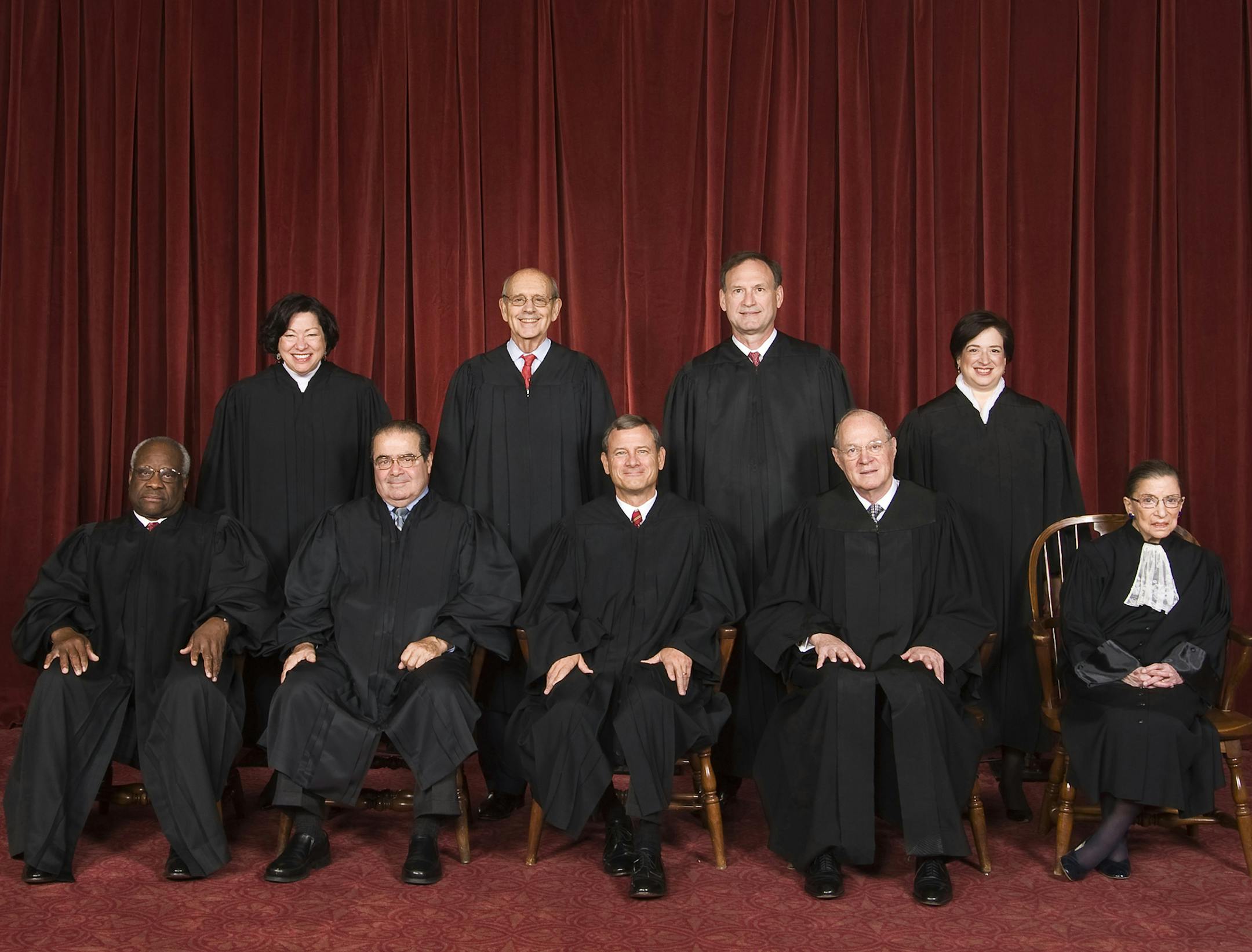
The U.S. Supreme Court under Chief Justice John Roberts certainly seems like a conservative juggernaut. From campaign finance to race to religion, it has moved the law dramatically to the right. But last week's high court decision on cellphone privacy shows that this isn't the entire story.
In a number of significant areas of law, a majority of the Roberts Court will line up behind rulings that are not so much conservative as libertarian — often with a surprisingly progressive bent.
That is certainly true of Riley vs. California, in which Roberts, on behalf of his unanimous colleagues, concluded last week that police may generally not search an arrestee's cellphone without due process.
"Our answer to the question of what police must do before searching a cellphone seized incident to an arrest is accordingly simple — get a warrant," wrote the chief justice. This finding echoes arguments about the Constitution's text and history made both by liberal organizations, such as the American Civil Liberties Union (ACLU) and the Constitutional Accountability Center (CAC), and by the libertarian Cato Institute.
And it's only the latest example. In a number of cases the court's relatively liberal justices have peeled off one of the court's conservatives — most often Justice Anthony Kennedy, who leans libertarian on many issues, or Justice Antonin Scalia, whose originalism sometimes leads him to expansive readings of the protections provided by the Bill of Rights — to craft a majority in favor of a libertarian-liberal outcome.
Consider, for example, Safford vs. Redding, a 2009 case in which liberal and libertarian organizations successfully argued that the strip search of a schoolgirl violated the Fourth Amendment. Or United States vs. Jones, a 2012 case in which the same coalition convinced the court that attaching a GPS tracking device to a car to monitor its location violates the Fourth Amendment.
The court's libertarian-liberal decisions are not limited to traditional search cases. For example, in Boumediene vs. Bush in 2008, a five-justice majority held that the constitutional protection of habeas corpus extended to the detainees held at Guantanamo, reaching a result urged by both liberals and libertarians.
Last year in United States vs. Windsor, the court held 5-4 that Section 3 of the Defense of Marriage Act (DOMA), which defined marriage to be solely between a man and a woman for purposes of federal law, violated the basic constitutional requirement of equality under the law. The decision at once struck a blow against government regulation of people's private lives (a triumph for libertarians) and against discrimination and inequality (a triumph for liberals).


