

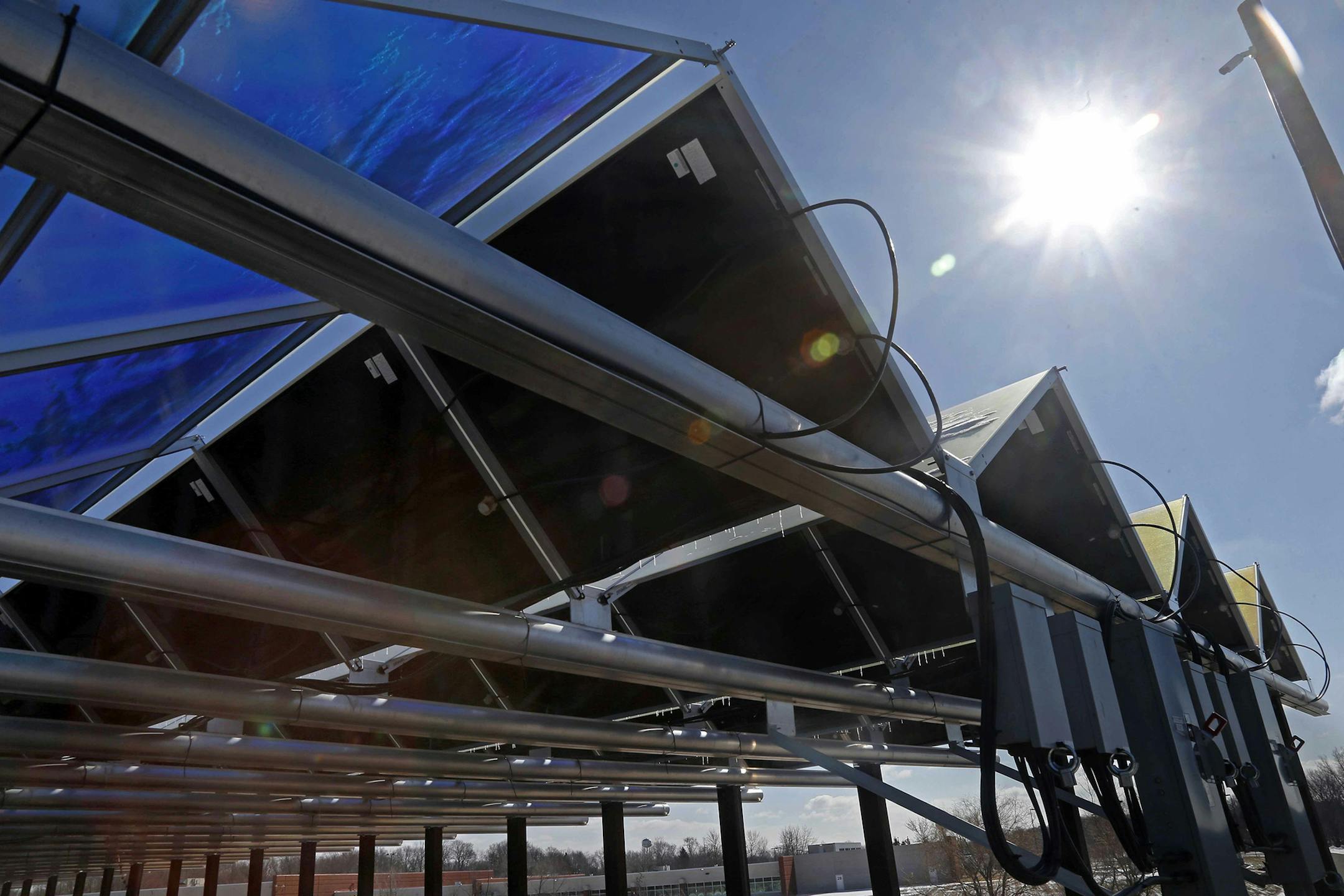
Minnesota's mandated community solar garden program has blossomed over the past few years, but questions have arisen about its complicated economics.
In recent months, Xcel Energy, which administers the program, has been stressing the costs of community solar gardens, particularly compared to larger-scale solar projects.
"We were really concerned that this would turn out to be an expensive program," Xcel CEO Ben Fowke said in a recent interview. And it has become just that, with the costs flowing down to ratepayers, he said.
Clean-energy advocates and solar power developers say Xcel's calculations don't consider "avoided costs" derived from the solar gardens, including damage to the environment from fossil fuels. In other words, "How much is Xcel not spending?" said Gabriel Chan, an assistant professor at the University of Minnesota's Humphrey School of Public Affairs.
The Community Solar Garden program was created by the state Legislature in 2013, a pioneering effort that has produced the nation's largest effort of its kind. Fifty-eight percent of Minnesota's solar power comes from the solar gardens. Larger-scale "utility" solar projects make up most of the rest — with more coming online in the near future.
Community solar gardens are aimed at residents, businesses and governments that want solar energy without setting up their own panels. They are developed, marketed and owned by independent energy companies. Xcel buys power from solar gardens and administers the program but makes no profit, although it gets credits to meet state solar energy goals.
The community solar program was intended to kick-start solar power in Minnesota — and it has, said Allen Gleckner, director of energy markets at Fresh Energy, a renewable-energy research and advocacy group in St. Paul. "It has been very successful and it has driven a ton of solar installations."
There are nearly 160 community solar gardens in the program. Residential subscribers numbered 10,060 as of early December, while there were about 570 commercial and government subscribers, according to Xcel. Residents account for 11 percent of the electricity sold through the program, as commercial customers take bigger chunks of power.


