Chalkboard captures the mood outside the governor's residence

Colors of anger, hope crowd chalkboard at governor's residence.

July 10, 2016 at 2:49AM
Alejandra De La Cruz Hogendorn signed "I don't like killing," on a chalk board in front of the Governor's Mansion, Friday, July 8, 2016 in St. Paul, MN. ] (ELIZABETH FLORES/STAR TRIBUNE) ELIZABETH FLORES • eflores@startribune.com
Alejandra De La Cruz Hogendorn, top, wrote “I don’t like killing” on a chalkboard Friday in front of the governor’s residence in St. Paul. Above left, Dallas Police Chief David Brown. Above right, Maxwell Silver, in sunglasses, and Elijah Lartey of St. Paul. (The Minnesota Star Tribune)

Amoreina Espinosa wandered up shyly to an 8-foot chalkboard set atop the pavement on Summit Avenue, a quiet, somber place just outside the crowd of peaceful demonstrators gathered at the governor's residence.

A small piece of white chalk in her delicate hand, she searched for a clear spot amid the hundreds of colorful messages already scrawled there. Finally, she found a tiny space near the middle of the board.

Then, ever so carefully, she etched:

"#All lives matter."

Just 14, Espinosa had navigated with a friend on a city bus to the grand, leafy avenue Friday, high-tops on her feet and baseball cap in hand. It was her first time at any sort of demonstration.

She'd seen the stories about police shootings of black men across the country, she said, but after Philando Castile, a school cafeteria worker from St. Paul, wound up dead in a traffic stop just miles from her home, the whole issue felt different.

"I never thought it could happen here," she said, almost in a whisper, her deep brown eyes fixed in a stern gaze of disbelief. She paused. "But it has. To me, that's America today. … I'm feeling lost."

Amid the hundreds of demonstrators who've assembled outside Gov. Mark Dayton's residence in recent days, the chalkboard set up on the blocked-off, police-protected avenue has served as a venting spot. Its surface displays the cauldron of emotions across Minnesota and the country in a week when police shot and killed black men in Falcon Heights and Baton Rouge, and a black Army veteran, seeking retribution, gunned down five white officers who were protecting a demonstration in Dallas.
"Why?" read one message in thick blue letters on the chalkboard.

"Prosecute the police," read another.

"I am so sorry that we're here."

Paulina Larenas-Bajwa walked up to the board, chalk in hand, and stood frozen as a man nearby used a loudspeaker to implore a couple hundred supporters to "get to know somebody that doesn't look like you."

After a while, she backed away from the board, at a loss for words. "I thought it was going to be easy because I have so much to say."

Originally from Chile, she said she realizes that people treat her differently because she appears Caucasian.

"I'm foreign. This guy was not foreign," she said of Castile. "It's horribly sad to realize that because of my color, I am safe."

Minutes later, Pedro Pinner decided there simply wasn't enough room on the board to scrawl what he wanted to say. He grabbed blue chalk and crouched to the road, writing in large letters that Castile's killing was "a hate crime with a badge."

Pinner and his wife moved to Minnesota from Mexico 20 years ago and built careers helping others in social work and legal aid, he said.

"I could be targeted because I am a little bit darker, or because I have an accent," he said. "Something is happening in our society."

As the chalkboard filled up, Lisa Ross carried a bouquet of pink hydrangeas and a black balloon. Last fall, she had watched from afar the protests over Jamar Clark's death at the hands of Minneapolis police. She had too many questions about that case to join in.

This time, Ross, a 54-year-old architect from St. Paul, said she felt compelled to act.

"I've benefited from profiling all my life," she said. "I wasn't going to be pulled over in my Subaru … that [thought] makes me uncomfortable."

Minnesota, she said, can be a catalyst for national change.

"I'm here for the long run with this one," she said before placing the flowers and tying the balloon to a metal fence.

Sarah Tay said she wasn't surprised that Castile's death drew some people to act for the first time. After a long day of teaching preschool children to respect one another, the 31-year-old stood before the chalkboard, finding a spot for her initials and a small heart.

She stood back and sighed, wondering how much will really change: "I'm African-American and this is an everyday struggle for us."

The raw, gut-wrenching video shot by Castile's girlfriend as he lay bloodied and dying in his car shocked people, she said. The reaction — both on this waning day on Summit Avenue and in scenes across the country — felt different this time, but still the same.

"I'm sad. I'm heartbroken," she said. And yet: "I'm really angry, though, at the end of the day. There are people that still really don't get it."

Sitting on the porch of the Summit Avenue house he restored, Gary Hietala, 72, watched the sea of people standing on his street. Some had scrawled nasty messages on his property the night before, assuming that the people who lived on the stately avenue were wealthy and unsupportive.

His wife has worked on social justice issues — hunger, housing and education — her entire life, he said. They feel that black people in America "have really been mistreated," he said. On the other hand, after a sniper, Micah Johnson, killed so many police officers in Dallas, Hietala said he couldn't help but feel the rhetoric had gone too far.

"I don't believe that [police] set out in the morning to find a black person to go out and shoot," he said of Castile. "It's a sad deal. I don't know what would be said now if [the officer] had looked in the window and got shot. … There doesn't seem to be an answer to it."

As dusk fell and music blared, demonstrators spread more chalk messages onto the pavement: "Omaha here," one woman wrote after driving more than five hours just to join the demonstration.

Down the block, St. Paul Police Cmdr. Joshua Lego stood near squad cars that were blocking traffic. During the demonstration, some of the passing protesters had said nasty and threatening things to his officers, he said.

"Our police officers are trained and well-disciplined enough to understand the source of it is anger and frustration and it's not personal," he said. "They don't know us."

Others were thankful. As he spoke, a woman yelled her thanks to officers, grateful that they were keeping the protesters safe.

As the evening wore on, the chalkboard covered in messages, Mary Richardson photographed it, then dumped water from a plastic bottle onto a cloth and slowly started washing the board clean. Richardson, a member of the Million Artist Movement, which set up the board, said organizers were erasing it periodically to give everyone space to vent.

"There's a lot of people out here," she said. "A lot of thoughts they want to get down."

Pam Louwagie • 612-673-7102


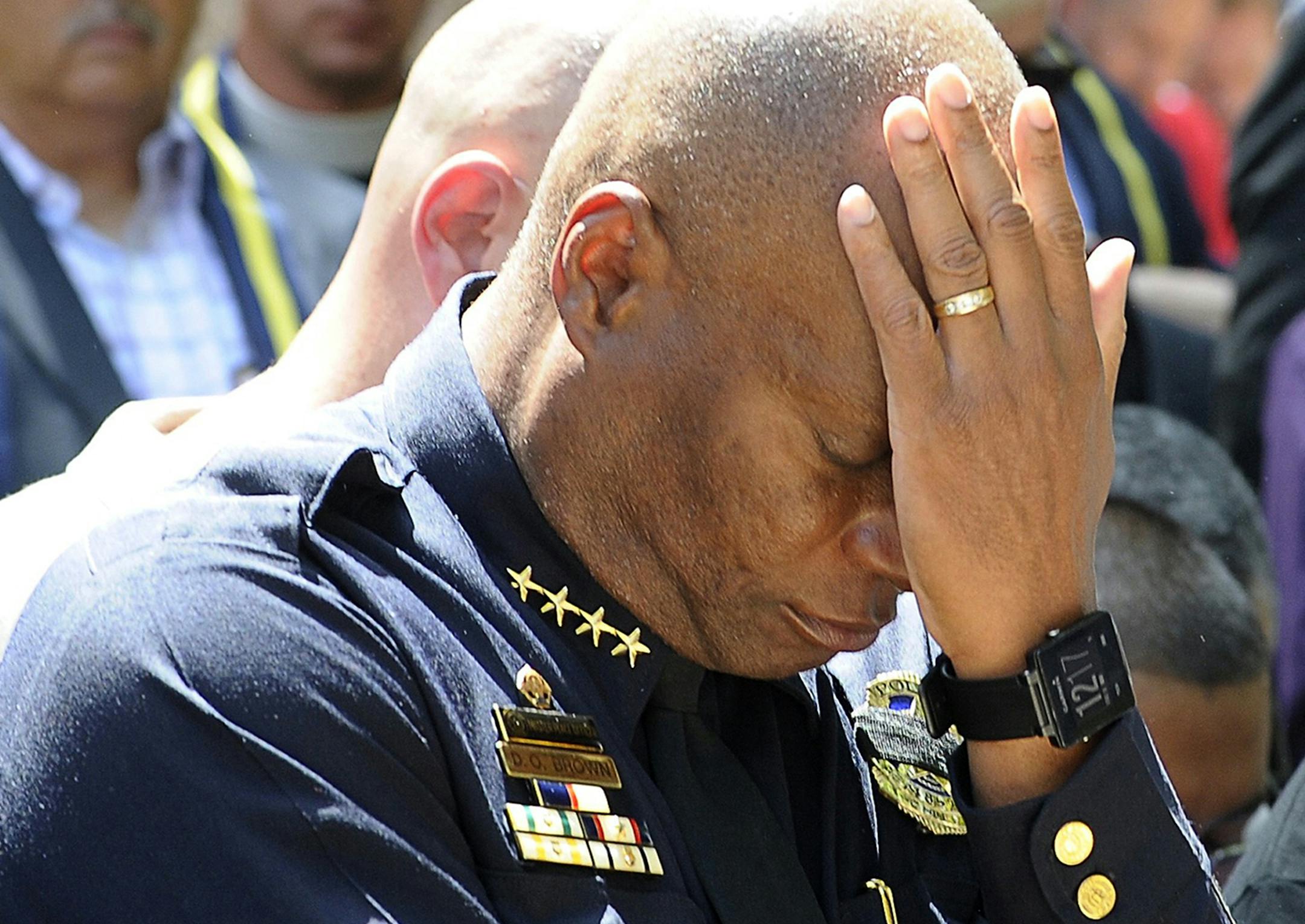
Dallas Police Chief David Brown, left, prays at a prayer service at Thanksgiving Square in Dallas on Friday, July 8, 2016. On Thursday, 12 police officers where shot, five fatally, before a gunman was killed by police early Friday. (Max Faulkner/Fort Worth Star-Telegram/TNS) ORG XMIT: 1187057 ORG XMIT: MIN1607081630222689
Dallas Police Chief David Brown, left, prays at a prayer service at Thanksgiving Square in Dallas on Friday, July 8, 2016. On Thursday, 12 police officers where shot, five fatally, before a gunman was killed by police early Friday. (Max Faulkner/Fort Worth Star-Telegram/TNS) ORG XMIT: 1187057 ORG XMIT: MIN1607081630222689 (The Minnesota Star Tribune)
Maxwell Silver, left, 19, and Elijah Lartey, 19, both of St. Paul, observe a moment of silence together outside the governor's residence. ] (Leila Navidi/Star Tribune) leila.navidi@startribune.com BACKGROUND INFORMATION: Protesters at the governor's residence in St. Paul on Thursday, July 7, 2016, one day after Philando Castile of St. Paul died after being shot by police in Falcon Heights, the aftermath of which was recorded in a video widely shared on Facebook.
Maxwell Silver, left, 19, and Elijah Lartey, 19, both of St. Paul, observe a moment of silence together outside the governor’s residence. ] (Leila Navidi/Star Tribune) leila.navidi@startribune.com (The Minnesota Star Tribune)
Shonte Curtis of St. Paul cries as a moment of prayer is observed outside the governor's residence. ] (Leila Navidi/Star Tribune) leila.navidi@startribune.com BACKGROUND INFORMATION: Protesters at the governor's residence in St. Paul on Thursday, July 7, 2016, one day after Philando Castile of St. Paul died after being shot by police in Falcon Heights, the aftermath of which was recorded in a video widely shared on Facebook.
Shonte Curtis of St. Paul cries as a moment of prayer is observed outside the governor’s residence. ] (Leila Navidi/Star Tribune) leila.navidi@startribune.com (The Minnesota Star Tribune)
Deputy Chief Mary Nash talked with people outside the governor's residence including Jacob Ladda, at right, about how they could not set up sleeping tents per a St. Paul city ordinance during a peaceful protest on Saturday, July 9, 2016 in St. Paul, Minn. ] RENEE JONES SCHNEIDER ï reneejones@startribune.com
Deputy Chief Mary Nash talked with people outside the governor's residence including Jacob Ladda, at right, about how they could not set up sleeping tents per a St. Paul city ordinance during a peaceful protest on Saturday, July 9, 2016 in St. Paul, Minn. ] RENEE JONES SCHNEIDER ï reneejones@startribune.com (The Minnesota Star Tribune)
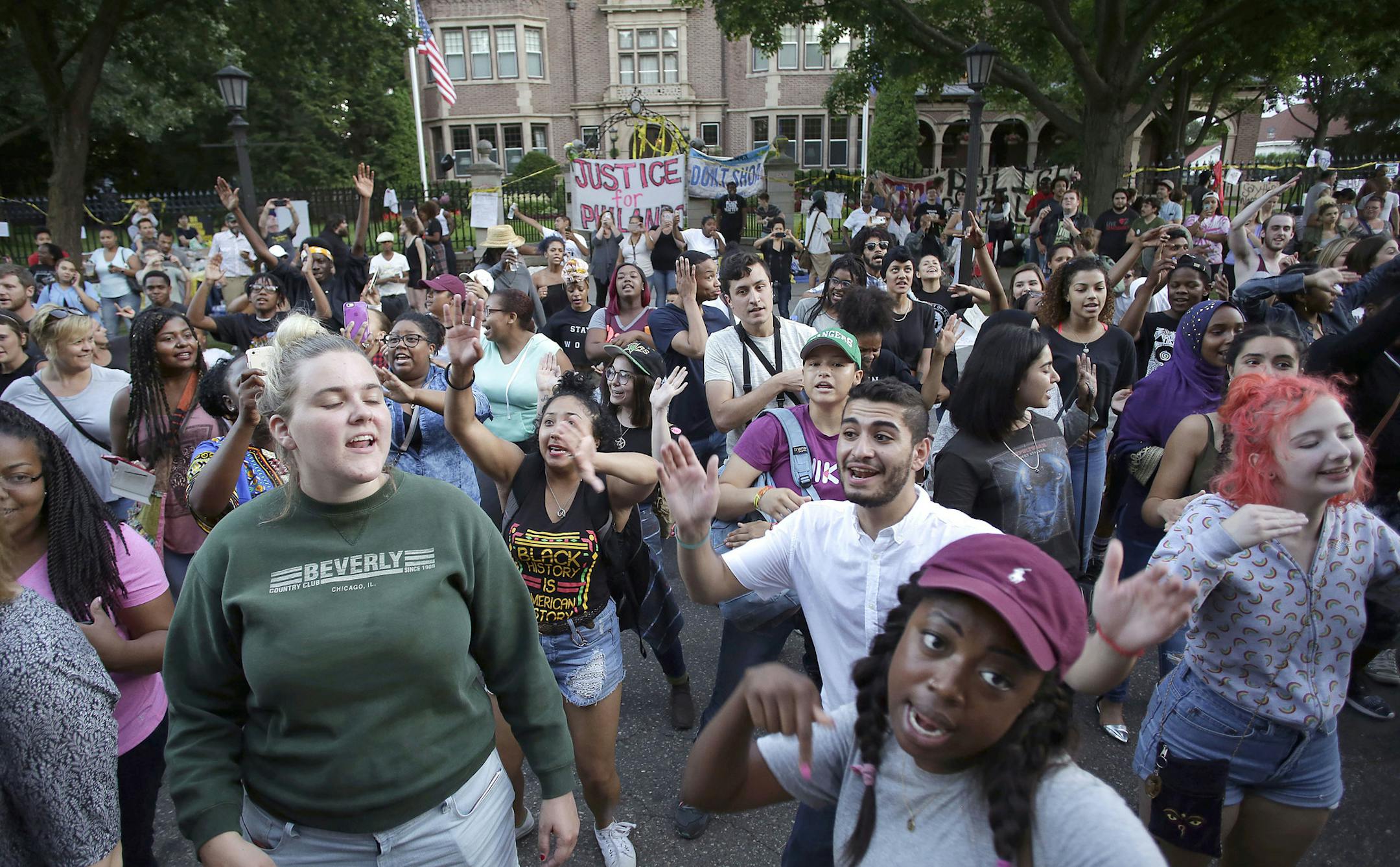
Demonstrators protest the fatal shooting of Philando Castile by dancing outside Gov. Mark Daytonís mansion in Saint Paul, Minn., July 8, 2016. As the United States reeled from a week that brought two high-profile killings of black men by police officers and then a deadly attack on police officers in Dallas, multiple cities saw major protests on Friday night. (Joshua Lott/The New York Times) ORG XMIT: MIN2016070916021207
At top, St. Paul Deputy Police Chief Mary Nash and an officer told activist Jacob Ladda that an ordinance prohibits setting up sleeping tents outside the governor’s residence. Shonte Curtis cried during a moment of prayer. And above, the crowd danced at a rally on closed-off Summit Avenue. (The Minnesota Star Tribune)
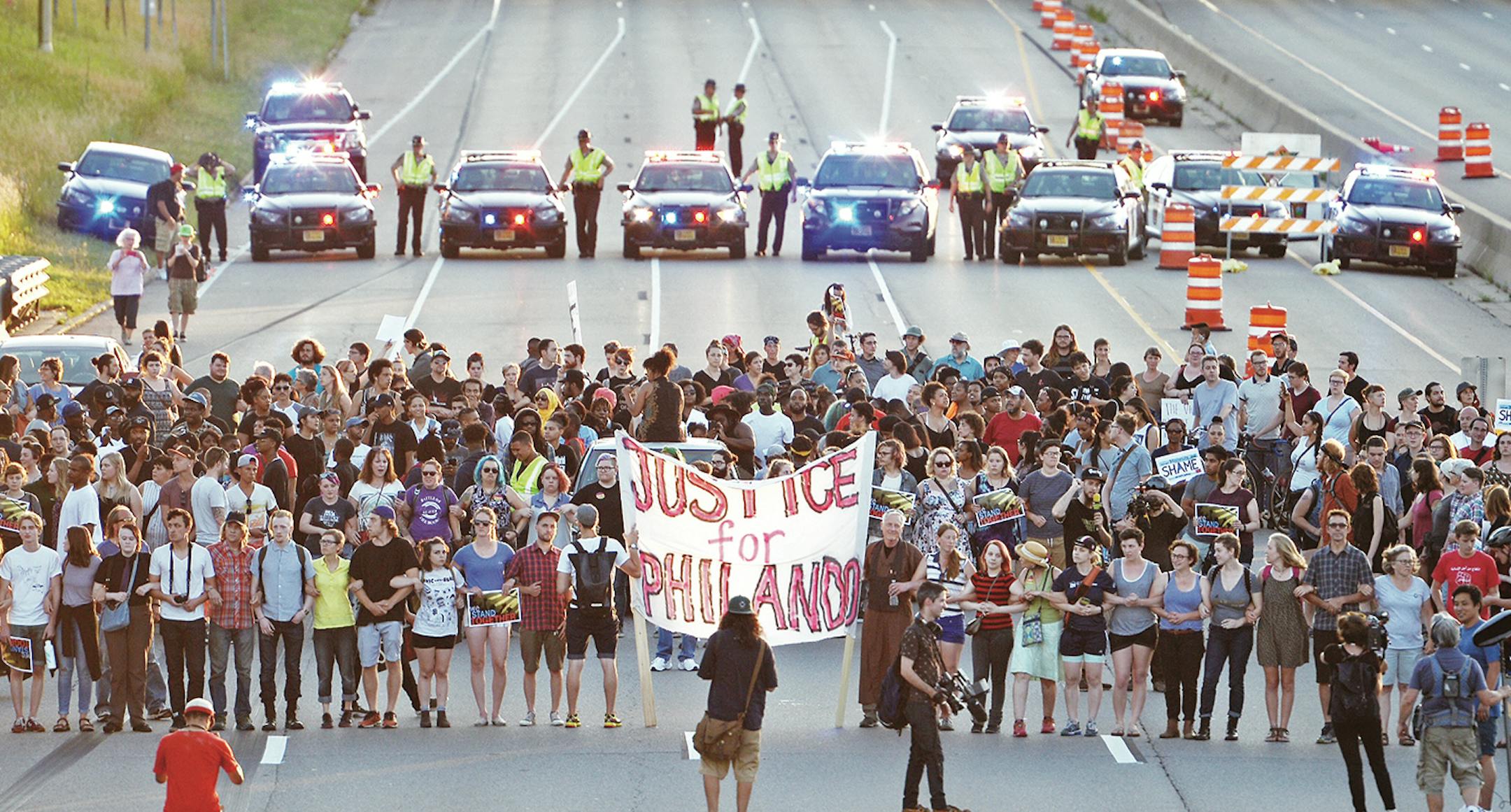
Marchers protesting the Wednesday night shooting death of Philando Castile by police have blocked part of Interstate 94 west of downtown St. Paul Saturday evening. Traffic was stacked in a thick logjam as early as 7 p.m., with the eastbound lanes mostly unmoving. About 7:30 p.m. Saturday, police and the State Patrol were diverting all traffic off eastbound I-94 at the Lexington Avenue exit, with scant traffic traveling in the opposite direction on westbound I-94. Marchers were refusing police or
Clashes: Protesters blocked I-94 west of downtown St. Paul Saturday night under threat of being arrested. Story on B3 (The Minnesota Star Tribune)
about the writer

about the writer

Pam Louwagie

Reporter

Pam Louwagie is a regional reporter for the Minnesota Star Tribune. She previously covered courts and legal affairs and was on the newspaper's investigative team. She now writes frequently about a variety of topics in northeast Minnesota and around the state and region.

See Moreicon