

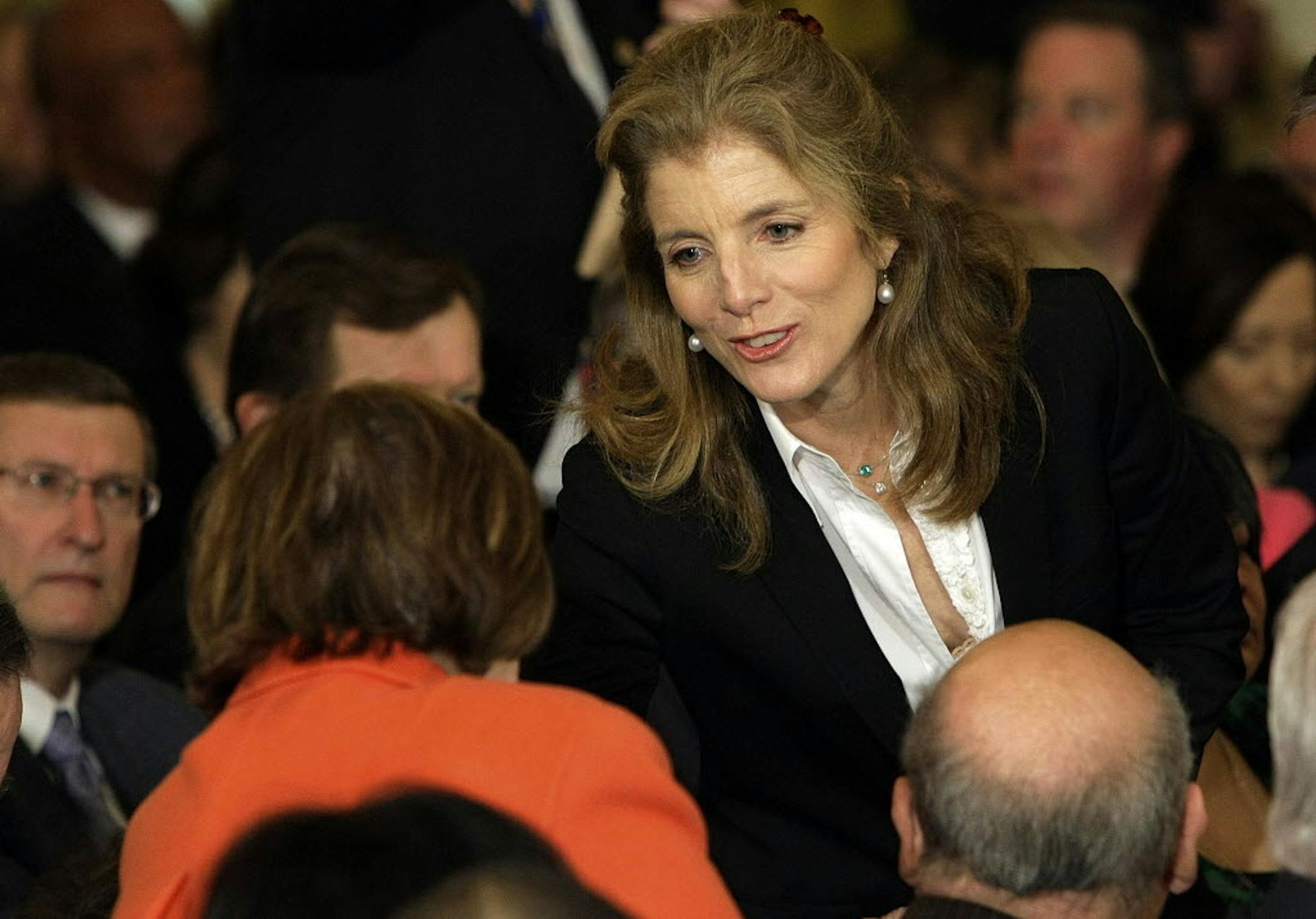
Being something of an op-ed writer myself, I consider the nomination of Caroline Kennedy for ambassador to Japan to be a breakthrough. While America's diplomatic envoys have been chosen on a variety of criteria before — ranging from the bundling of donations to the actual giving of their own personal cash — the Kennedy nomination is perhaps the first time in history that an individual has been nominated for a top ambassadorial post primarily for having written an opinion column.
Early in 2008, back when Barack Obama was hardly a shoo-in to be the Democratic nominee for president, Kennedy penned a piece for the New York Times called "A President Like My Father." In it, she described Obama as a man who could inspire a new generation of Americans as her father, President John F. Kennedy, had inspired a previous generation. It provided Obama with a big boost and, along with the support he received from Sen. Edward Kennedy, gave the candidate the imprimatur of the political-celebrity wing of the Democratic establishment in his tight race against then-Sen. Hillary Clinton.
Other than writing that op-ed, Kennedy has not the slightest qualification to be ambassador to Japan. Trained as a lawyer, she has led a worthy life of dedication to family charities, other nonprofits and writing. But she has no particular experience with Japan, no experience with diplomacy or foreign affairs, and no government experience. Hers is a nomination that reflects more on the president's views toward the diplomatic service and by extension the entire Department of State than it does on anything she has ever done. It also, by extension, illustrates the ever-growing centrality of the White House — and, more important, the president himself — to the conduct of U.S. international relations.
This is well-illustrated by the comments of former Assistant Secretary of State Kurt Campbell in the New York Times article announcing Kennedy's nomination: "For those who say she doesn't know a lot about Japan, I say 'sure,' but neither did Walter Mondale," said Campbell, referring to the former vice president who once served in the Tokyo post. He then went on to say: "What you really want in an ambassador is someone who can get the president of the United States on the phone. … I can't think of anybody in the United States who could do that more quickly than Caroline Kennedy."
I have great personal regard for Campbell. But this comment is disturbing. It dismisses the foreign policy and government experience of Mondale, a former vice president and senator, as being as flimsy as that of Kennedy. It is worth noting that the other political "marquee figures" who have served in the Japan job are Howard Baker and Thomas Foley, one a former Senate majority leader, the other a former Speaker of the House.
These were all men chosen because they sent a message to Japan that America considers the job of U.S. representative to Japan a high priority and honor. Sadly, the selection of Kennedy sends a message, too. She is succeeding another appointee whose sole qualification was the ability to get the president on the phone — John Roos, a big-time fundraiser.
The Campbell statement is also rich with irony, given that it comes from someone who bears so many scars of the tug of war between the State Department and the White House over who should shape U.S. foreign policy. It includes the idea that the most important thing in U.S. diplomacy and foreign policy is access to the president. (I leave aside for the moment the rather unsettling notion that the person in the very best position to get the president to take her call is Caroline Kennedy, celebrity endorser.)
The idea that the principal job of an ambassador is to get the president on the phone grossly undervalues the role of the entire State Department and the rest of the U.S. government in relations between the United States and Japan or any other government. It suggests that all major policy issues travel through the White House, are resolved by the White House, are implemented at the behest of and with the influence of the White House, and that central to each of these is the president.


