
Boeing's gigantic 777X facility is taking shape near Seattle

Just 14 months after the groundbreaking, massive factory is put on display.

May 26, 2016 at 12:11AM
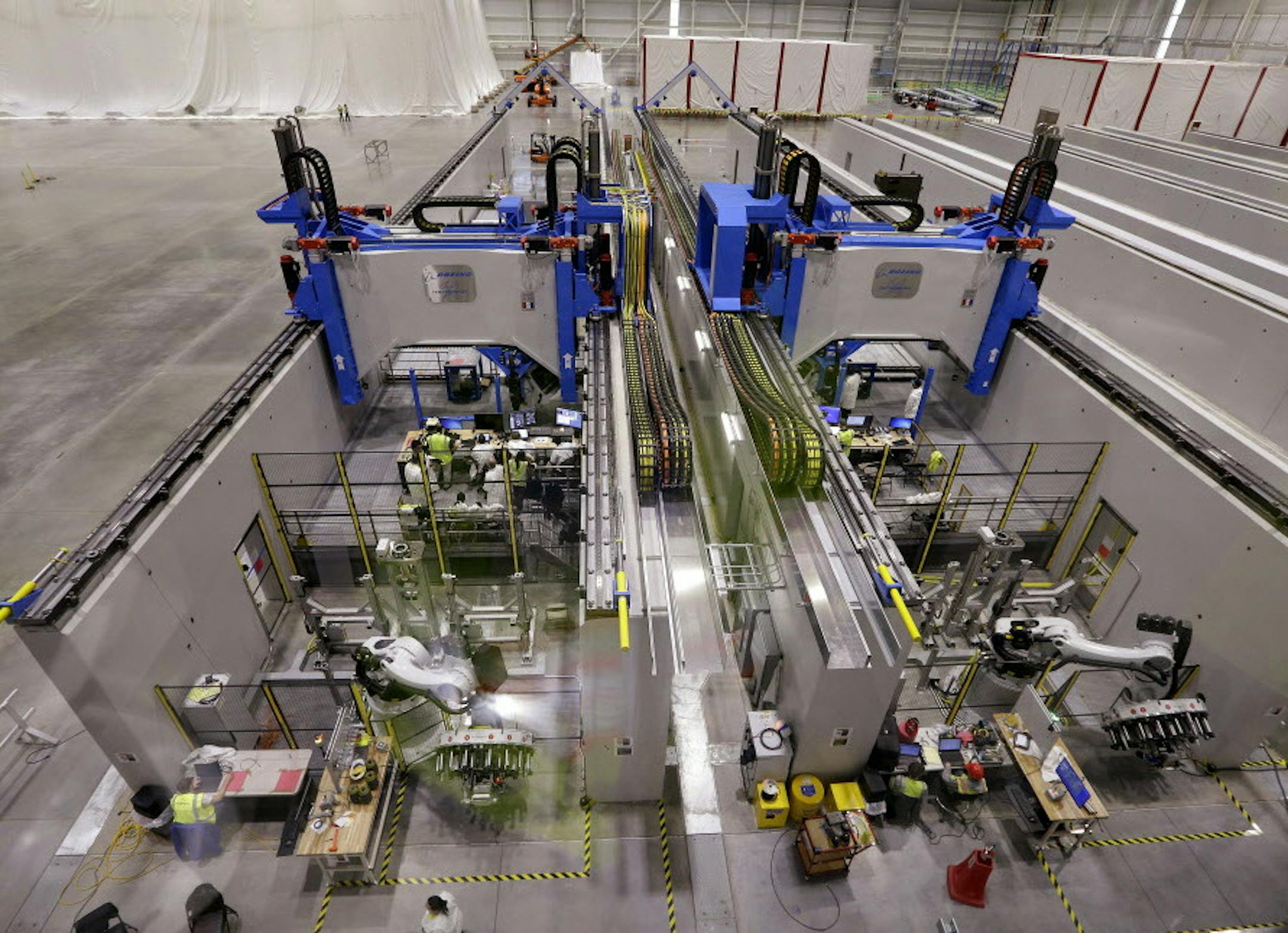
A gantry system where overhead supports hold robotic heads that will be used to build carbon fiber wings work through testing of the devices at the new Boeing 777X Composite Wing Center a day ahead of its grand opening, Thursday, May 19, 2016, in Everett, Wash. The facility, which is still under construction, will manufacture the world's largest composite wings for Boeing's newest commercial jetliner, the 777X. (AP Photo/Elaine Thompson)
A gantry system where overhead supports hold robotic heads that will be used to build carbon fiber wings work through testing of the devices at the new Boeing 777X Composite Wing Center a day ahead of its grand opening, Thursday, May 19, 2016, in Everett, Wash. The facility, which is still under construction, will manufacture the world's largest composite wings for Boeing's newest commercial jetliner, the 777X. (AP Photo/Elaine Thompson) (The Minnesota Star Tribune)

EVERETT, Wash. – Boeing has begun installing heavy equipment and robotic machines inside its gigantic new 777X composite wing center in this Seattle-area city, and the first engineers have moved into offices that overlook production.

Last week, just 14 months after the groundbreaking, Boeing showed off the awesome proportions of its $1 billion investment.

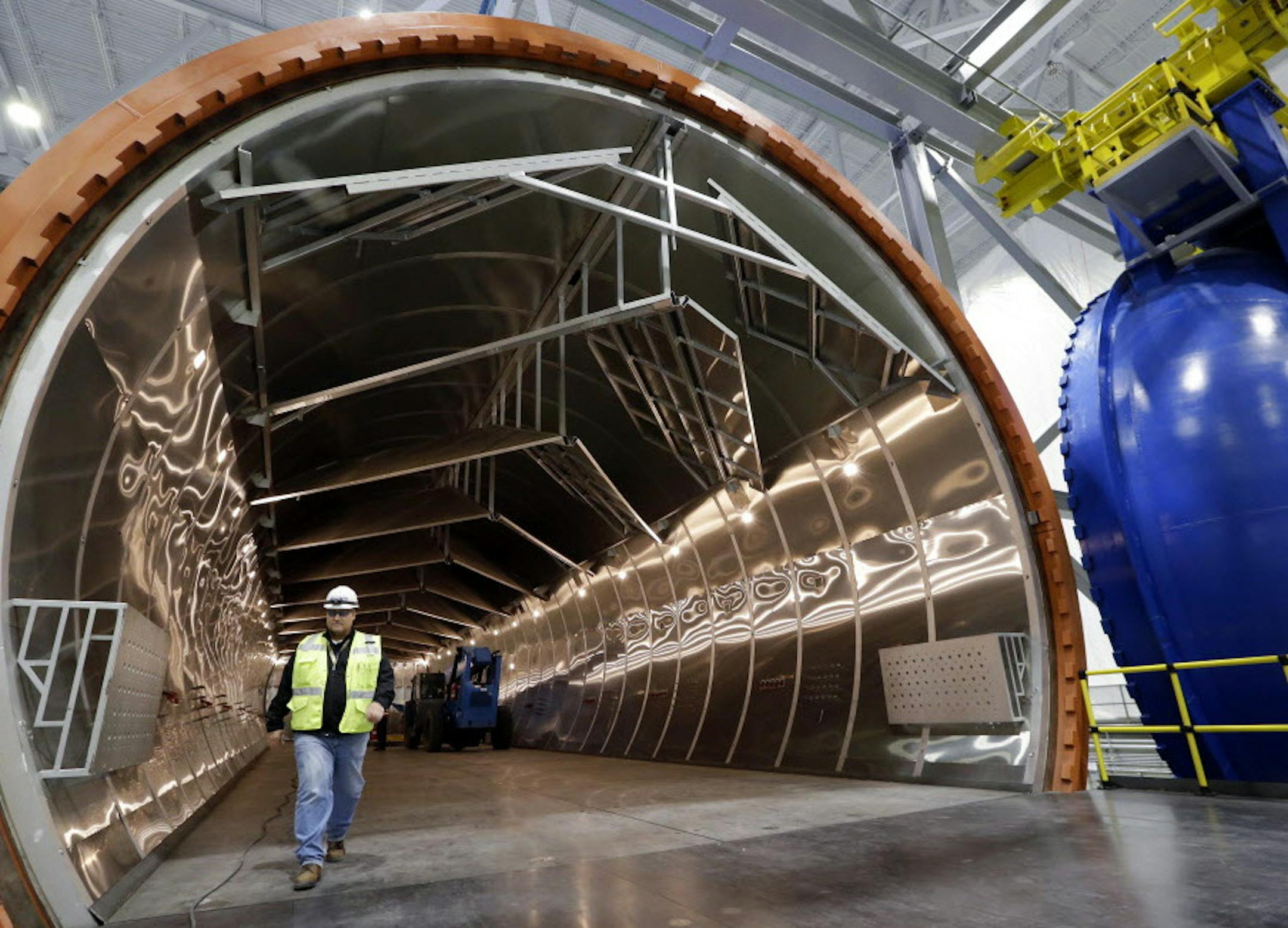
A huge cylindrical autoclave — a pressurized oven for baking the composite wing parts to hardness — is being cycled through its heating and cooling phases.

But even at 120 feet long and 28 feet in diameter, it looks small from a perch at the far end of the building.

On the other side of the wing center, in a "clean room" free of dust and debris and at a tightly controlled temperature and humidity, two big Automated Fiber Placement machines are being tested and calibrated, their robotic heads laying down strips of carbon fiber tape as they zip along.

Layer by layer, these machines, designed and built by engineering firm Electroimpact, build up the 105-foot-long 777X wing spars — structural beams that form the leading and trailing edges of the wings.

The parts for Electroimpact's corresponding wing skin fiber placement machines are already in the building, but not yet in place.

"We'll start to see this building fill up over the next few months and as we get into next year we start to move toward early production parts," said Eric Lindblad, the Boeing vice president responsible for the 777X wing, before a grand opening last week.
A major prize

The facility is the major prize Washington state won with its $8.7 billion extension of the aerospace-industry tax credits in 2013.

It provides the region a new expertise in composites that could be critical if it's to build future aircraft.

Inside, the wing center gives an even greater feeling of immensity than the famously massive widebody jet final-assembly plant that it sits beside.

While the 4.3 million-square-foot Everett final-assembly plant is the largest building in the world, its interior space is subdivided into six main bays separated by walls.

The 1.2 million-square-foot wing center — 1,250 feet long, 955 feet wide and 110 feet tall, covering an area equivalent to about 21 football fields — is divided by a narrow, four-story line of offices and storage into just two vast production spaces uninterrupted by columns.

Boeing has already assembled two sub-scale, 80-footlong wings to test its processes and to provide data for the full-scale models to come.

Full-scale, a 777X wing is 110 feet long, which gives the final airplane an immense wingspan in flight of 235 feet 5 inches, including wingtips that fold upward after landing so that the jet will fit at the airport gate.

The 777X wing's 11-foot folding wingtip is a separate structure, which will be built by Boeing in St. Louis and sent to Everett for assembly.

Composite wings

While the fuselage of the 777X will be longer than that of the current 777-300ER passenger jet, it's otherwise similar and will be made from aluminum. The major difference in the 777X structure is the composite wings. The current 777 carries 365 passengers. The new 777X will carry 408.

But the two jets will weigh the same and the 777X will be 20 percent more fuel- efficient, Lindblad said.

One component of the added efficiency is new engines, the advanced GE9X.

The other two components of efficiency derive from the wing: lower weight and better aerodynamics.

The composite material is lighter than metal, and the composite manufacturing method allows Boeing to create a more slender, more aerodynamic wing shape.

A worker walks out of a massive autoclave that will be used to bake carbon fiber wings with super-heated pressure, during a tour of the new Boeing 777X Composite Wing Center a day ahead of its grand opening, Thursday, May 19, 2016, in Everett, Wash. The facility, which is still under construction, will manufacture the world's largest composite wings for Boeing's newest commercial jetliner, the 777X. The new $1 billion, 1 million square foot center is close to the widebody plant where the 777X wi
A gantry system, left, and a massive autoclave, right, used to bake carbon fiber wings with superheated pressure at the Boeing 777X facility that will manufacture the world’s largest composite wings for Boeing’s newest commercial jetliner, the 777X. (The Minnesota Star Tribune)
about the writer

about the writer

DOMINIC GATES, Seattle Times

More from Business

See More
card image
Richard Tsong-Taatarii/The Minnesota Star Tribune

The “economic blackout” day creates unnecessary risk for people who are on the side of getting ICE out of Minnesota.

card image