

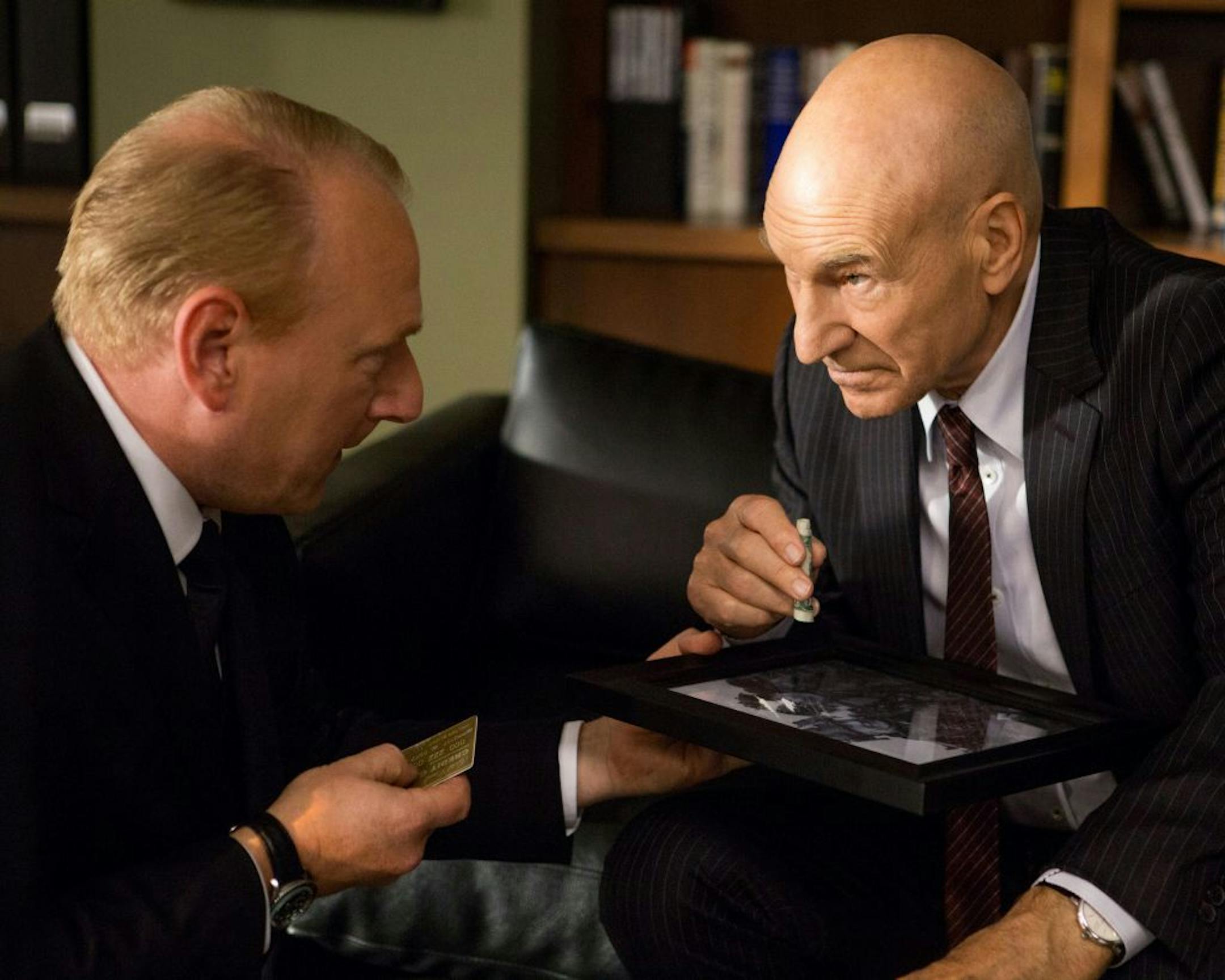
Within the first five minutes of "Blunt Talk," a bawdy new comedy about an egomaniacal cable-news commentator making ugly headlines, Patrick Stewart manages to accomplish what legions of Borg and mutant-hunting robots could not: destroying Captain Jean-Luc Picard and Professor Charles Xavier.
The actor's long associations with his "Star Trek" and "X-Men" characters have certainly been prosperous. The films have earned roughly $2 billion in box-office sales and a knighthood for their stoic star.
But in recent years, Stewart, 75, has rallied to shatter the stereotype of the unflappable leader, portraying himself opposite Ricky Gervais in a 2005 episode of "Extras" as a horndog obsessed with playing a superhero who can make clothes melt off women's bodies, and lending his voice to numerous Seth MacFarlane projects, including "Ted" and "Family Guy."
No surprise then that MacFarlane had Stewart in mind when he helped create "Blunt Talk," which premieres Saturday with our soused protagonist getting caught on camera nuzzling the bosom of a nearly underage transgender hooker. In future episodes, Blunt sneaks out of an Alcoholics Anonymous session to infiltrate a sex-addicts meeting and fakes a remote report from the center of a storm to keep up with the competition.
Stewart chatted earlier this week about showing off his naughty parts, but not before we asked him to step into the transporter for a trip back to 2001, when he graced the Guthrie stage as belligerent George in "Who's Afraid of Virginia Woolf?":
Q: What are your memories of that time?
A: It was one of the best stage experiences I've ever had. The play was the last piece of work I did before joining the cast of "Star Trek" in 1987. We were going to take the show from the Young Vic to the main stage in the West End, but that didn't happen because I went to Hollywood.
For many years, I couldn't get the part out of my head. I was talking to Joe (Dowling) one day and he said, "Why not do it at the Guthrie?" The Guthrie really sticks out in actors' minds, probably more than any other regional theater in America, because it was named after one of our great directors and it was forward looking from the very beginning. The audience for "Woolf" was very focused and appreciative. Most people don't know how much the audience can give to a production.


