
Case touts investment opportunity in Minnesota tech firms

Billionaire Steve Case will invest $100,000 in a start-up business in Minneapolis.

October 8, 2014 at 2:50PM
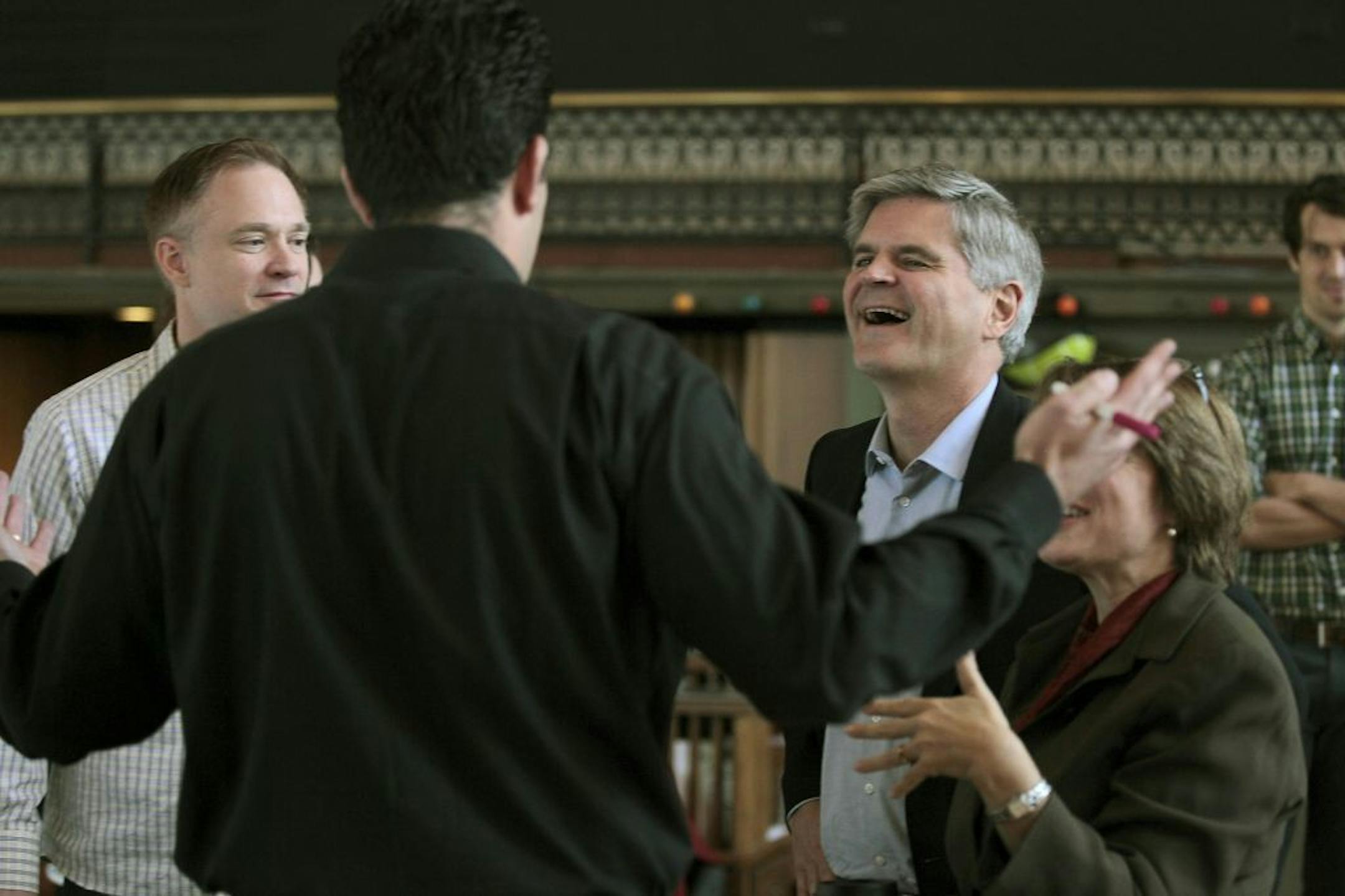
AOL.com founder and startup-business promoter Steve Case, center, and Senator Amy Klobuchar, right, listened to Colin Hirdman, left, and Josh Becerra's business pitch at CoCo's "startup fair," Tuesday, October 7, 2014 at the former Grain Exchange floor in downtown Minneapolis, MN. Case is visiting several cities as part of his "Rise of the Rest Road Tour," where he will invest $100,000 in a new business.
AOL.com founder and startup-business promoter Steve Case, center, and Senator Amy Klobuchar, right, listened to Colin Hirdman, left, and Josh Becerra's business pitch at CoCo's "startup fair" Tuesday at the former Grain Exchange floor in downtown Minneapolis. (Dml - Star Tribune/The Minnesota Star Tribune)

It was a little like "Shark Tank," with a heavy dose of Minnesota Nice.

Ten Minnesota start-ups gave tech billionaire Steve Case and a panel of five others their best pitch, and one of them won a $100,000 investment from the AOL founder himself.

"We need to get more investors to recognize something interesting is happening in the middle of the country," Case said Tuesday. "Since investors focus in a few places like Silicon Valley, it's really hard for most entrepreneurs in places like Minneapolis to get the capital to grow."

The start-ups — ranging from GreenBook, an exchange for minority-owned businesses, to Apruve, a business-to-business payment firm — pitched their businesses on the stage at the Varsity Theater in Dinkytown.

In the end, Case and a panel of entrepreneurs and investors including Jacquie Berglund, Erin Newkirk, David Golden, Abir Sen and Prince Wallace chose 75F. The Mankato firm last month also won the Minnesota Cup competition for entrepreneurs.

"Think of it as Nest meets Sleep Number," said Deepinder Singh, CEO of the firm, which sells a system that uses sensors, software, dampers in HVAC ducts and cloud computing to reduce heating and cooling costs in office buildings, and make people more comfortable.

The big players in the market are focused on huge buildings, but 75F goes after smaller office buildings.

"There is a void in that market," Singh said. "That void represents a $40 billion opportunity for the right product."

The panel agreed, and afterward, Singh posed for pictures with Case, who is on a tour of 10 cities to draw investor and media attention to the explosive growth of small tech companies outside the traditional tech centers of Silicon Valley, Boston and New York. The tour, dubbed "The Rise of the Rest," is sponsored by Case's investment firm, called Revolution, along with Google and other tech investment firms.

"Most people, when they think about innovation and entrepreneurship, think about Silicon Valley. A few think about Boston, New York City. Not many think about Minneapolis. Not many think about Madison, Des Moines, Kansas City," Case said. "Most people around this country, and certainly most people around the world, do not associate them with innovation and entrepreneurship. And that's wrong."

In each city, Case is judging pitches from local tech start-ups for a $100,000 investment by him. Case began the day at CoCo Minneapolis, a cooperative workspace and business accelerator for local tech firms. There, he and Sen. Amy Klobuchar spoke at a breakfast where local tech executives, bankers and investors discussed the environment for raising capital in the Twin Cities. Several entrepreneurs noted they had raised all the capital for their firms from investors in either Silicon Valley or New York.

One effect of the outsized flow of funds to firms in Silicon Valley is that valuations in those companies also become huge, and the endgame payoff turns smaller for investors in the middle of the process.

A firm in the Midwest is likely to see lower valuations during its middle stages, but that can lead to bigger results down the road for its investors. "There's kind of an arbitrage from an investment standpoint," Case said. "When the company is successful, whether they get acquired or go public, nobody cares where they are."

Klobuchar noted that one of the few pieces of legislation to make it through Congress in the past couple of years was designed to help tech start-ups. "It does allow small businesses to basically double what they can deduct for some of their start-up costs," she said. "Also, it makes it easier to deal with the SEC filings because it's really hard for a start-up to hire bevies of lawyers to get that done."

Before leaving CoCo, Case and Klobuchar met with executives of several companies that started at the workspace, which occupies what was once the trading floor of the Minneapolis Grain Exchange.

Kent Cavender-Bares, chief executive of Rowbot Systems, a company that has made a robotic device for farmers to apply fertilizer to cornfields after plants grow too tall for tractors, told Case that he had raised $1 million from outside investors. Now the company needs more to grow, and Cavender-Bares explained its dilemma to Case.

"The local investing community generally can't deal with those larger numbers," Cavender-Bares said. "We get good conversations with West Coast or East Coast investors but it's hard to get them to invest because we are where we are. They get concerned we won't be able to hire talent or ask why we aren't building it in California. All we have to say is, where is the corn? It's not in Silicon Valley."

Another executive who started out at CoCo, Aaron Kardell, founder of Mobile Realty Apps Inc., encountered an obstacle in meeting Case. The billionaire's investment firm has already bought a stake in a rival company. Even so, Kardell said he was happy for the introduction because it may come into play down the road. "He already knows the business," Kardell said.

Duane Johnson, founder of GreenBook Network, which is developing a platform for construction firms to identify and do business with minority- and women-owned firms, had a report from Klobuchar's office about employment trends in Minnesota ready as part of his pitch for Case.

Johnson said he was surprised to see Klobuchar herself. The senator shook his hand and said, "I'm glad to see someone reads these things."

Evan Ramstad • 612-673-4241

AOL.com founder and startup-business promoter Steve Case, center, and Senator Amy Klobuchar, listened to a business pitch at CoCo's "startup fair," Tuesday, October 7, 2014 at the former Grain Exchange floor in downtown Minneapolis, MN. ] (ELIZABETH FLORES/STAR TRIBUNE) ELIZABETH FLORES • eflores@startribune.com
AOL.com founder and startup-business promoter Steve Case, center, and Senator Amy Klobuchar, listened to a business pitch at CoCo's "startup fair," Tuesday, October 7, 2014 at the former Grain Exchange floor in downtown Minneapolis, MN. ] (ELIZABETH FLORES/STAR TRIBUNE) ELIZABETH FLORES • eflores@startribune.com (The Minnesota Star Tribune)
about the writers

about the writers

Adam Belz

Reporter

Adam Belz was the agriculture reporter for the Star Tribune.

See Moreicon

Evan Ramstad

Columnist

Evan Ramstad is a Star Tribune business columnist.

See Moreicon

More from Business

See More
card image
Jerry Holt/The Minnesota Star Tribune

President Donald Trump’s order starts the process of reclassifying cannabis alongside drugs with recognized medical uses, a change that could reshape taxes and enforcement in Minnesota.

card image
card image