

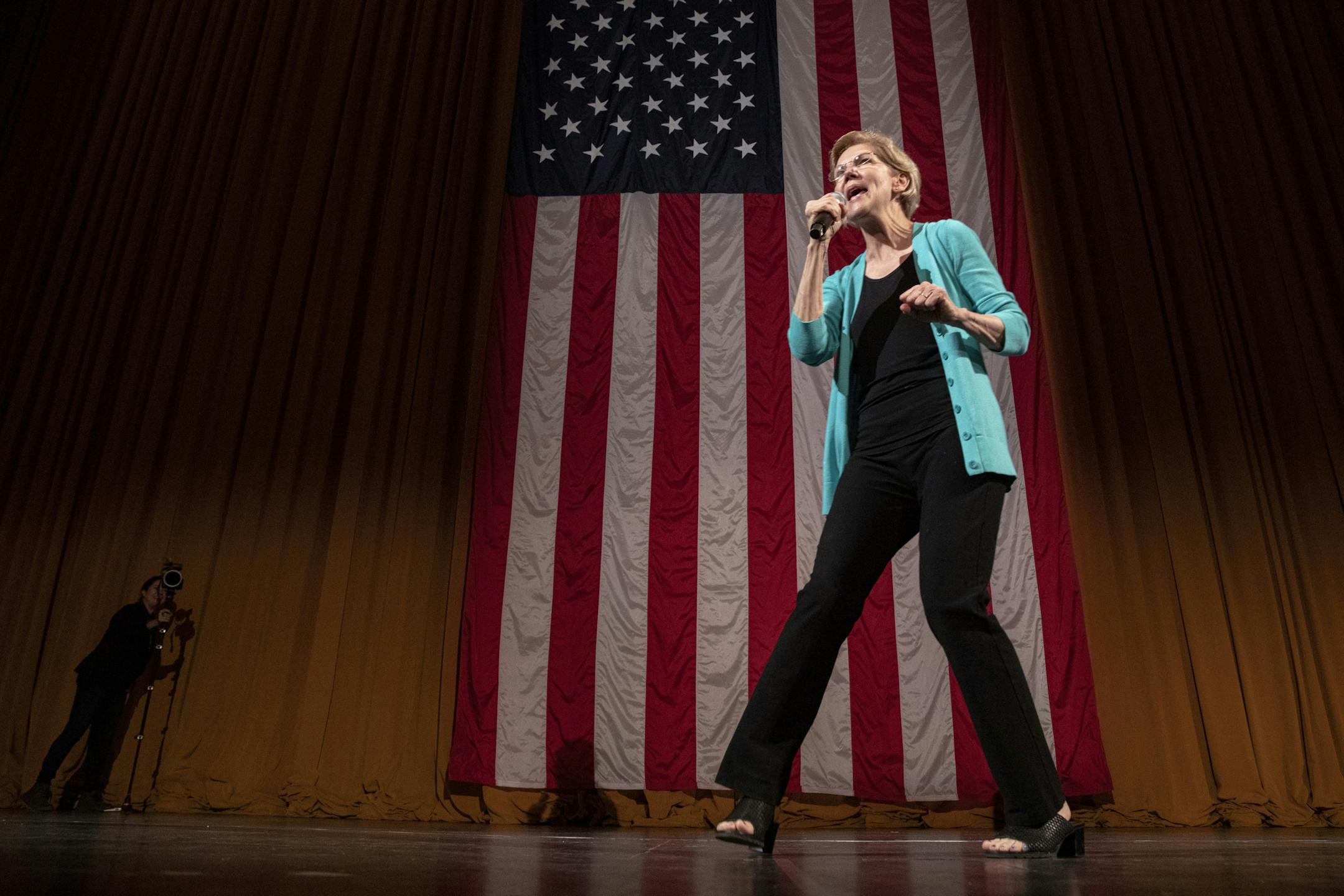
Sen. Elizabeth Warren, D-Mass., has made her proposed 2% wealth tax on those worth more than $50 million a central part of her presidential campaign. Emmanuel Saez and Gabriel Zucman, two economists at the University of California, Berkeley, who helped developed the proposal, estimated that it would rake in $187 billion a year.
Their response is disingenuous. They focus most of their fire on what they label as our revenue estimate: that the proposed wealth tax would raise $25 billion annually, rather than the $187 billion they estimate. In reality, we are explicit that $25 billion is a rough back-of-the-envelope number and state that "we would be surprised if the $25-billion-a-year figure we suggest was not a significant underestimate of the revenue potential of a 2% wealth tax." The purpose of our piece was not to provide an alternative revenue estimate for the wealth tax but to call into question the naively high estimate provided by Saez and Zucman.
Readers may find it difficult to evaluate the technical aspects of this debate. But they should keep in mind that Saez and Zucman are writing in a commissioned letter to a presidential candidate for a campaign proposal. Meanwhile, experts with experience in tax policy scorekeeping and academics on the progressive end of the political spectrum — such as ourselves and MIT economist Jonathan Gruber — are much more pessimistic on the revenue-raising potential of wealth taxation. In this context, Saez and Zucman's indignant insistence that their $187 billion number is not a "best case scenario" but instead a "middle-ground" estimate seems unsound.
As we explain at some length in our piece, naive estimation of the kind offered by Saez and Zucman tends to be way optimistic relative to scorekeeping by government experts. This point is well illustrated by the difference between academic and government estimates of taxing carried interest as ordinary income or of the value-added tax. Nothing in Saez and Zucman's response suggests they are immune from this problem.
They attempt a broad allowance for tax avoidance, assuming the rich would successfully shelter at most 15% of their wealth from taxation. They base this guess on four academic studies that consider the international experience of wealth taxation, which find that a 1% wealth tax reduces reported wealth by 0.5 and 35%, which they simply average to 15%. But this strikes us as too low.
First, Saez and Zucman's interpretation of the international experience differs from ours. They rely on estimates suggesting that a 1% wealth tax in Denmark and Sweden results in evasion of less than 1% (which makes their 15% estimate look huge). But in both countries, wealth taxation proved so easy to avoid and so difficult to administer that these taxes were repealed. In fact, of the 12 nations in the Organization for Economic Cooperation and Development that had wealth taxes in 1990, only three still have them today.
Second, the estate tax is informative on the potential magnitude of wealth tax evasion. Let's consider Saez and Zucman's estimated tax base for people with wealth greater than $50 million: about $9.3 trillion in 2019. If we were to apply the current 40% estate tax to this figure — assuming 2% of those families will experience a death this year (a conservative estimate) — we would expect that tax to generate about $75 billion this year. And if we apply the effective estate tax to that figure (accounting for charitable contributions and spousal bequests), it would raise $25 billion this year. In reality, the estate tax will raise about $10 billion from estates of more than $50 million this year. In other words, it seems plausible that tax avoidance is closer to 60%.


