

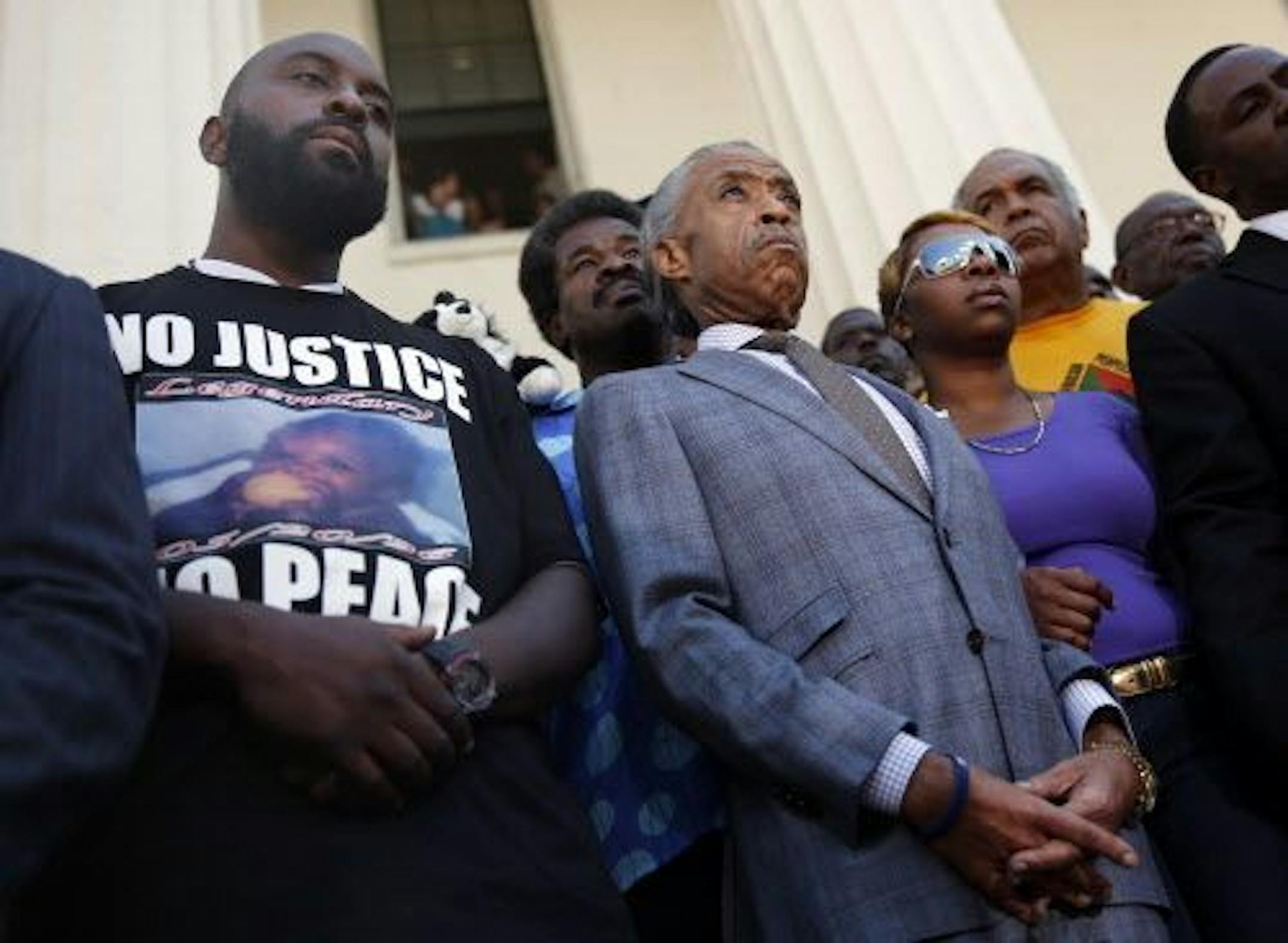
Stepping to the pulpit at Greater Grace Church — minutes from where a suburban St. Louis police officer shot and killed an unarmed black 18-year-old — the Rev. Al Sharpton wielded the fiery words that have marked his long, often notorious career.
"These parents are not going to cry alone," he preached to the crowd that packed the pews last Sunday in Ferguson, Missouri. "We have had enough!" But when Sharpton sat down days later with New York's mayor to discuss the response to a Staten Island man's death in a police officer's chokehold, he recalibrated his rhetoric. "We don't have to agree on everything, but we don't have to be disagreeable," Sharpton said, facing the city's police commissioner.
Plenty has been said in recent years about Sharpton's "reinvention," as he shed nearly 170 pounds, traded warmup outfits for tailored suits, took to the camera for a daily cable television show, and built relationships with the White House and New York's city hall. But to allies and critics who have watched him parachute into racially charged crises for more than three decades, recent weeks are just testament to Sharpton's unflagging ability to seize the moment, regardless of setbacks and no matter how the opening presents itself.
"He always seems to be in the right places and seems to be able to absorb and overcome some devastating blows," said the Rev. Herbert Daughtry, 84, who has known Sharpton since he was a boy preacher at Brooklyn's Washington Temple and has marched alongside him time and again. "I don't see that he's changed. The core of Rev. Sharpton is the same ... the root is the same, the substance is the same."
Sharpton returned to Ferguson on Monday to speak at the funeral for Michael Brown, following a weekend protest march in New York, cementing his place at the intersection of advocacy and controversy.
He first commanded national attention in 1987 as the medallioned 305-pound spitfire demanding justice for an upstate New York teen, Tawana Brawley, in the uproar surrounding what turned out to be a made-up rape.
He was widely derided for his incendiary rhetoric, but his doggedness earned credibility with some blacks as the voice of the street, says David Bositis, an analyst specializing in African-American politics who counseled Sharpton before his 2004 run for president. The activist's change in tone since then is no accident, he said.
"He knows what it's like when you're judged outside," Bositis said. "I think ... in his own way, this is a calculation about being effective, being influential."


