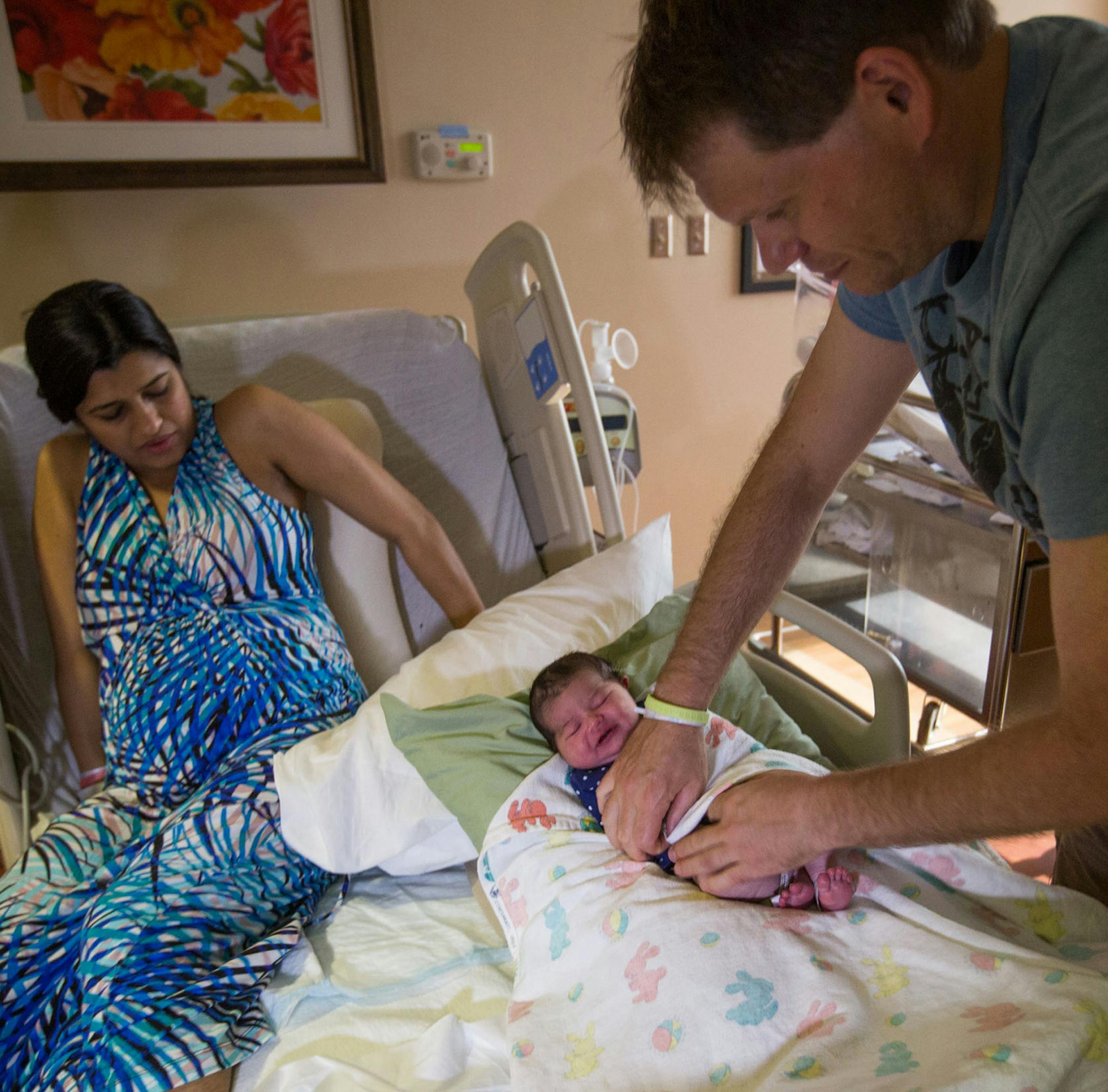
WASHINGTON — At the growing number of hospitals in the United States that are certified as "baby-friendly," the naked, often unbathed infant is put on the mother's bare chest within the first hour of birth. Mothers are to nurse "on demand" whenever babies are hungry. No pacifiers are available. Formula may be provided, but only on request, and only after, in some instances, mothers sign a waiver acknowledging that using a bottle could impede breast-feeding. Lactation consultants roam the floor.
And healthy babies, if possible, are rarely, if ever, taken to the nursery. If a mom wants to send her newborn, staff members often have to ask why and then fill out paperwork explaining the reason.
The number of U.S. hospitals applying for the baby-friendly certification has gained momentum since 2010, when the U.S. Department of Health and Human Services incorporated the practices into federal goals. And the hospital measures are in keeping with the latest research about the significant health benefits of breast-feeding.
But for some mothers, this new push to breast-feed feels like the old one of decades ago, when zealous "lactivists" were accused of trying to guilt other women into abandoning the bottle.
That's the impression Lisa Stone got after delivering her daughter in December at Inova Alexandria Hospital in Alexandria, Va. She had decided not to breast-feed because of frequent travel for her job with a nonprofit group.
"Yet right after my daughter was born, they were ripping open my gown and trying to set the baby up to breast-feed. It was really uncomfortable," the 30-year-old said.
So much so that Stone asked to be released a day early. "I certainly think if you want to have your baby next to you all night, and that makes you feel better, you should have that choice," she said. "My problem was feeling like I was forced into that position."
So far, 199 U.S. hospitals, of more than 3,000, have been certified as baby-friendly, said Trish MacEnroe, executive director of Baby-Friendly USA. About 700 hospitals nationally are implementing the standards — though not always smoothly.