

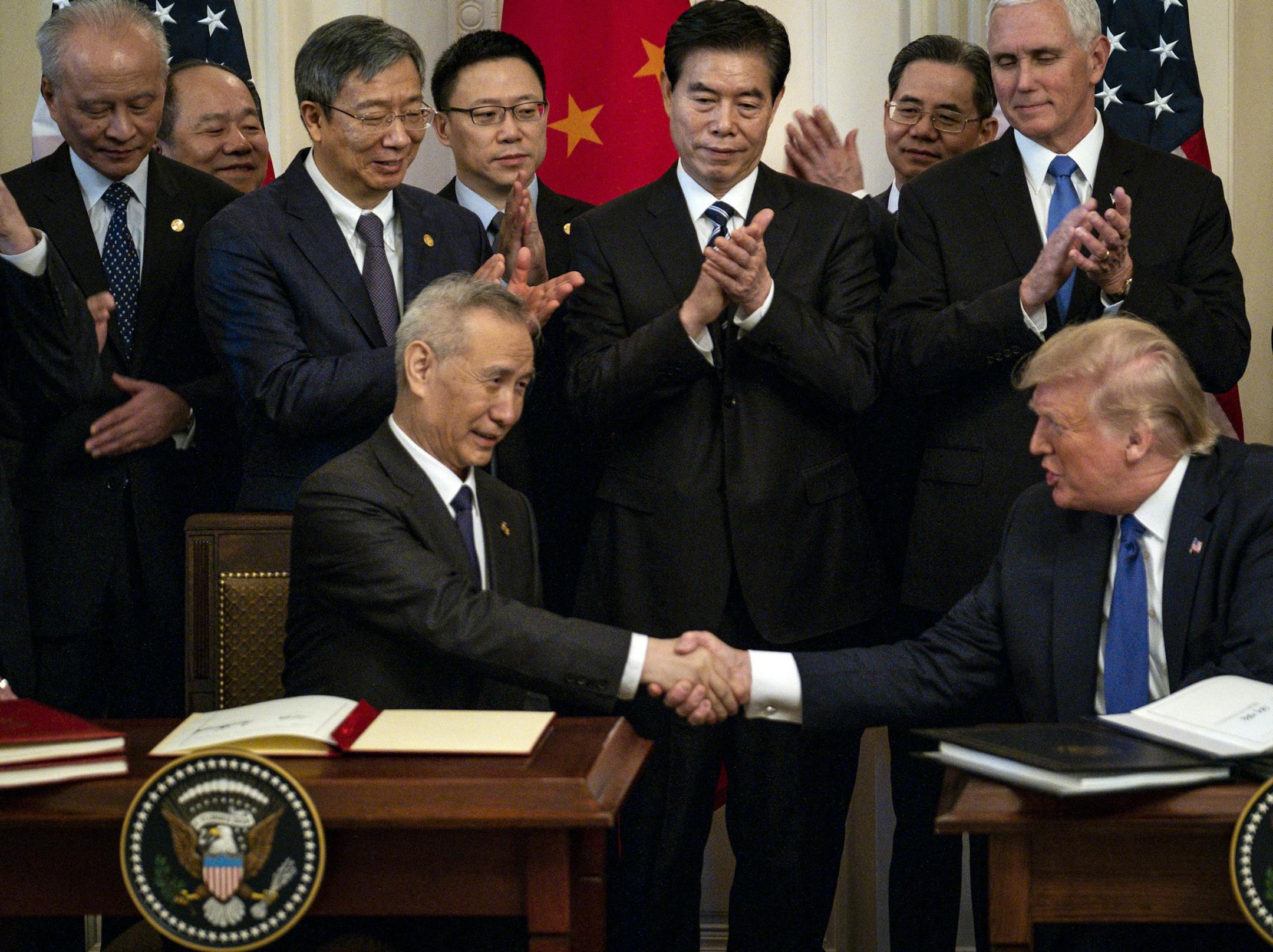
In a letter read aloud during Wednesday's trade deal signing at the White House, Chinese leader Xi Jinping asked President Donald Trump to take steps to "enhance mutual trust and cooperation between us."
That won't be easy: Apart from the trade agreement, the U.S. and China are butting heads on everything from technology to human rights to territorial disputes. Just this week, Secretary of State Michael Pompeo told executives in Silicon Valley the U.S. is "facing a challenge from China that demands every fiber of your innovative skill and your innovative spirit."
A return to acrimony could have major consequences for China, and for Xi.
In the short term, renewed tensions with the U.S. risk weakening an already fragile economic situation, while investment restrictions could hamper plans to secure technologies essential to driving growth. For Xi, a perceived failure to manage U.S. ties could also dent support for a third term in office at a key Communist Party meeting in 2022.
"This is China's most important bilateral relationship by a country mile, and Xi Jinping has made it clear that he's in charge from the beginning," said Trey McArver, co-founder of Beijing-based research firm Trivium China. "He's under pressure to do a good job because if he doesn't it opens him up to criticism that he's not a good statesman and not a good steward of the nation."
Early on, Xi himself defined the terms of a successful relationship. Even before taking the top job in 2012, he called for a "new type of great power relations" that would see the two powers respect each other's "core interests" and abandon a "zero-sum" mentality.
Just days before Trump took office in 2017 after campaigning on an "America First" platform, Xi sought to claim the mantle as a defender of free trade by preaching "openness" and "economic liberalization" at the World Economic Forum in Switzerland. Later that year, he declared that China was "approaching the center of the world stage" as he outlined a road map for turning the country into a leading global power by 2050.
Trump, however, sought to thwart those plans. His move to raise tariffs has disrupted China's export-led economic model, accelerating a shift in global supply chains as lower-cost manufacturers look for cheaper places to set up shop. It also opened the door for his administration to blacklist Huawei Technologies Co. and other burgeoning Chinese tech companies that still rely on U.S. firms for vital components.




