

Twenty years after it declared independence from the Soviet Union, Ukraine is stepping out to tout its own heritage and cultural savvy. Visitors to the capital, Kiev, tell of new shops, restaurants, art museums, and even a stadium under renovation for the 2012 European soccer championships.
A glittering new show at the Museum of Russian Art in south Minneapolis appears to be part of this effort to walk proud on the international stage. "Antiquities From Ukraine: Golden Treasures and Lost Civilizations" features a handsome collection of 7,000-year-old pottery and remarkably intact gold jewelry and ornaments from Scythian burial mounds dating to 700 B.C., plus gorgeous Greek gold jewelry and Byzantine artifacts from later eras.
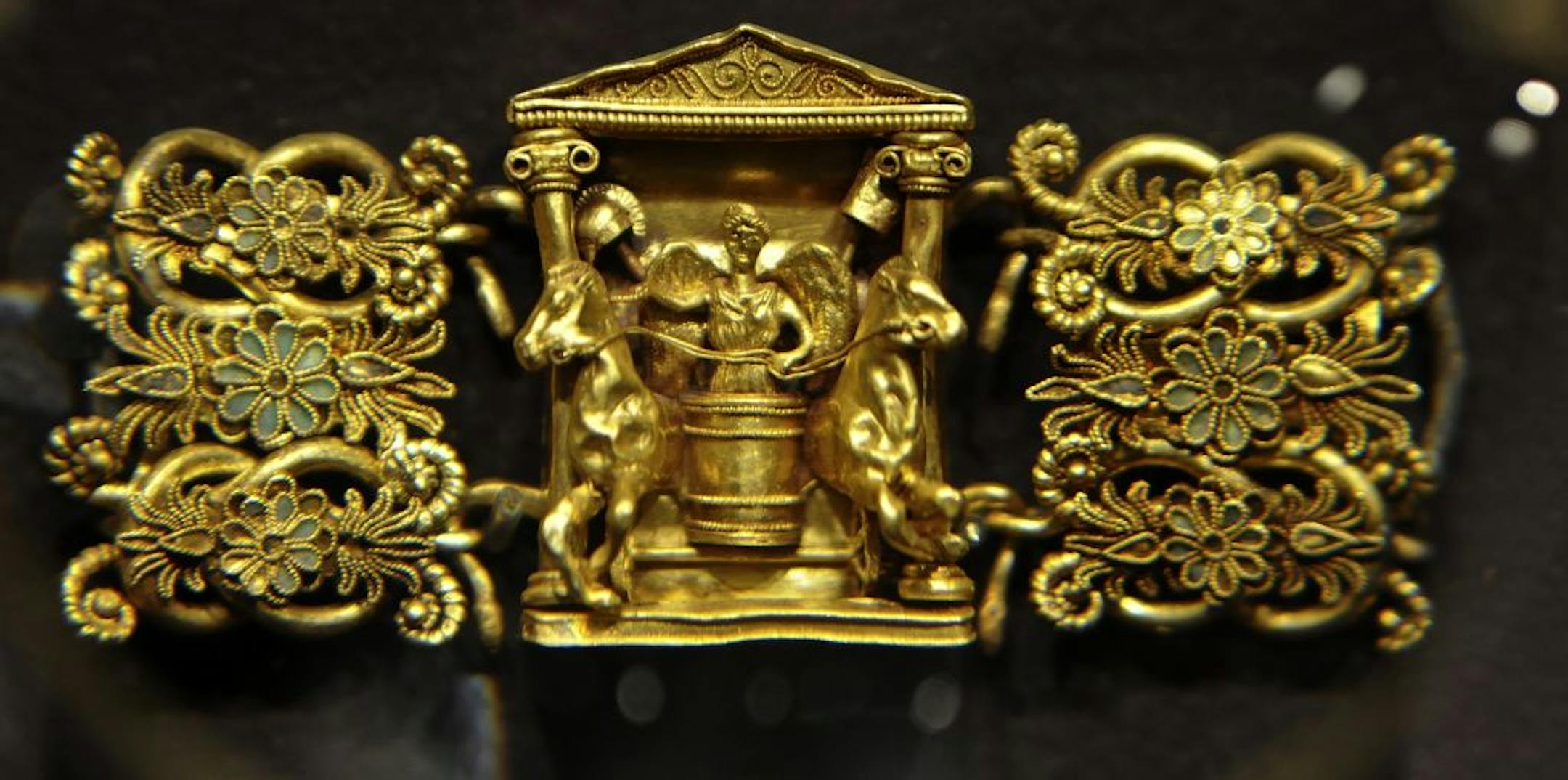
Some of the jewelry is astonishingly delicate, notably a garland from the 4th century B.C. in the shape of an oak branch sprouting tiny leaves and acorns, and a stunning golden buckle whose centerpiece is a little temple from which gallop two miniature horses pulling a manned chariot. There's a whole room full of such treasures, including golden pitchers and drinking vessels, cosmetic cases, bracelets, necklaces, jewel-encrusted diadems and more, all up to 2,500 years old.
While the art is on loan from PlaTar, a privately funded museum in Kiev, the Ukrainian government cooperated in its U.S. tour, which included museums in Houston and Omaha. It was organized by the Foundation for International Arts and Education, a Maryland-based nonprofit that promotes culture of the former Soviet Union.
Despite such official endorsements, the PlaTar collection is controversial in its homeland. Ukrainian archaeologists charge that its treasures came to light through "black archaeology" -- the looting of archaeological sites. The country has way more sites than its academic scholars have time or money to excavate. Armed with sophisticated metal detectors, looters can quickly plunder treasure-rich burial mounds along the Dnieper River or in the ruins of Greco-Roman cities on the Black Sea. The immense private wealth of Ukraine's new oligarchs aggravates the problem by creating a vast high-end market for looted goods, critics say.
The PlaTar collection was founded by a pair of Ukrainian businessmen, Sergei Platonov, who died in 2005 (leaving his art to his heirs), and Sergei Taruta, whose fortune is estimated at $2 billion. PlaTar officials insist they just want to preserve Ukraine's heritage from avaricious foreigners, particularly Russian collectors. Platonov even seemed to believe that all collections of antiquities are compromised, once challenging a critic to "Show me a comparable collection created with 'white archaeology.'"
Long history; myriad relics
Masha Zavialova, the Minneapolis museum's Russian-born curator, acknowledged the issues. "Private collectors of archaeological artifacts are always questionable," she said, "but these have at least created a museum and made their collection public. Many people collect, especially in Ukraine, but few share their collections."


