

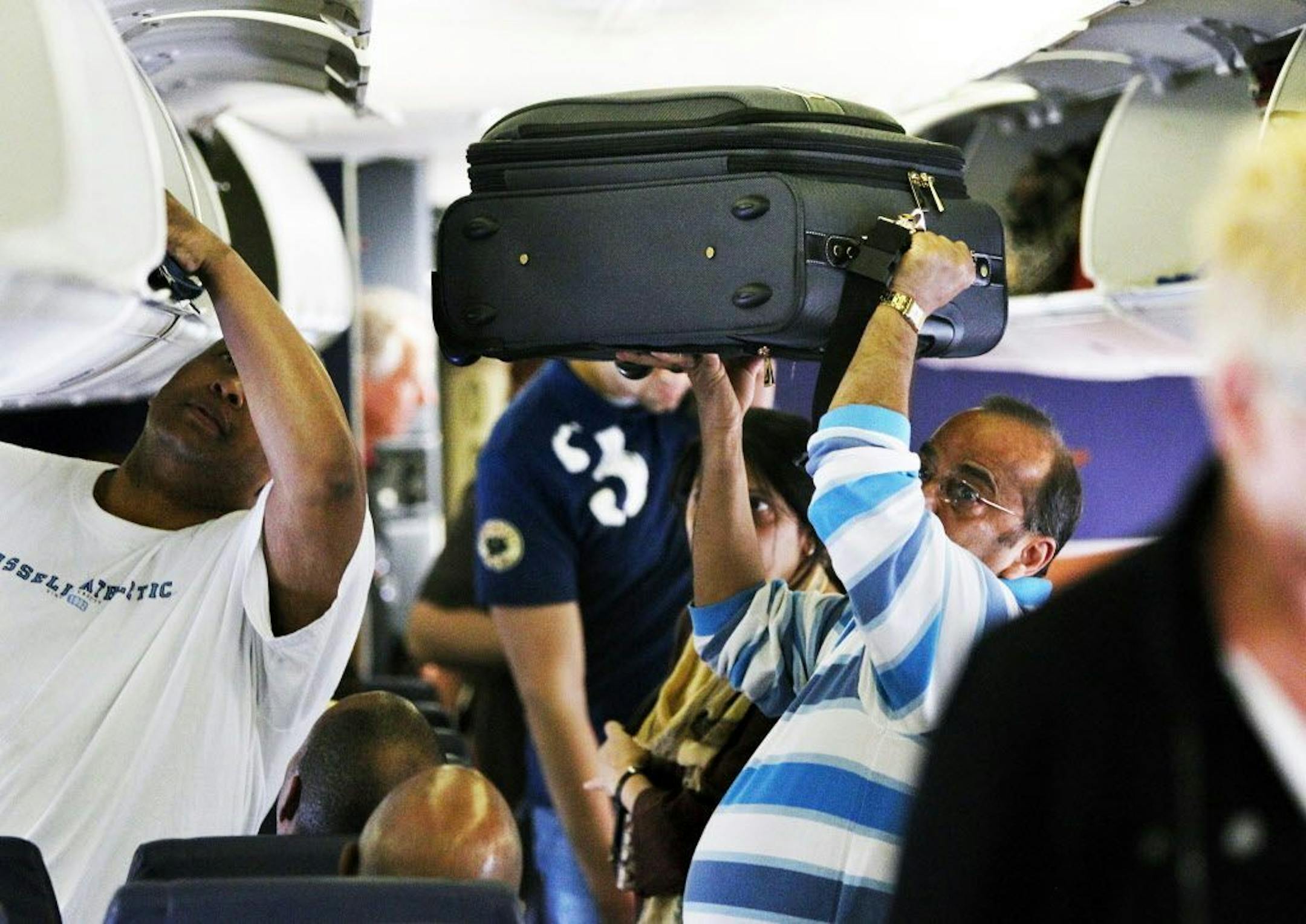
NEW YORK — Millions of fliers might soon want to buy new carry-on suitcases.
Global airlines announced Tuesday a new guideline that recommends shrinking carry-on bags, in an effort to free up space in packed overhead bins.
The guideline, which is not binding, means that many existing bags currently in compliance with airline rules would not be given preferential treatment in the boarding process. While details of how the guideline will be implemented are murky, and could vary from airline to airline, it raises the possibility that many fliers would be forced to check their favorite carry-on bag.
Fliers might ultimately need to buy smaller suitcases or pay a fee to check their bags, typically $25 each way.
The recommendation by the International Air Transport Association suggests an "optimal" carry-on size at 21.5 inches tall by 13.5 inches wide by 7.5 inches deep. That's smaller than the current maximum size allowed by many airlines. For instance, American Airlines, Delta Air Lines and United Airlines all currently allow bags up to 22 inches by 14 inches by 9 inches — although gate agents don't always enforce those more-generous measurements.
"Once again, the airlines find a way to make their problem the passenger's problem — and an expensive problem at that," said travel industry consultant Henry Harteveldt. The lack of overhead space is due to airlines cramming too many seats on planes and charging passengers to check their suitcases, he said.
Airlines around the globe have varying standards — different enough that a carry-on bag that is acceptable to one airline isn't allowed in the cabin of another. The airline trade group says the new guideline will not necessarily replace each airline's rules on bag size, but gives them a uniform measurement that "will help iron out inconsistencies."
Charlie Leocha, a consumer advocate and co-founder of Travelers United, said if enough airlines adopt these guidelines it will be great for travelers to at least know what size bag is acceptable on multiple airlines. However, Leocha measured his own carry-on bag Tuesday— one that he has traveled with for more than a decade and never struggled to fit into an overhead bin — to find out that it doesn't comply with the new suggested size.


