

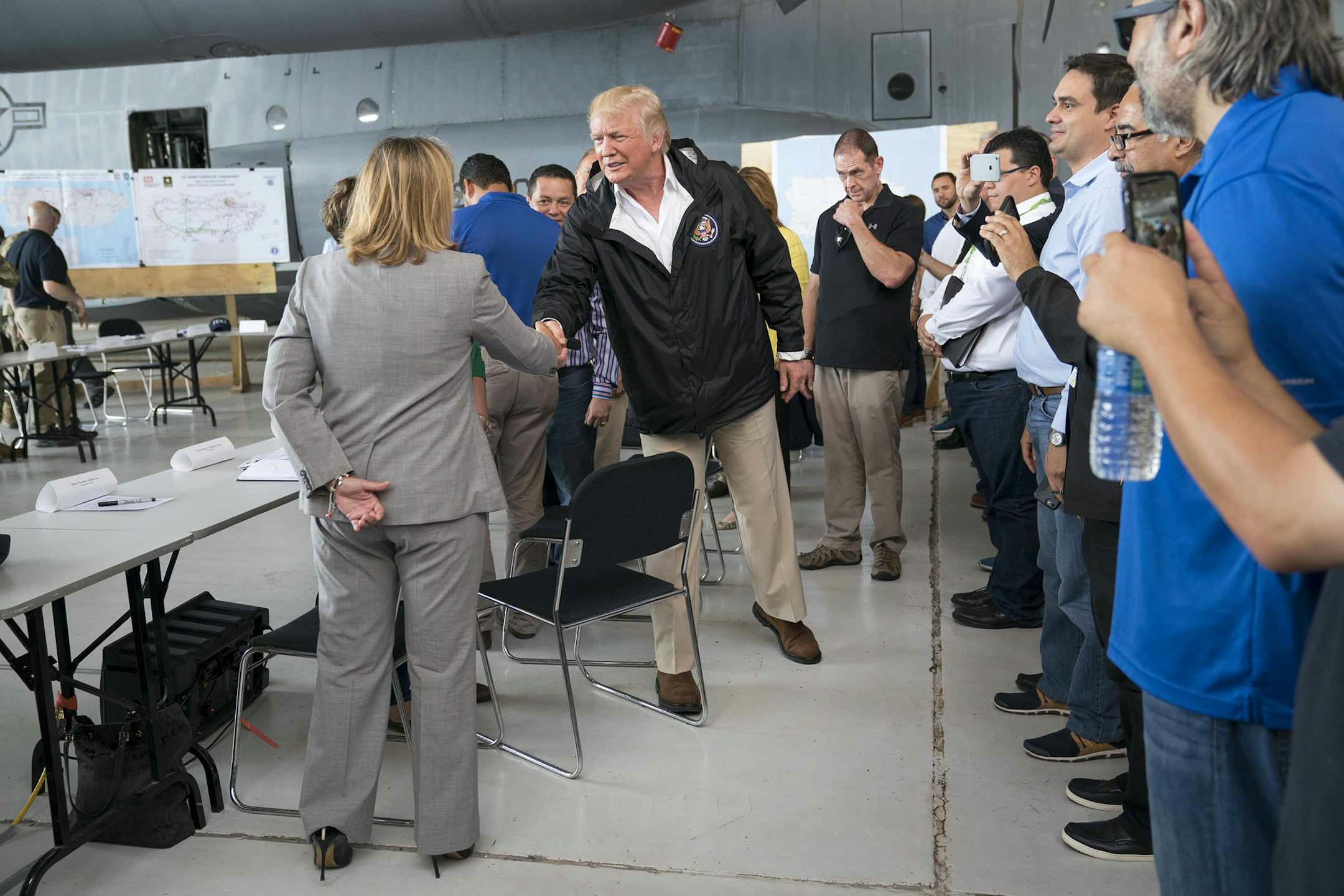
"Send in the cavalry."
That was the advice retired Army General Russel Honore gave President Donald Trump this week about responding to the devastation of Puerto Rico by Hurricane Maria. And Honore's opinion was well informed: in 2005, President George W. Bush sent him to bail out New Orleans after Hurricane Katrina's 30-foot storm surge overran its levees. And by Honore's judgment, Trump has fallen short: "This is a hit on White House decision making," he told Bloomberg News.
Plenty of others piled on.
So, how fair were such criticisms?
I decided to talk to someone whose experience rivals that of General Honore: retired Navy Captain Jerry Hendrix. Now a senior fellow with the Center for a New American Security, Hendrix served for decades both on the high seas and in high-level staff jobs, including with the Chief of Naval Operations' Executive Panel and the Office of the Undersecretary of Defense for Policy's Irregular Warfare Quadrennial Defense Review. Few people know more about military history than Hendrix, who has degrees from Purdue, Harvard, the Naval Postgraduate School and a PhD from Kings College in London. Little wonder that in 2012 was named the service's director of naval history.
Here is a lightly edited transcript of our discussion:
Tobin Harshaw: Jerry, before we get to the immediate issue of Puerto Rico, why don't you give us a brief rundown of your own experience in the Navy with disaster relief.
Jerry Hendrix: Like virtually every sailor of the past century, going back to Theodore Roosevelt's dispatch of the Great White Fleet to respond to a massive earthquake on the island of Sicily, I had several exposures to humanitarian assistance/disaster relief operations during my career. Perhaps the most instructive was when I served with Tactical Air Control Squadron 11 from 2005 to 2008. During that tour, the squadron provided detachments in response to earthquakes and volcano eruptions, including directing air operations in Kashmir following a 7.1 magnitude earthquake. The devastation made the roads largely impassable to wheeled vehicles and at that altitude the air is so thin that helicopter cannot lift as many supplies with each flight.


