

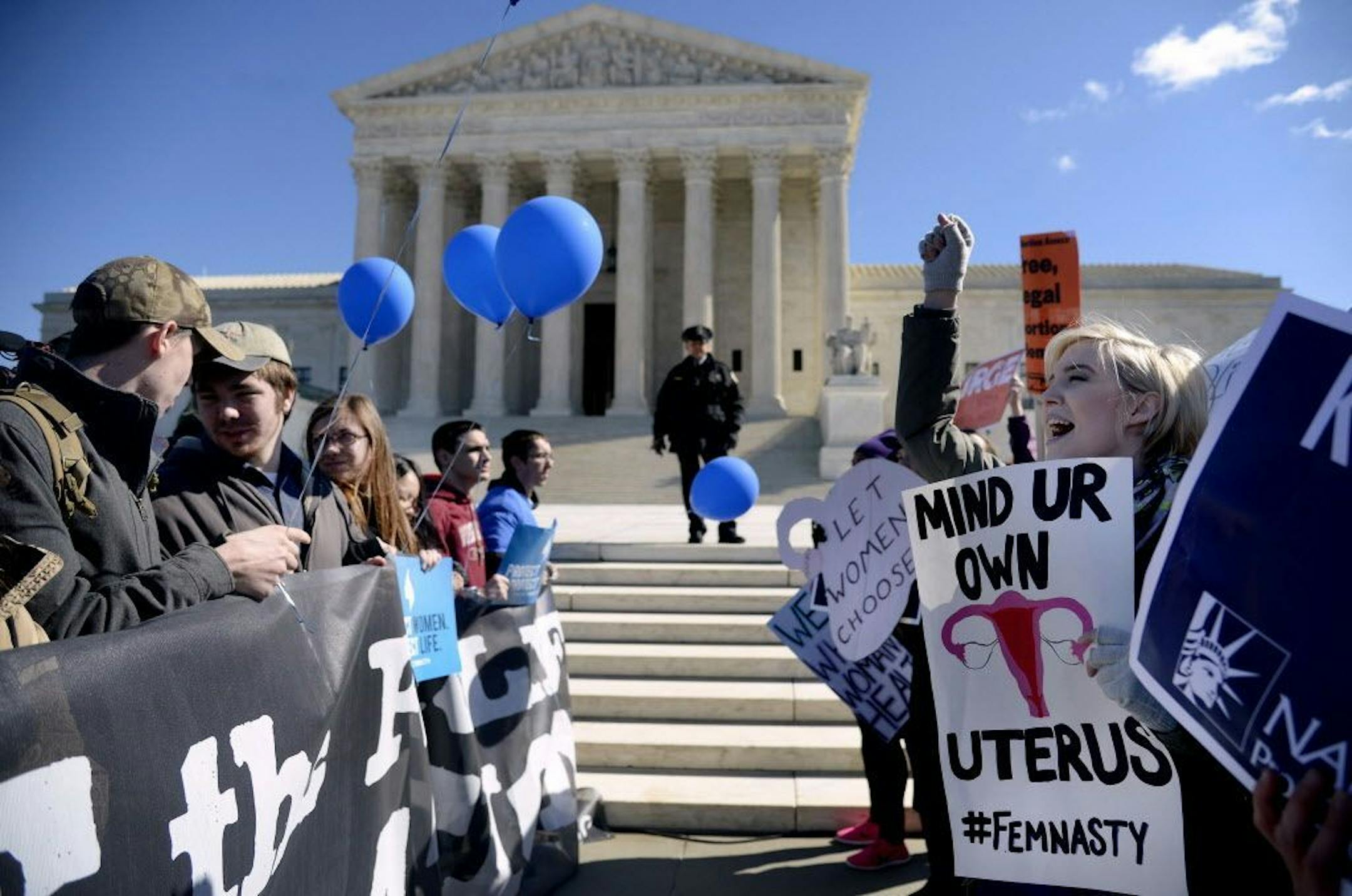
WASHINGTON — A Supreme Court deeply split over abortion wrestled Wednesday with widely replicated Texas regulations that could drastically cut the number of abortion clinics in the state. As ever, Justice Anthony Kennedy appeared to hold the outcome in his hands on a court operating with eight justices since the death of Justice Antonin Scalia.
The court's most significant abortion case since the early 1990s crackled with intensity during 85 minutes of pointed questions from liberal and conservative justices that suggested little common ground in resolving the clinics' claim that the regulations are medically unnecessary and unconstitutionally limit a woman's right to an abortion.
Texas says it is trying to protect women's health in rules that require doctors who perform abortions to have admitting privileges at nearby hospitals and force clinics to meet hospital-like standards for outpatient surgery. The rules would cut the number of abortion clinics in the state by three-fourths, abortion providers say.
The three women justices and Justice Stephen Breyer repeatedly questioned why Texas needed to enact the 2013 law. "But what is the legitimate interest in protecting their health? What evidence is there that under the prior law, the prior law was not sufficiently protective of the women's health?" Ruth Bader Ginsburg asked Texas Solicitor General Scott Keller.
More than 210 women are hospitalized annually as a result of complications from abortions, Keller said. Pressed by Ginsburg, Keller acknowledged that was a relatively small complication rate but said the state still could act to make abortion safer. With about 70,000 abortions a year in Texas, that works out to a rate of less than one-half of 1 percent.
Justices Elena Kagan, Sonia Sotomayor and Breyer all pointed out that other procedures, including liposuctions, colonoscopies and dental surgeries, have higher complication rates and yet can be performed in facilities that do not meet the stringent standards.
The clinics, backed by the Obama administration, argue that the regulations already have closed half the roughly 40 clinics that existed before the law was enacted and that only about 10 clinics would remain if it is allowed to take full effect.
The high court, again divided between liberals and conservatives, has blocked the surgical center requirement from taking effect.

