

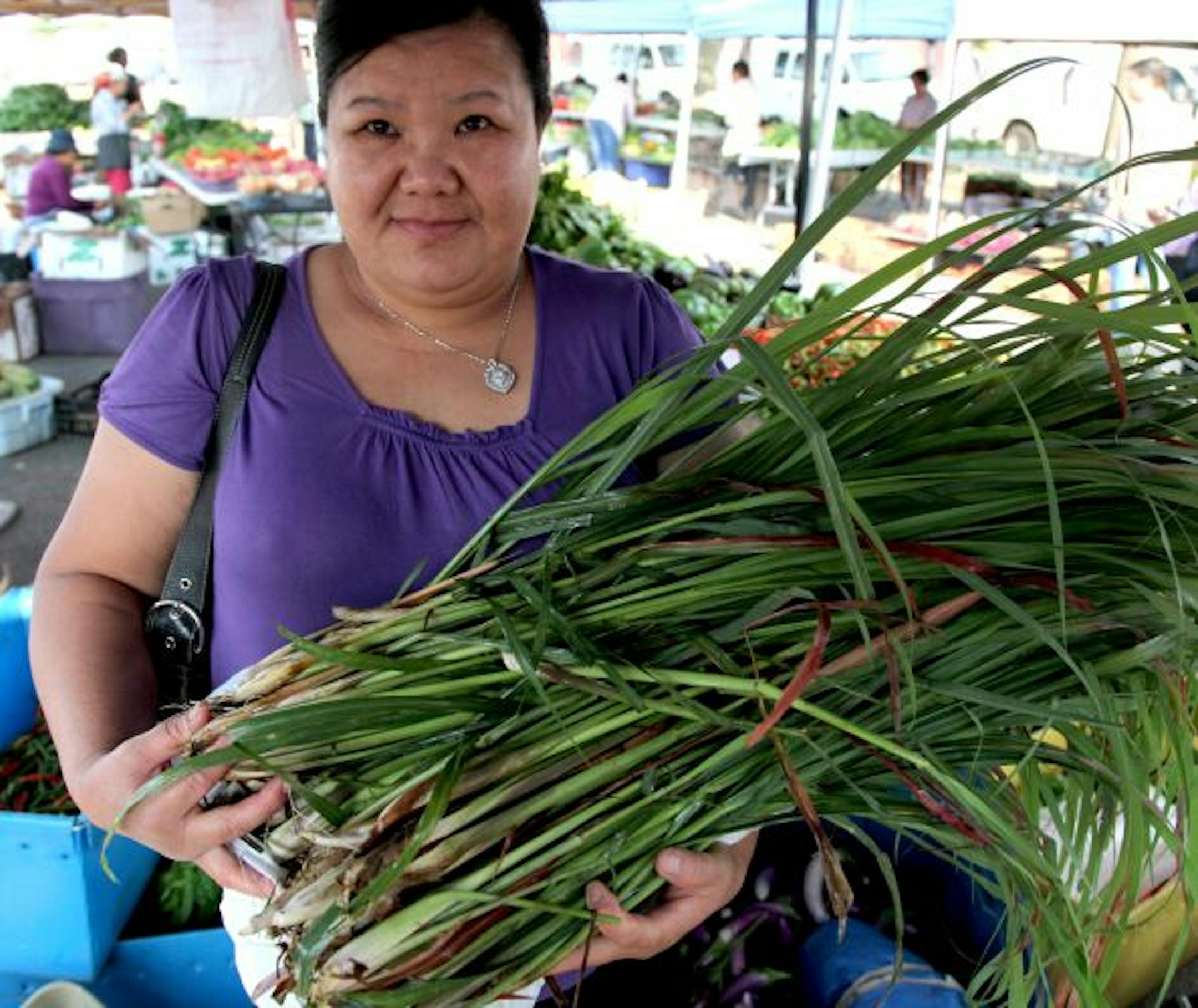
Mai Ly navigated the Hmong farmers market like a pinball, zigzagging between stands in search of the greenest, shiniest vegetables. We were at the busy market on a Sunday morning, in the parking lot of Sun Foods on University Avenue in St. Paul. Fueled by a cook's blend of pickiness and hope, Mai Ly (pronounced My Lee) had faith that she'd find a better batch of eggplant right around the corner.
"That's amaranth. Garlic chives. Let's get these long beans," she said. Mai picked up a bunch and tipped them toward the vendor. He took her dollar and dropped them in a bag. "We'll use them in the papaya salad. And here," she said, pointing to a scraggy bundle of seeded-out cilantro, "this is fresh coriander. We need to make pepper sauce, too."
Her menu for our afternoon cooking session, full of dishes she felt would demonstrate the range of Hmong cooking -- papaya salad, chicken soup with traditional herbs, larb, sticky rice, squash vine soup -- was already huge, and here she was adding to it.
Finally we found a stand selling the Hmong "soup herbs" we needed for the chicken soup. They were gathered into a thick, motley bunch -- some delicate like basil, some saw-toothed, some stiff like field grass. "When I first came to St. Paul you couldn't find these herbs," Mai said. "I had a booth at the downtown farmers market for 11 years, and it took awhile to find the seeds to grow things like sweet potato leaf, Thai eggplant and Chinese amaranth. Later, we all had seeds for the soup herbs. Someone must have smuggled them in from Laos."
I joked about the illegality of this bundle, but she grew serious. "We have to have these herbs."
Minneapolis-St. Paul is home to the largest metropolitan population of Hmong people in the United States, and while Hmong growers have a big presence at all of the farmers markets in St. Paul, their cuisine has remained oddly underground. I can only guess as to why: one, because they're a distinct cultural group without a home country (native mostly to Laos, and going way back, to China) and two, they don't have a tradition of writing down recipes.
"That's true," said Mai, as she picked through the sheaves of lemongrass. "But it's also because some good Hmong cooks guard their recipes like secrets."
On the other hand, Mai wants to help popularize iconic Hmong dishes with the best, most authentic recipes. This means no shortcuts and no substitutions -- and a lot of vegetable schlepping.


