

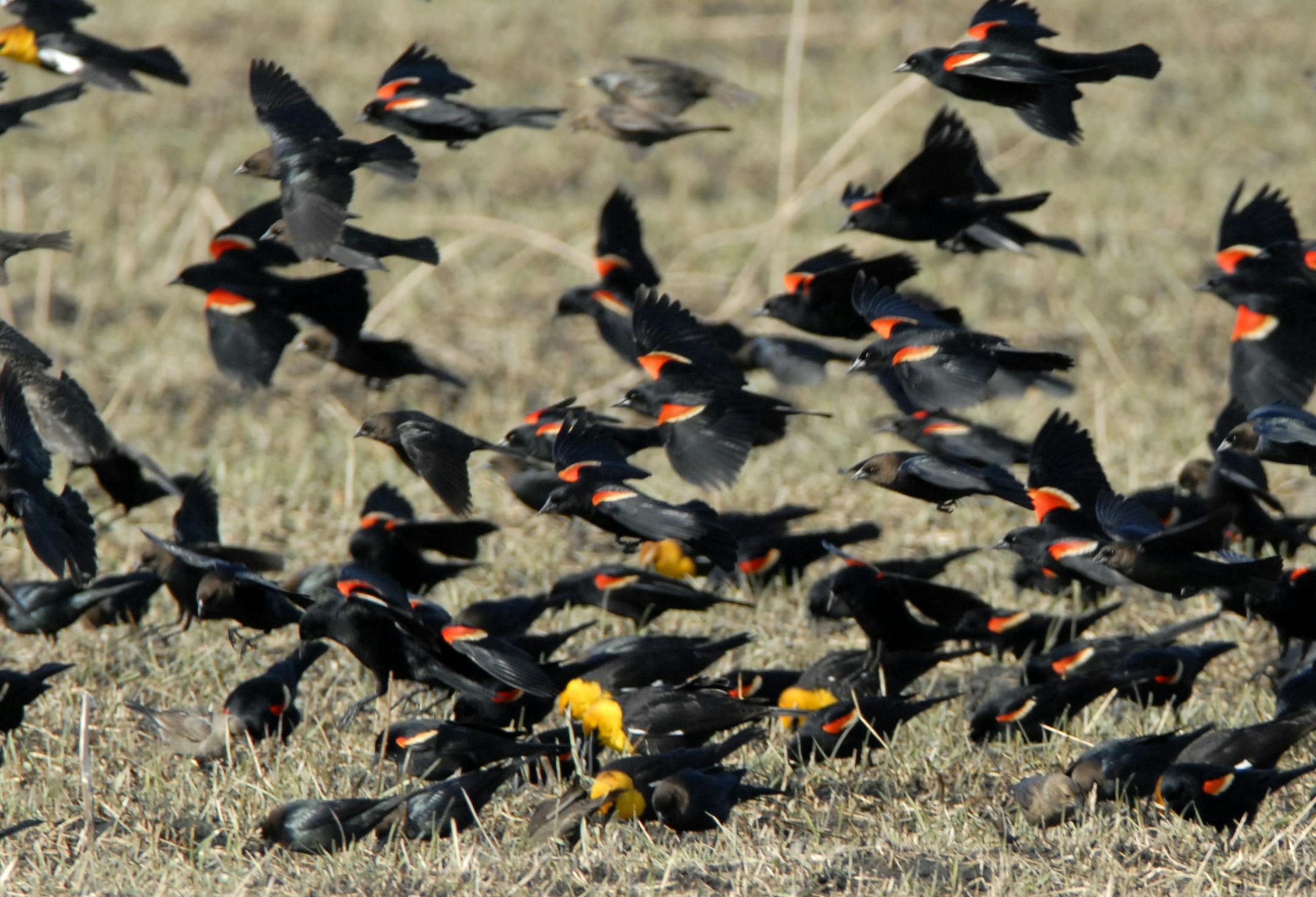
It's just plain hard to sleep on autumn nights if I start thinking about one of the most awe-inspiring events in the natural world, the annual passage of billions of birds on their way south.
Most songbirds travel at night, when it's cooler and fewer predators are on the wing. Hundreds, even thousands of these birds pass in the darkness over my house and neighborhood each evening as they begin their journeys to winter homes. Mixed flocks might include rose-breasted grosbeaks, gray catbirds, tiny warblers and the whole family of thrushes.
Something like 204 of the bird species that breed in Minnesota migrate away each fall. Some, like the blackbird family, travel in daylight. But on some nights, there truly is a virtual river of birds overhead, although their numbers ebb and flow over the migration season. Streams of birds heading south converge from the north, west and east. And this river of birds then stays on course on the journey's first leg by following a key landmark, the Mississippi River, a major migratory flyway.
Self-guided tour
Many of us assume that birds travel on autopilot, following directional instructions embedded in their genes, but we now know that birds use a variety of signals to create a migration map.
Navigation over long distances is a complex business: Birds assess light patterns from the setting sun and a reading of the local magnetic field as they start out each evening. Along the way, they look up at the stars and down to landmarks on the ground, such as rivers and mountains, to stay on course. Over time, after a number of migrations, they develop a sense for the best route, storing up vital information on good replenishing sites and where to stop to rest. (Young birds do rely for their first trip on instructions hard-wired into their brains, then modify it as they gain experience.)
Some, like bluebirds, may travel only a few hundred miles. But long-distance champs like purple martins, scarlet tanagers and blackpoll warblers may cover thousands of miles before their final touch-down. Some of our summer birds spend the winter among such rain forest exotics as trogons, motmots and manakins.
Running a gantlet
Migration is the most dangerous and energetically expensive thing birds do in their lives. They fly through storms (even hurricanes), face predators, dodge communication towers and tall buildings, and encounter sites freshly sprayed with pesticides and drastically altered landscapes. Another major hazard is loss of habitat, places to stop and refuel during their flights.
For example, a large stand of bushes whose berries birds feasted on last year may have been plowed under to build a strip mall, and a barrier island that formerly offered shelter might now be covered by a string of vacation homes. These kinds of stopover sites are disappearing at an alarming rate, as we humans build on and plow under open spaces and alter the environment.
