

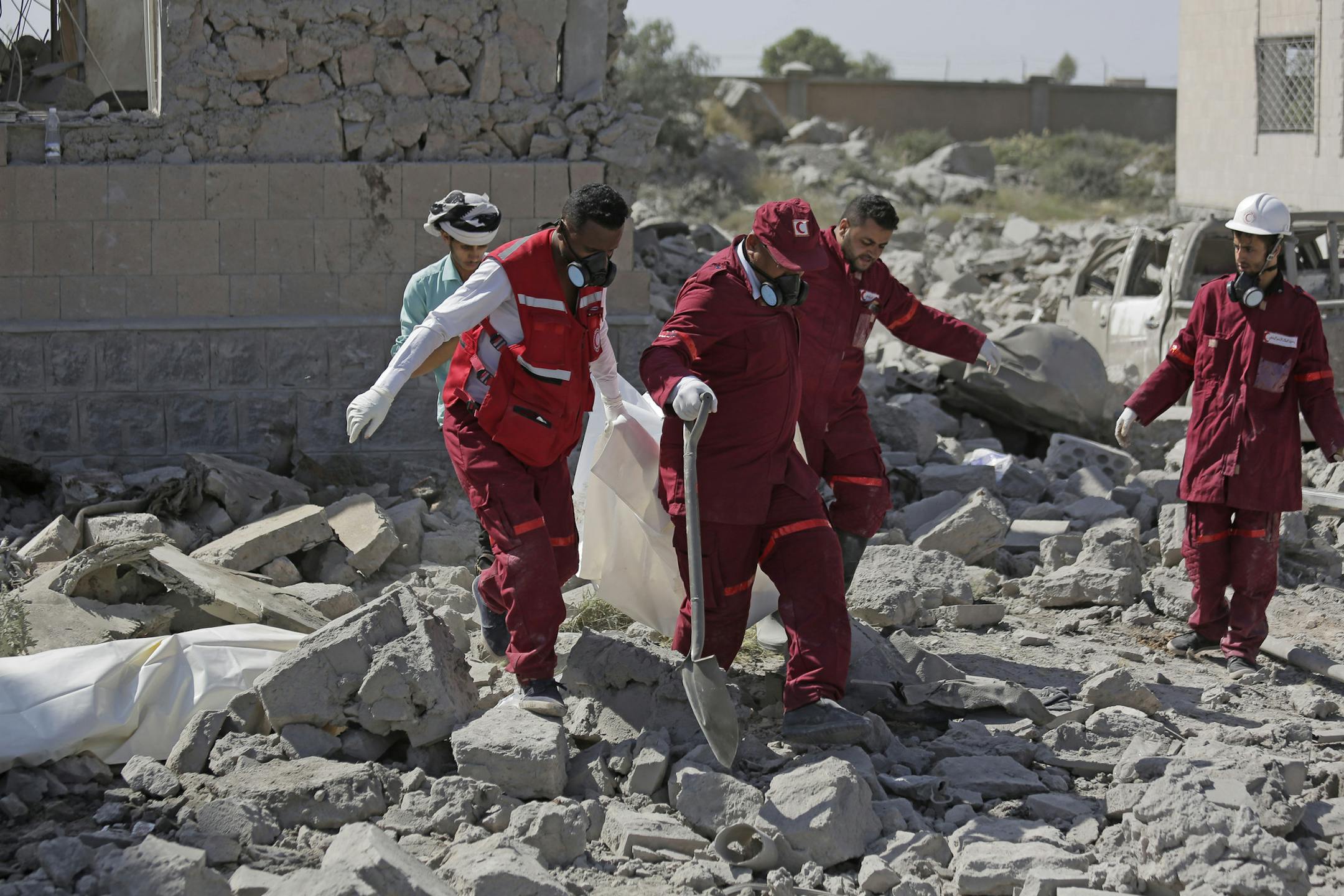
Last Sunday, the U.S.-backed Saudi Arabian-led coalition killed more than 100 people with airstrikes on a detention center in Yemen. It was described as the deadliest attack on Yemen this year. The Red Cross suggested this was likely a war crime, and the U.S. special envoy to Yemen said, "To hit such a building is shocking and saddening … . [W]itnessing this massive damage, seeing the bodies lying among the rubble was a real shock." This is just the latest on the war in Yemen, adding to the tens of thousands of civilians already dead.
Many readers may have little knowledge of Yemen, a small, poor country along the southwest border of Saudi Arabia. Yemen's unemployment rate is 27% and its poverty rate is 54%. It is also experiencing the largest cholera outbreak in history, with some 10,000 new cases of suspected cholera reported each week. At the same time, mothers huddle with their children in basements to escape the bombing. They and their children die anyway.
What began as a civil war between factions arising from the failed 2014 Arab Spring movement has now become a proxy war among the world's superpowers. It is largely Saudi Arabia and the U.S. against Iran and Russia. Aside from weapons sales, the U.S. provides intelligence, logistics and midair refueling of Saudi bombers that are destroying the country and the people of Yemen.
There is no effort to avoid civilian casualties; bombs fall on hospitals and schools. Even more deaths are due to war-induced closings of ports providing food and medicine. The United Nations refers to Yemen as the world's greatest human catastrophe and warns that "Yemen is sliding fast toward what could become one of the worst famines in living history." The people of Yemen are not interested in the objectives of Iran or the coalition; they merely want to live and feed their children.
Our president has history with Saudi Arabia. In 2016 he said, "I get along with all of them … . They buy apartments from me. They spend $40 million, $50 million." Saudi investments in Trump properties are well-documented. In Chicago alone, one analysis revealed a 169% increase in Saudi Arabia-based patrons since 2016.
Trump gave Saudi Arabia the honor of his first trip after entering office. He was given a regal welcome, with a medal and participation in a traditional sword dance. Trump was vocally impressed by the regal gold and jeweled palace in which they met.
Later, many readers will recall that Trump defended the crown prince in the torture and assignation of Jamal Khashoggi, a U.S.-based journalist. American and international intelligence sources universally implicated the Saudi crown prince in Khashoggi's killing. Trump unilaterally rejected this intelligence without evidence, stating that "maybe he did and maybe he didn't!"
Khashoggi's murder was tragic, especially as a journalist, but even broader is the reality of human-rights violations in Saudi Arabia. Amnesty International places Saudi Arabia among the worst 10 human-rights abusers. The U.N. puts the Saudi-led coalition on its "list of shame." Amid this, Trump states, "I have great confidence in … the Crown Prince of Saudi Arabia."


