

By SETH BORENSTEIN Associated Press
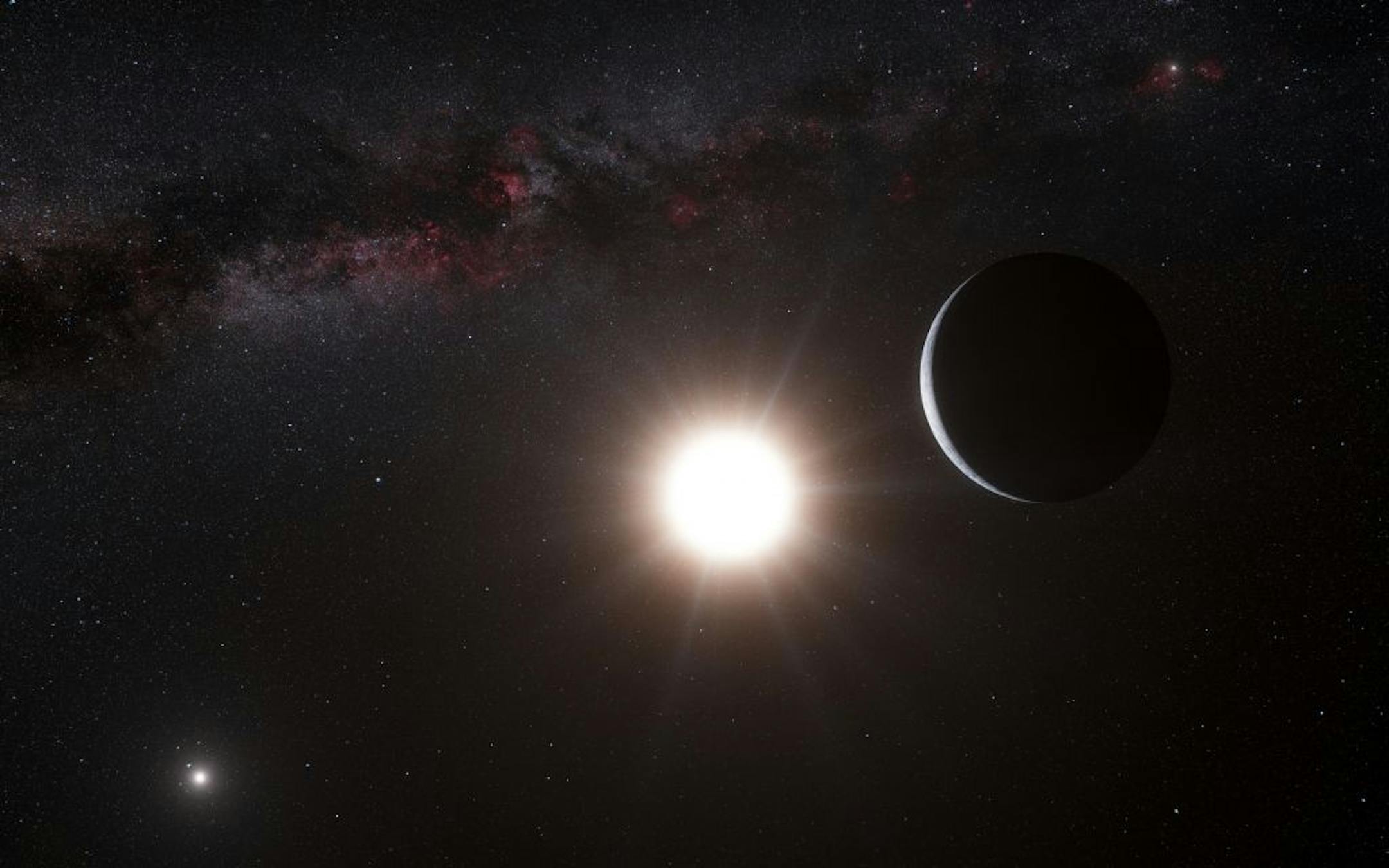
European astronomers say that just outside our solar system they've found a planet that's the closest you can get to Earth in location and size. It is the type of planet they've been searching for across the Milky Way galaxy and they found it circling a star right next door -- 25 trillion miles away.
But the Earth-like planet is so hot its surface may be like molten lava. Life cannot survive the 2,200 degree heat of the planet, so close to its star that it circles it every few days. Astronomers said it's likely there are other planets circling the same star, a little farther away where it may be cool enough for water and life. And those planets might fit the not-too-hot, not-too-cold description sometimes call the Goldilocks Zone. That means that in the star system Alpha Centauri B, a just-right planet could be closer than astronomers had once imagined.
It's so close that from some southern places on Earth, you can see Alpha Centauri B in the night sky without a telescope. But it's still so far that a trip there using current technology would take tens of thousands of years. But the wow factor of finding such a planet so close has some astronomers already talking about how to speed up a 25 trillion-mile rocket trip there. Scientists have already started pressuring NASA and the European Space Agency to come up with missions to send something out that way to get a look at least.
The research was released online in the journal Nature. There has been a European-U.S. competition to find the nearest and most Earthlike exoplanets -- planets outside our solar system. So far scientists have found 842 of them but think they number in the billions.
While the newly discovered planet circles Alpha Centauri B, it's part of a system of three stars: Alpha Centauri A, B and the slightly more distant Proxima Centauri. Systems with two or more stars are more common than single stars like our sun, astronomers say. This planet has the smallest mass -- a measurement of weight that doesn't include gravity -- that has been found outside our solar system so far. With a mass of about 1.1 times the size of Earth, it is strikingly similar in size.
Stephane Udry of the Geneva Observatory, who heads the European team, said this means "there's a very good prospect of detecting a planet in the habitable zone that is very close to us."
And one of the European team's main competitors, Geoff Marcy of the University of California, Berkeley, gushed even more. "This is an historic discovery," he said. "There could well be an Earth-size planet in that Goldilocks sweet spot, not too cold and not too hot, making Alpha Centauri a compelling target to search for intelligent life."


