

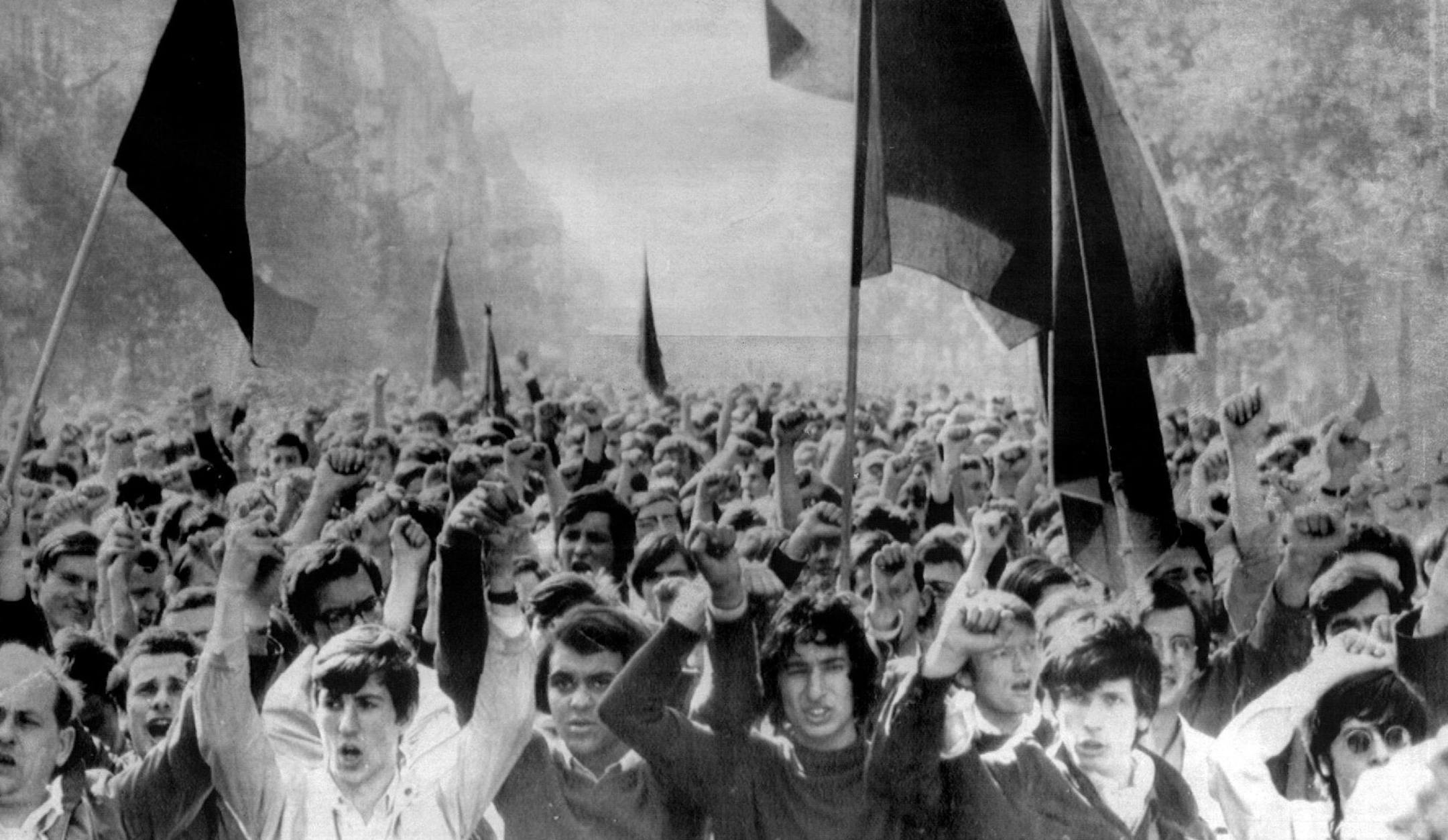
On May 5, 1968, when I flew out of JFK, America's cities were aflame; when I arrived in Paris, it too was burning.
Mankato, Minn., in the 1950s, a conservative agricultural hub with a sleepy state teachers college, was not the typical launchpad for a life of social activism. The few liberals, such as my father, could all be found on Saturday morning in a single barber shop on Front Street whispering their politics. The region hadn't elected a Democrat since the American Civil War.
So it's not surprising that my own life in protest began not in my southern Minnesota upbringing but on the streets of Paris in May 1968. The recipient of a small grant from a foundation that permitted me to travel, I arrived by bus from Luxembourg on the night of May 5 in the only remaining public transportation whose workers were not "en greve" — "on strike."
I lived on the tip of the Ile de la Cite on the edge of the Latin Quarter, the center of the student protests, in the Hotel Henri IV, an appropriately rundown family hotel frequented by bohemians and expats. A week later I moved into the Latin Quarter itself, walking the torn-up streets where cobblestones laid in the previous century were being pried up with crowbars and piled in 8-foot barricades. Cars were overturned and set afire. Tear-gas canisters and flash-bang stun grenades punctuated the nightly protests.
Paris that year was a social laboratory for identifying the conflicts in a post-World War II order in which neocolonial societies came to grips with the class, race, gender and immigration issues of a burgeoning global society. I saw my own country for the first time through Parisian eyes.
The French had already fought and lost their "Vietnam War" in Indochina. We were in the throes of ours. Unions in France, unlike those in the U.S., were organized along political party lines — communist, socialist and Christian democratic — but were free from the rigid restrictions imposed in the U.S. by our legal framework for collective bargaining. All three unions coexisted in each workplace in France. As a result, most French unions took up the students' cause, and Paris was quickly in the middle of a general strike.
Societies in the middle of revolutionary struggles, whether real or only perceived, give birth to a culture of magical thinking that converts the mundane to inspiration, the obvious to poetry. At that same time, half a world away, Mao's Red guards were expelling professors from their universities and exiling veterans of the Comintern to countryside re-education camps. One French Maoist told me that Notre Dame should be reduced to rubble if it couldn't be turned into a serviceable hospital.
Mornings in Paris 1968 were periods of calm and discourse. Cafe life reflected the ambition of French society to purify itself through discussion. In the Cafe des Malherbe, I met a group of African-American expatriate writers who, in the wake of the Watts uprising, had found America too debilitating and too confrontational toward their biracial marriages. I also met Ted Joans, cousin of Leroy Jones, the noted American poet and playwright. Ted was also a writer, supremely impressed by the tenacity of French women fighting pitched battles with the police to protect their barricades. "Our sisters could learn something from the French," he observed.


