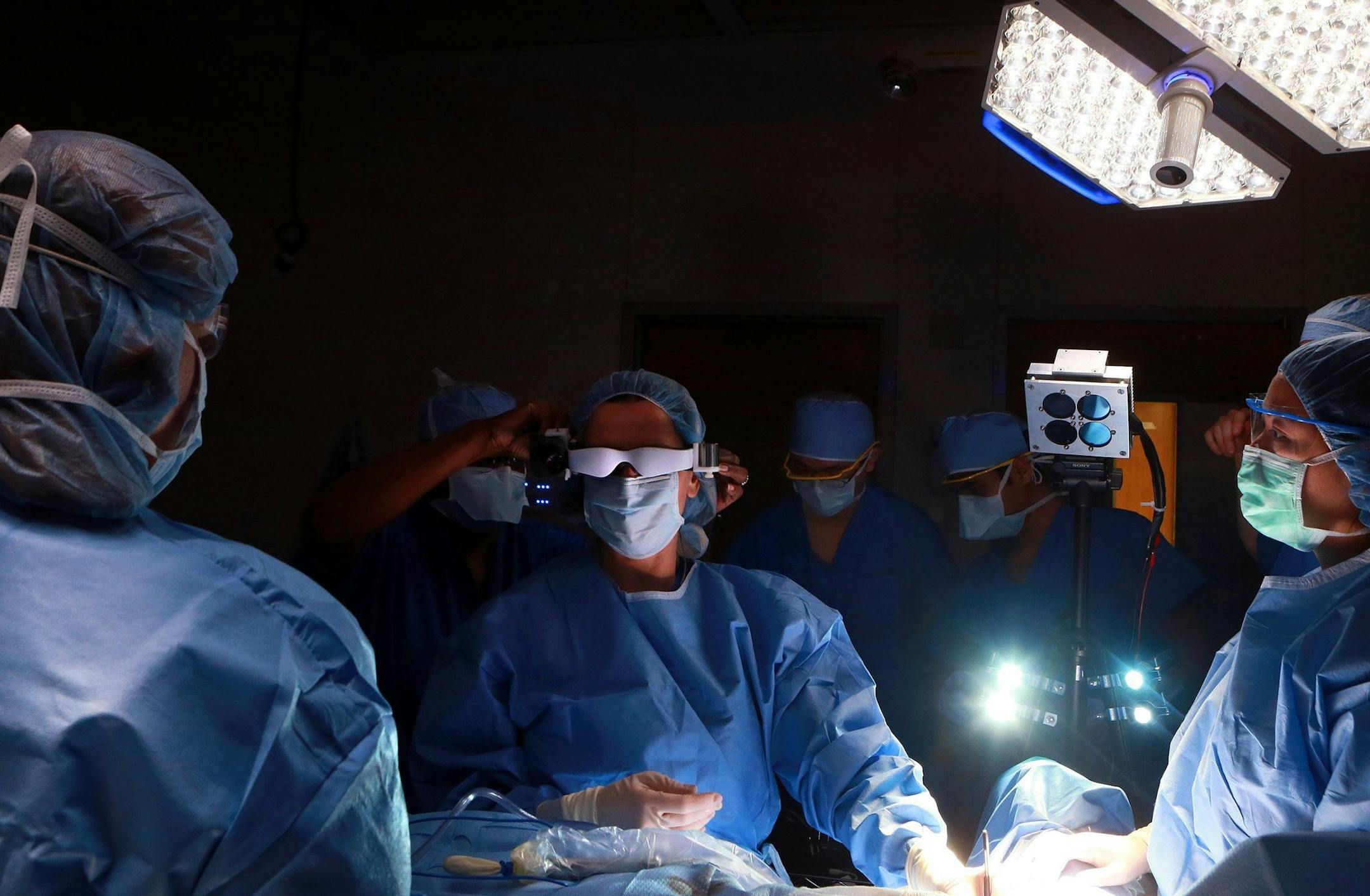
Which superhuman power would you choose for help on the job? For Dr. Julie Margenthaler, it's a technology that brings to mind X-ray vision, used for the first time during an operation at Barnes-Jewish Hospital to remove a patient's lymph node.
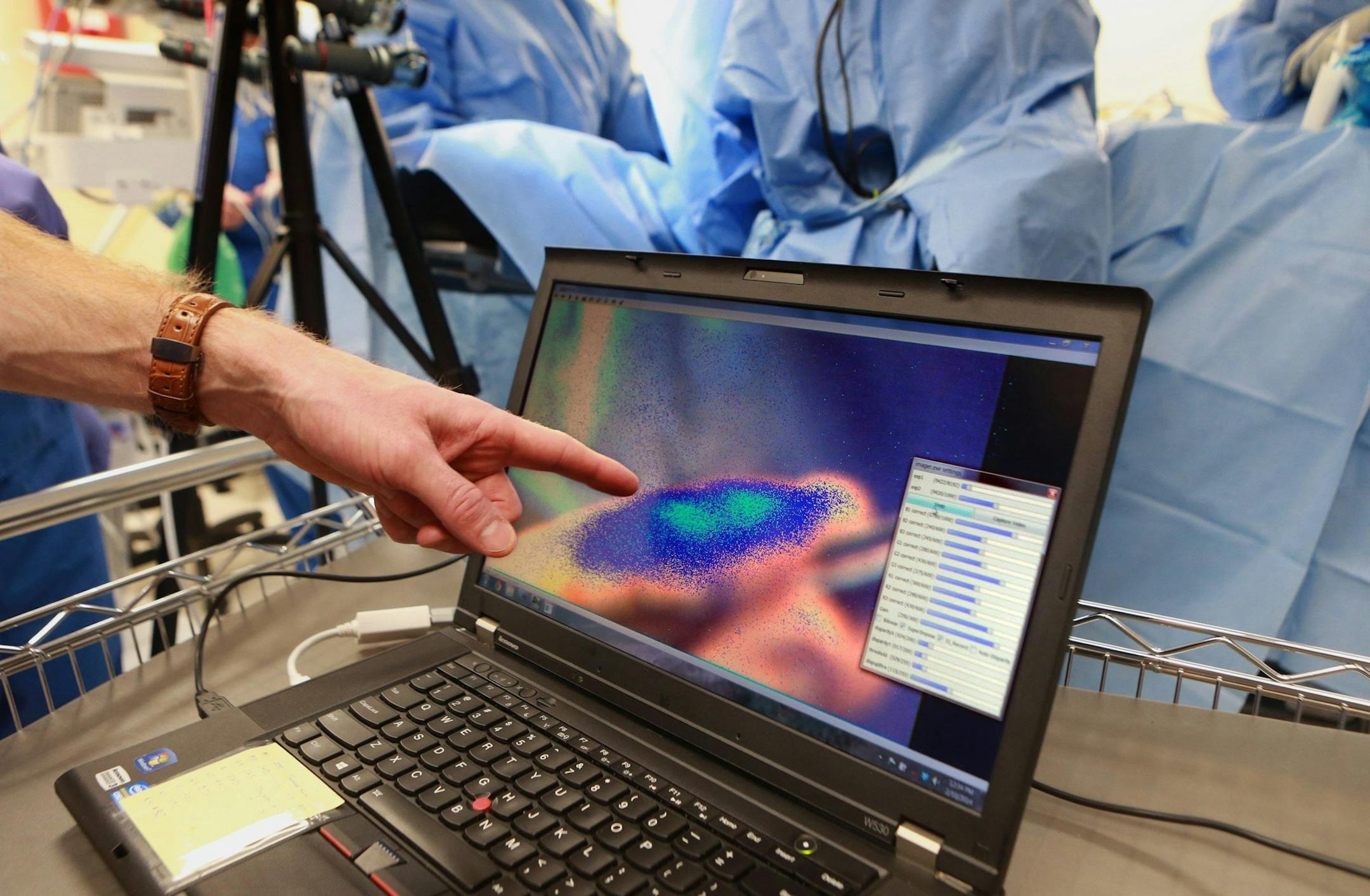
"It's like I'm in a sci-fi movie," she said after she put on goggles that allowed her to see the patient's lymph node light up with a blue glow invisible to the naked eye. A video camera projected the surgeon's visual field onto the screen inside the goggles and on a computer screen in the operating room.
The technology developed at Washington University in St. Louis could eventually be used to see microscopic cancer cells during surgery and enable a more thorough removal of tumors. For now, the team is testing the goggles on 20 to 30 breast cancer and melanoma patients to find lymph nodes that will be tested for possible spread of the cancer. "We're all interested in finding some way to perfect our surgical technique and ultimately find cancer cells earlier," Margenthaler said.
The research team of surgeons and biomedical engineers has been working on the imaging technique for several years. The idea came out of discussions among surgeons and scientists about the challenges of identifying the margins of tumor cells during cancer surgeries. Samuel Achilefu, a professor of radiology and biomedical engineering, remembered the night-vision goggles used in the Persian Gulf War and thought a similar technology could be used in the operating room.
"Once you put on these goggles, you can detect tissues with high sensitivity," said Achilefu, who leads the team. "It gives the information processed in real time about the tumor's location, shape and about the tissue surrounding it so that you can make immediate medical decisions."
Currently, surgeons use X-ray or MRI images to plan the removal of tumors. But because the images don't pick up smaller clusters of tumor cells, surgeons take extra tissue to send to a lab. If additional cancer is found, more surgery is scheduled — something that happens for as many as one-fourth of patients who have breast lumpectomies.
The researchers also developed a new dye formula that can target cancer cells to make them glow during surgeries using the goggles. The dye is awaiting approval for use in humans. In mouse studies, the system detected tumors as small as 1 millimeter in diameter, said the team's research funded by the National Cancer Institute and published in the Journal of Biomedical Optics.
Achilefu said he hopes the technology can be used in telemedicine, in medical schools or even to guide a surgeon in another country. The final, wireless version is expected to be finished by year's end. The system should cost less than $10,000, he estimated. He said, "I can see it being used in so many places."