

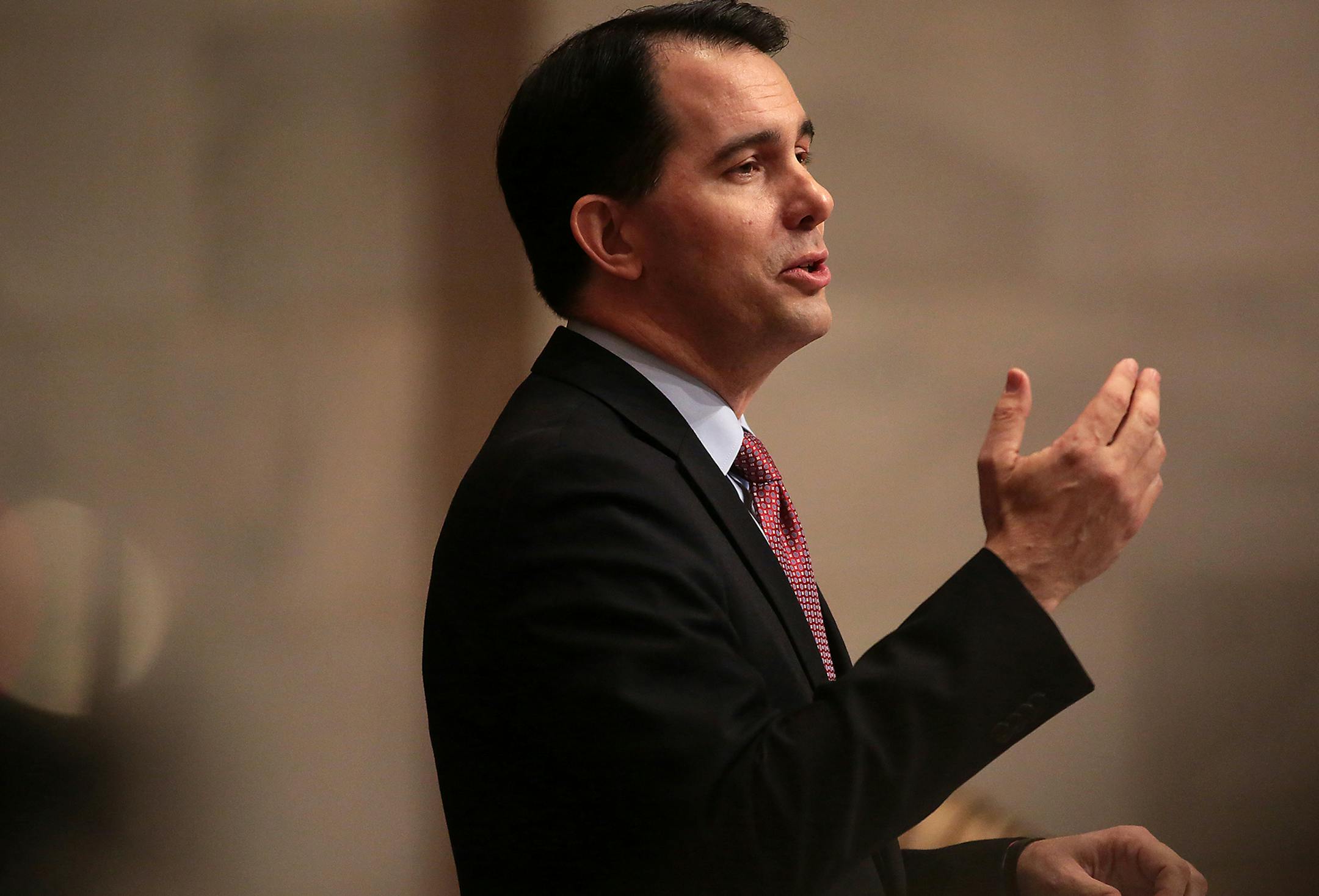
It's hard to believe that Gov. Scott Walker's proposal to cut $300 million from the budget of the University of Wisconsin system over the next two years would allow the school to maintain its quality. Walker, a Republican, would prohibit the university from raising tuition during that period but instead give university officials more flexibility in managing contracting and construction projects.
The theory is that this flexibility could yield savings equal to at least 13 percent of the university's budget. Good luck with that.
Walker's proposal provides a stark example of a broader trend that has been too little noticed: In the past three decades, many states have cut their appropriations for higher education, drastically eroding the quality of public universities.
As Prof. Tom Kane of Harvard and I have shown, states have tended to reduce higher education spending during economic downturns, but then have not restored the money during recoveries. The cumulative effect of this downward ratcheting has been enormous.
In 2000, states devoted 13 percent of their budgets to higher education. By 2014, that share had shrunk to less than 9.5 percent. If, over the past five years, allocations had kept pace with other types of state spending, then funding for public colleges and universities in 2014 would have been $16 billion more than it was. That's a loss of more than $1,000 per student enrolled in public colleges in just the past five years — and the trend has been going on for a few decades.
The myth has been that tuition hikes can offset these spending cutbacks. (In Wisconsin, Walker isn't even trying for that.) In reality, they haven't. And it's not surprising: Given that, 30 years ago, state governments contributed four times more than tuition to public higher education budgets, to offset a 20 percent reduction in state support, you'd have to raise tuition by 80 percent. State legislators are not willing to impose that kind of pain on students and their families.
Instead, the harm has been more subtle. In 1980, new associate professors at the University of Illinois at Urbana-Champaign and the University of Texas at Austin (both leading public universities) earned about as much as much as their counterparts at the University of Chicago and Rice University (leading private schools). By 2000, the public professors were earning about 15 percent less, and now it's 20 percent less.
In the late 1980s, eight public universities ranked in the top 25 nationally, according to the admittedly imperfect U.S. News and World Report assessment. The top one, the University of California, Berkeley, came in fifth. Today, Berkeley remains the top-ranked public university, but it has fallen to 20th place overall; two other public universities barely made the top 25.


