

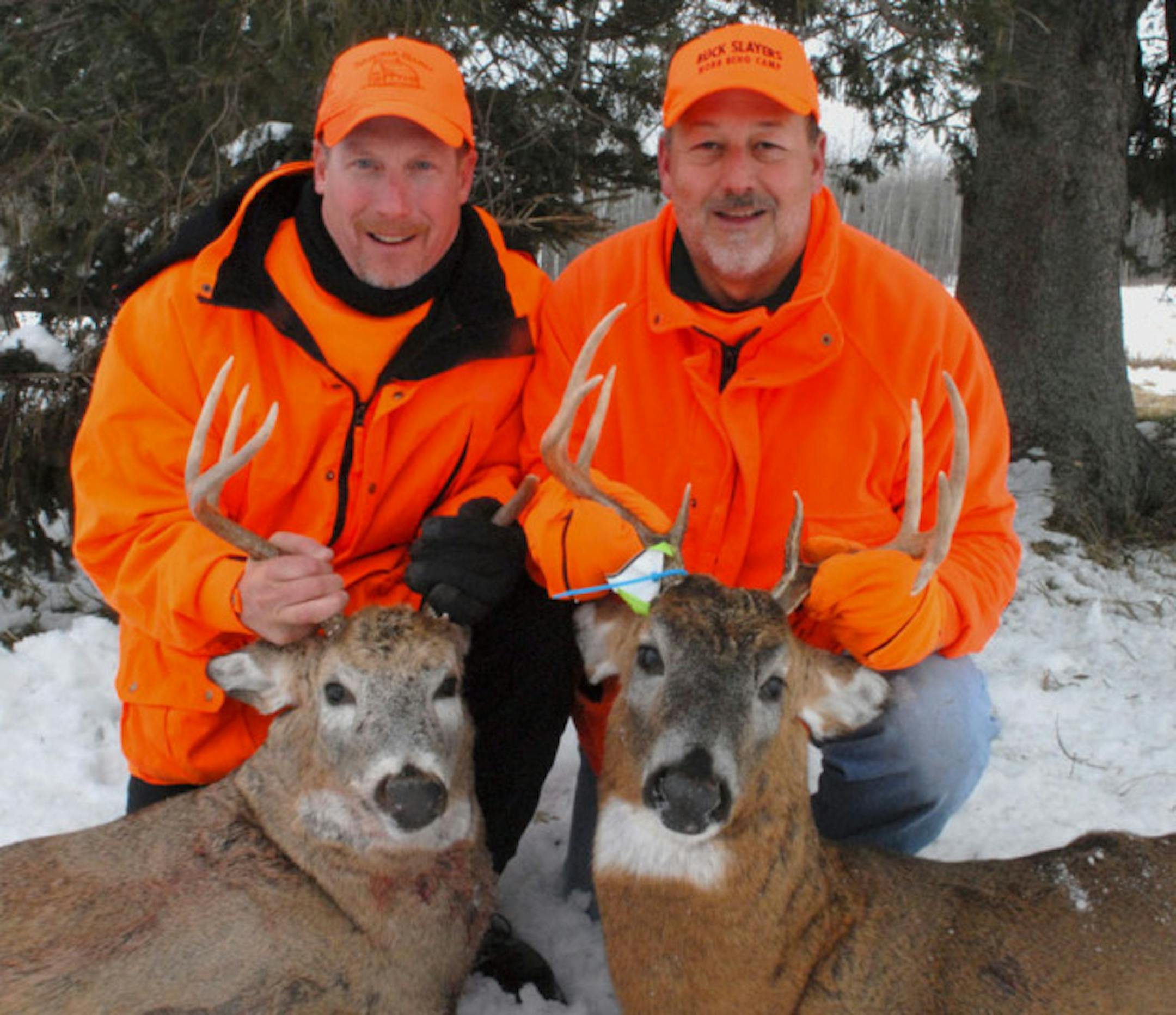
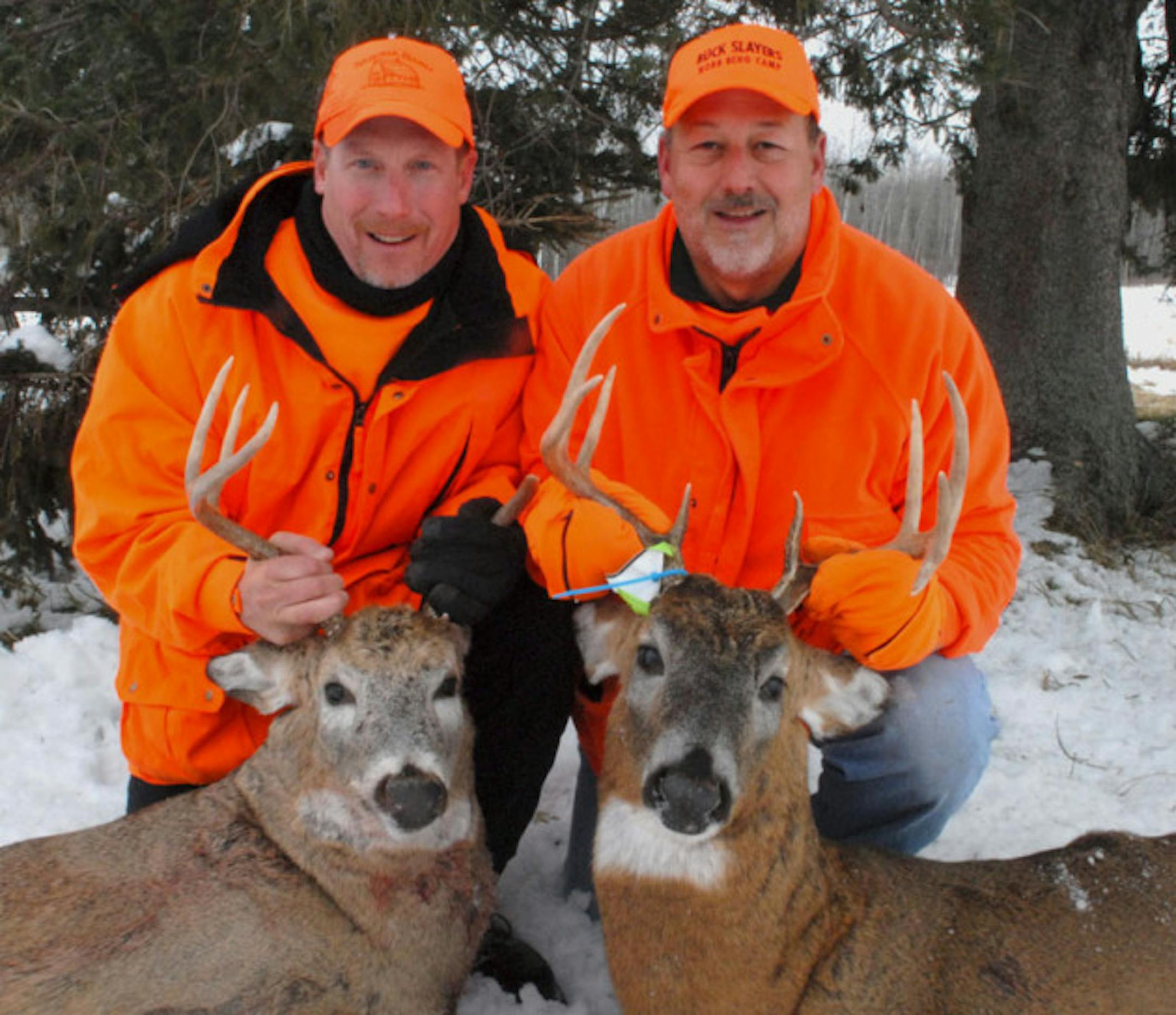
For many years , Wisconsin deer hunters have complained about whitetail management in their state. This doesn't make them unique: Deer hunters always want more and bigger animals in their sights — like the two Wisconsin bucks above, killed during a recent November season.
Oddly, a politician turned the complaints into a political issue, promising that, should he be elected, he'd have the state's DNR studied, or investigated, or reviewed, to determine whether the agency was competent, and if so, whether it was pursuing deer management correctly in the Badger State.
Gov. Scott Walker's campaign promise came true today, Tuesday, with a report issued by Dr. James Kroll ("Dr. Deer") that Wisconsin DNR Commissioner Cathy Stepp says will take time to digest.
So it will — it's fairly exhaustive.
Meanwhile, here's the report's Executive Summary.
The full report can be found here.
FINAL RECOMMENDATIONS
Population Management
1.Limit the use of SAK/accounting style models to monitoring deer population size and trends at the state and regional levels.
2.Do away with population goals and population estimates at the DMU level. 3. Replace the current DMU population goal definition of comparing the deer population estimate with the desired population goal for the DMU with a simplified goal statement of increase, stabilize or decrease population
density. 4. Develop a set of metrics to monitor progress towards the DMU goal of
increasing, stabilizing, or decreasing population density. 5.Reduce the number of DMUs and combine the Farmland regions. 6.Revise the Wisconsin Deer Management Plan.
Hunting Regulations, Seasons and Bag Limits
1. Simplify the regulatory process by setting antlerless harvest goals, harvest regulations and antlerless permit quotas on a 3-5 year cycle.
2.Base Antlerless Permit Quotas on DMU historical demand. 3.Increase the cost of all antlerless tags for Regular and Herd Control Units to
$12. 4.Consider charging a fee for antlerless tags in the CWD Zone. 5.Establish a public lands antlerless permit system. 6.Limit antlerless deer harvest in Regular and Herd Control Zones. 7.Establish a Deer Management Assistance Program (DMAP) antlerless permit
system.
8.Re-evaluate the effectiveness of the October antlerless seasons in the CWD Zone.
9. Maintain the current buck limit of one buck per Deer Gun License (may be used in muzzleloader season) and one buck per Archery Deer License.
10. Maintain the Bonus Buck Regulation in CWD Zone. 11.Resolve the cross-bow season issue through the public involvement
process. 12. Resolve the baiting and feeding issue outside CWD affected areas. 13. Put the fun back into hunting by simplifying seasons, bag limits and youth
qualifications!
Predator Studies and Management
1.Continue to conduct research on the impacts of predators on the deer herd. 2.Involve the public as much as practical with field-based research projects. 3.Revise the Wisconsin Wolf Management Plan to include updated information
and provide current public attitudes to guide management decisions through
the early years of this post-delisting era. 4. Establish a wolf population management program to limit/decrease wolf-
societal conflicts.
5. Geospatial studies of predator distribution and densities, especially for wolves, should be encouraged and developed to assess long-term trends and issues.
Chronic Wasting Disease
1. We believe it is time to consider a more passive approach to CWD in the DMZ.
2.There is a clear need for a new sampling protocol for CWD in Wisconsin, one that gives a true picture of the progress of the disease; but more importantly, one designed to detect spread.
3. Dealing with wildlife diseases is not unlike responding to wild fires, and response plan should be developed on this model, focusing on early detection of "break outs" and citizen involvement (active approach).
4.We recommend implementation of a statewide DMAP program; and, nowhere is such a program needed more than in the DMZ.
5. There is a need to provide more information about concerns for humans contracting a CWD variant.
6. The time required to receive CWD test results from hunter-killed animals must be decreased to a few days.
7. An annual meeting of DMAP cooperators would be an excellent venue for reporting on various aspects of CWD, in addition to the topics discussed earlier. This would greatly enhance public awareness and WDNR credibility.
8. WDNR should work closely (through the local biologist) with the Conservation Congress in developing goals and strategies at the county level. we feel use of human dimensions research to anticipate, rather than reacting to issues as they arise would be very effective.
9. We feel use of human dimensions research to anticipate, rather than reacting to issues as they arise would be very effective.
10. Charlotte the Deer should become the "Smokey Bear" of CWD in Wisconsin, serving as the centerpiece for a public education program developed with stakeholder organizations such as QDMA, Whitetails of Wisconsin and Whitetails Unlimited.


