

So, the building looks great, but does it work? That's the question every client wrestles with after the architect decamps and the construction crews sign off. In the case of the recently expanded Weisman Art Museum, which opened a $14 million suite of new galleries this fall, the answer is, "Yes, splendidly."
The University of Minnesota museum essentially doubled its exhibition space with the addition of three brick-covered cubes that appear to pop out of the building's back, facing the campus on the south and east. Perched on tall pillars, the new boxes animate a facade that was previously a dull brick wall. Another gallery was added on the north along with a new entrance canopy. Designed by Los Angeles architects Frank Gehry and Edwin Chen, who did the original 1991 building, the harmonious extensions improve the original.
The building not only looks smarter and more complete, but it functions better. All the spaces flow seamlessly, woven together by new wooden floors, intriguing vistas and inviting angles.
Artists at work
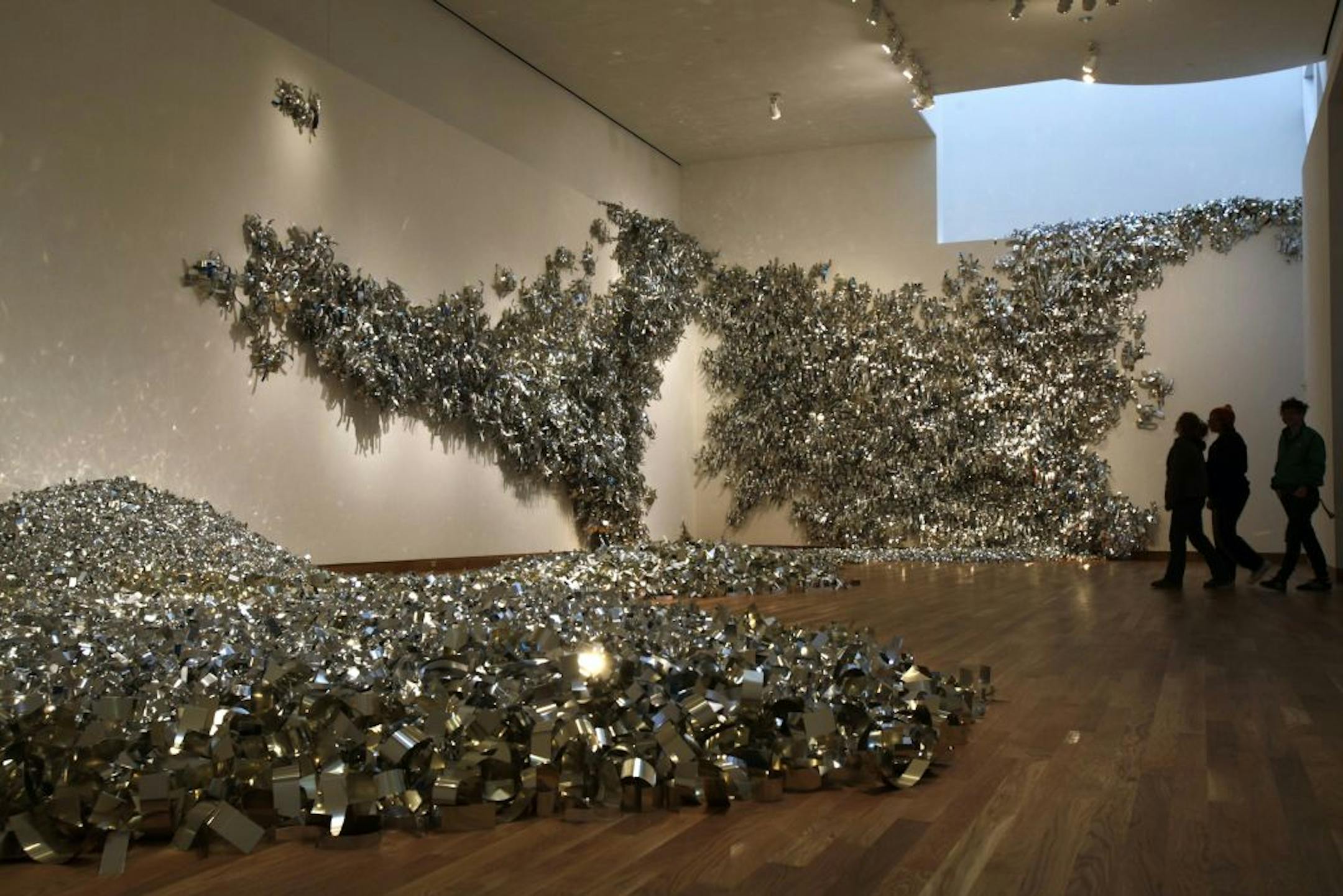
Only two of the original galleries, both near the entrance, remain unchanged. In the first, New York artist Sharon Louden and her assistants assembled "Merge," an extravagant cascade of thousands of ribbon-like strips of aluminum flashing. Curled, clumped and puddled, the aluminum pieces ripple down the walls, undulate across the floor, reflect sunlight and creep amoeba-like into the entrance hall. Alluding to the museum's gleaming metal facade, the piece welcomes visitors on a celebratory note.
In the adjacent gallery, Duluth artist Eun-Kyung Suh offers a meditative response to the museum's collection of traditional Korean furniture. She created mirage-like spaces defined by diaphanous panels of blue silk printed with old photos of Korean immigrants as they assimilate into their new communities.
The Weisman's new "collaborative studio" is nearby. Designed as a work space, the gallery has an inviting window overlooking the building's entrance plaza, where 20,000 students pass daily en route to the West Bank campus. Concrete floors, plywood-topped tables and push-pin wall displays emphasize the studio's utilitarian nature. It's now full of drawings, notes and videos by architecture firms that competed to redesign the entrance plaza. While the videos are sometimes difficult to hear, the casual, interactive display is engaging and even includes a drawing table on which visitors can sketch their own ideas.
Korean connection


