

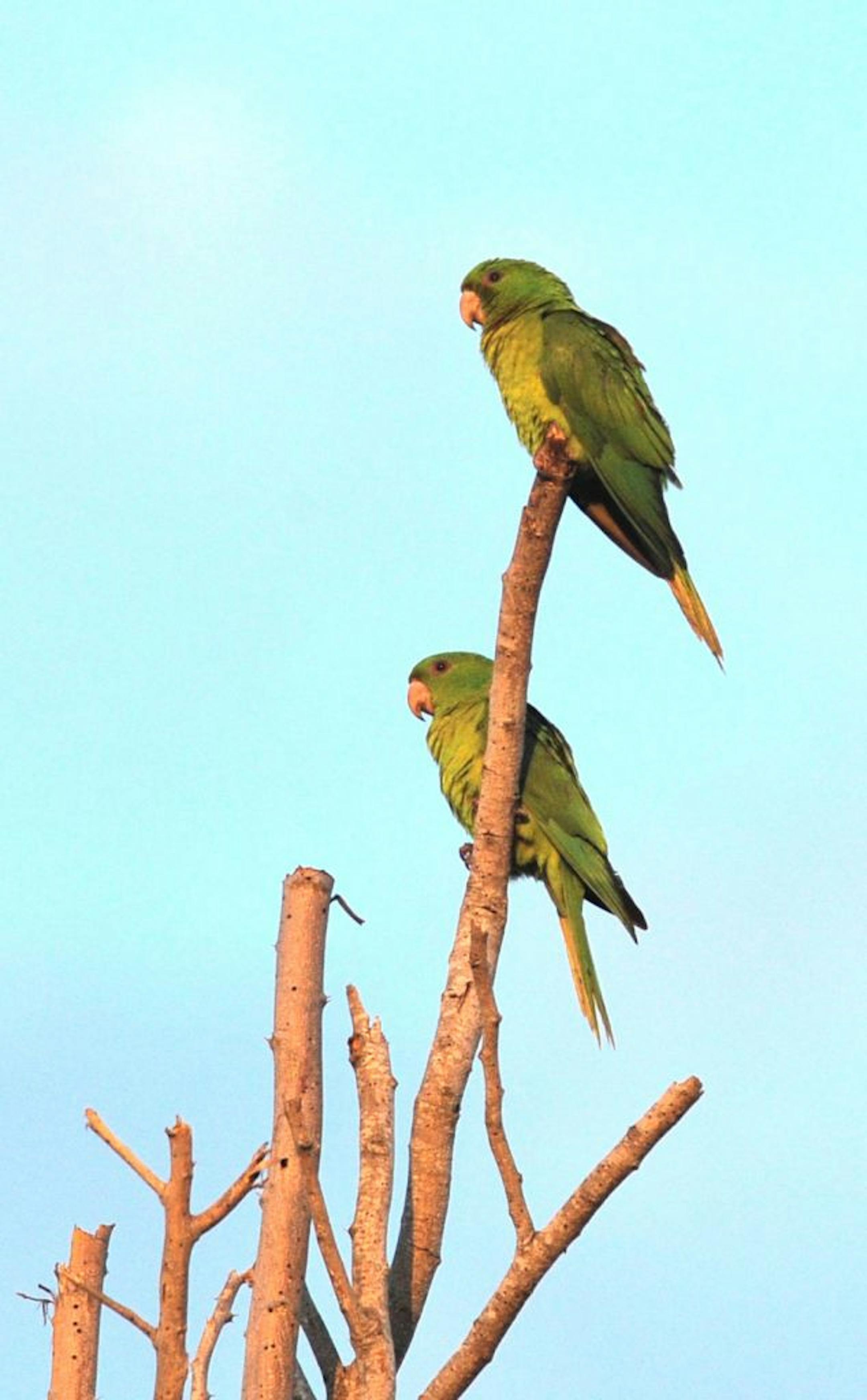
Save for the rare escapee, we have no parrots or parakeets here. These mostly are vacation-climate species. Chicago has parrots, though, as do New York City and cities in Connecticut and New Jersey. So, why not us -- why don't beautiful, noisy green birds brighten our neighborhoods?
Well, it's climate; we're not Australia, a country thick with members of the parrot family. A species of small parakeet, officially a budgerigar, is the most likely escapee here. It's native to Australia.
Sometimes called budgies, they're common cage birds. You can buy them at Petsmart in a variety of colors for $21.99 each. If they escape your kitchen, they will die outside, victims of temperature or predators.
Other parts of the country do have thriving wild parrots, none native. The new edition of the "National Geographic Field Guide to the Birds of North America" offers information on 11 species of parakeets, six of parrots and one lovebird (yes, there really are lovebirds).
Most of them are found in Florida, Texas or California.
Once the United States had two native parrot species. We killed all of the Carolina parakeets early in the past century. Those birds had a southeastern base, ranging as far west as the Mississippi River and getting as close to Minnesota as northwestern Iowa. The thick-billed parrot that once lived in Arizona in habitat shared with Mexico was extirpated on this side of the border years ago.
So, we make do with escapees. A particularly hardy and well established species, the monk, or Quaker, parakeet, actually could live here. It's a large green bird that would be a dandy addition to your feeder flock. But feelings about this bird are mixed.
Monks thrive in Brooklyn, where they are so beloved there is a club devoted to them, plus a website, http:// brooklynparrots.com.


