

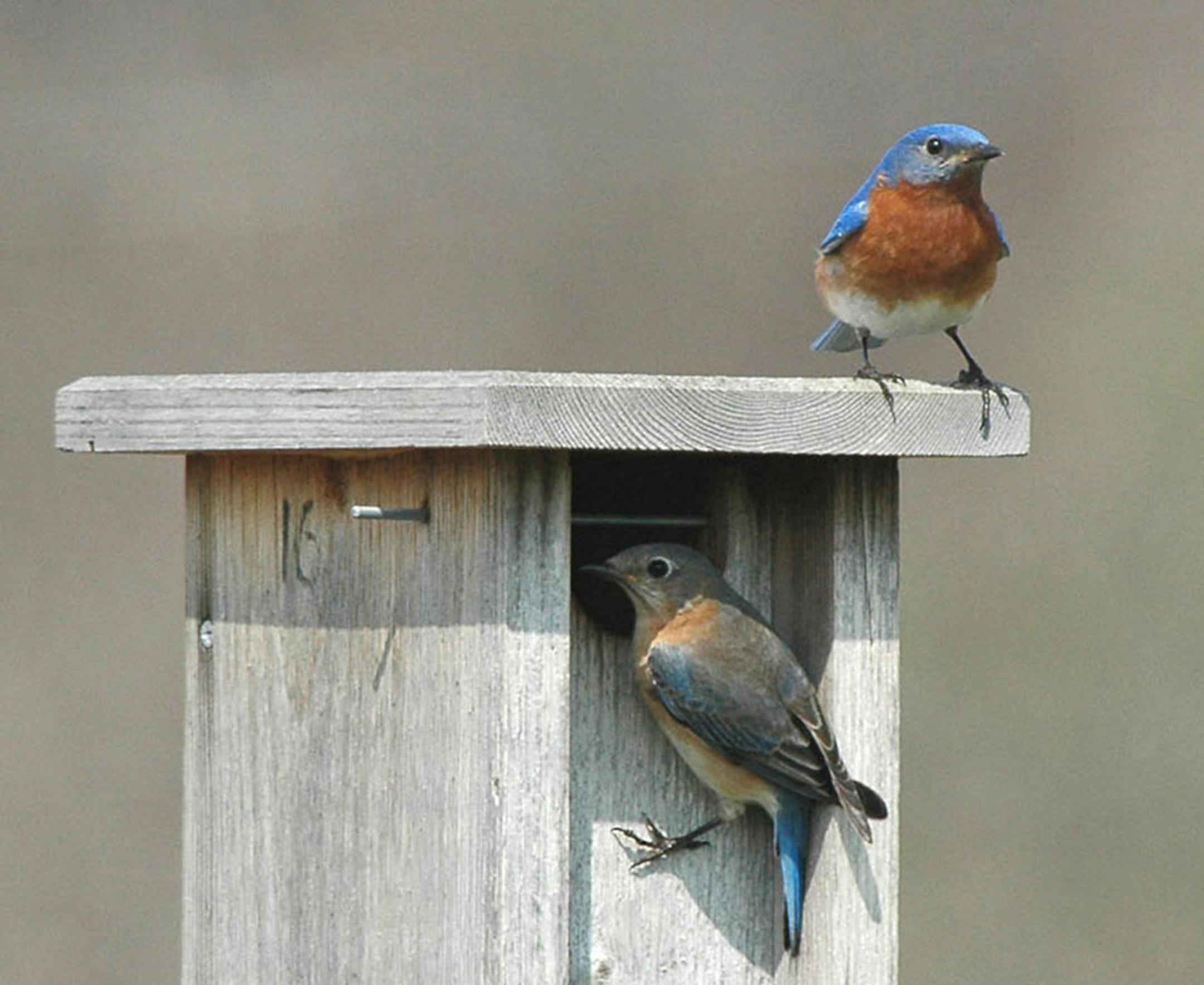
Q: I've recently moved to the city and would love to see bluebirds. Are there places I can go to see these beautiful birds?
A: I asked a couple of bluebird experts and they agreed that the north end of Cedar Lake in Minneapolis is a reliable spot. There is a bluebird trail within Como Park in St. Paul, so you might spot them there, and there are bluebird trails at Elm Creek Park Reserve, Hyland Lake Park Reserve and Carver Park Reserve. Check here (www.threeriversparks.org/parks) for directions to these parks.
Right direction?
Q: I've fixed up an old bluebird box and want to mount it on a pole, but don't know what direction the box should face.
A: I asked Mary Ellen Vetter of the Bluebird Recovery Project of Minnesota, who offered this advice: "The direction most often chosen by bluebirds, in order of preference, is east, northeast, south and west. Prevailing winds, sightlines to a safe perch, away from auto traffic, and direction of hottest sunlight, should be considered." So, to keep the winds away from your nest box, turn it so the entrance faces east, northeast or south. Bluebirds raise two broods in a season so there's still plenty of time to attract a nesting pair.
Small oriole?
Q: We had quite a few orioles at our feeders this spring, including one that was smaller than the others. It was mostly black with just a bit of orange on the chest, and I wondered if it was some type of mutation.
A: I'd bet that the smaller bird was not an oriole but instead a kind of warbler, the American redstart, which some birders refer to as the "mini-oriole." They're much smaller than Baltimore orioles, and are mostly black except for touches of orange on the wings, shoulders and tail. During our long, cold spring, a number of warblers were visiting back-yard feeders, which is fairly unusual for this family of birds.
What's with the orioles?
Q: We had so many orioles at the feeders this year — they came in nonstop for two weeks, and then they disappeared. Is this something to worry about?
A: Don't fret about the disappearance of the orioles; this is perfectly natural behavior. The large groups you were seeing in early May were made up of migrants moving through and stopping to refresh themselves at your feeders. Now the birds have dispersed to find and hold territories for nesting season. Many people report that they don't see "their" orioles again until late June or July, after the youngsters have left the nest and parents lead them to feeders.


