
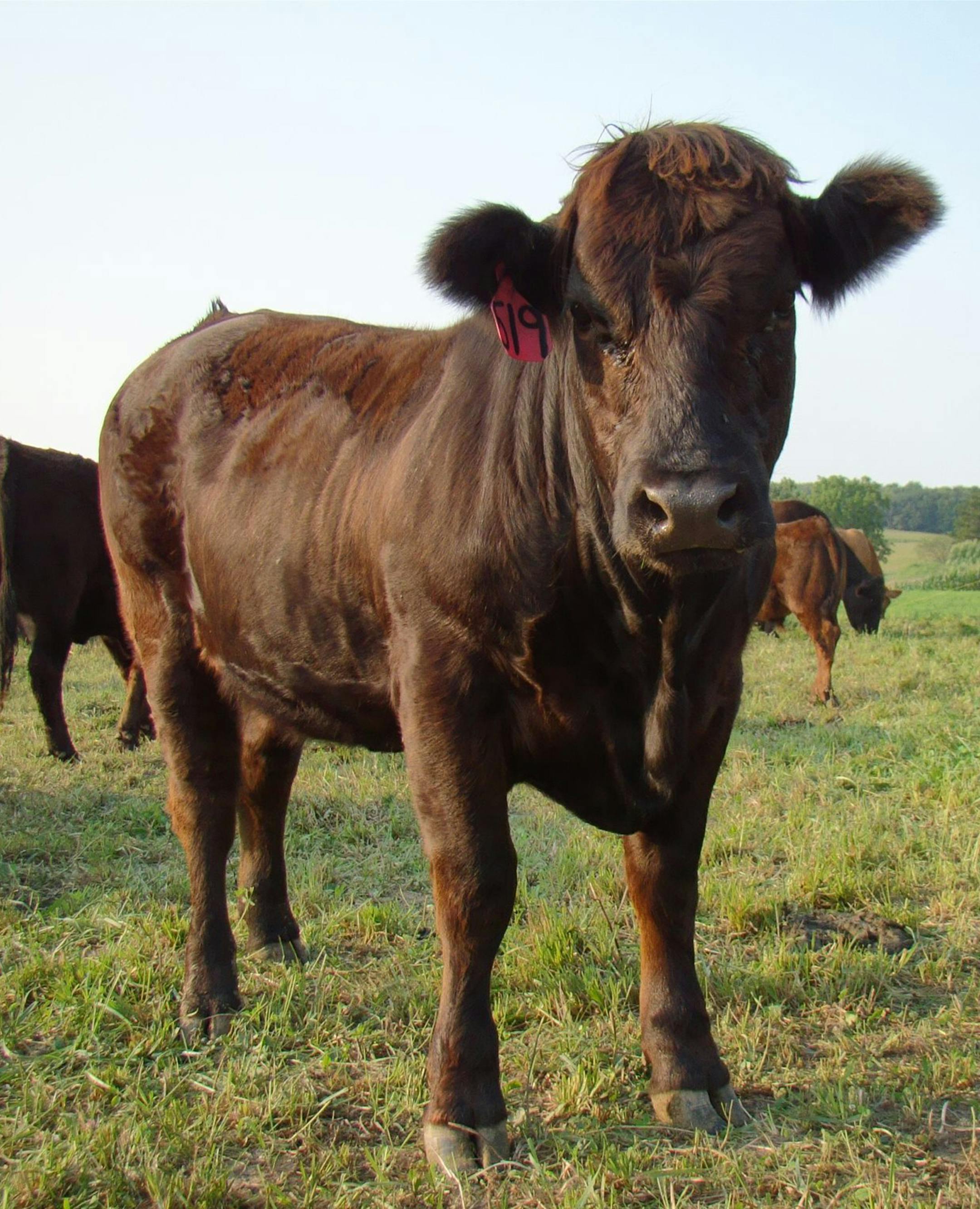
Where's the beef? Find it in Osceola, Wis.

When seeking burger-making inspiration, many Twin Cities chefs turn to a family-run farm, Peterson Limousin Beef.

January 4, 2017 at 5:13PM
Provided
Peterson Limousin Farms
Provided Peterson Limousin Farms (The Minnesota Star Tribune)

Regular readers of Burger Friday — that's my weekly examination of a must-eat Twin Cities burger, at startribune.com/taste — will have noticed a pattern, one that involves top-shelf burgers made with Peterson Limousin Beef.

Discerning chefs rely upon this family-owned purveyor for its lean, rich and flavorful ground beef, culled from the Limousin breed of cattle raised at this western Wisconsin operation. Here's co-owner Andy Peterson on ...

The Peterson family: "We farm as a family. Dad is the boss. He's the primary caretaker on the day-to-day basis. My brother and I get in and help. I do marketing and distribution, and my brother helps out on weekends. We tag-team. It's nice that our schedules fit. And our brother and sister, they're involved, too, just not on the day-to-day stuff.

"We've always farmed in the St. Croix Valley. It goes back to my paternal grandfather. They did dairy in the 1960s. In the 1970s, it was a little of everything: pigs, chickens, cows, horses, mostly a commodity cash crop. In the '90s, my family simplified, going into beef cattle, horses and a cash crop.

"Our intention isn't to grow a brand and then sell it to a bigger outfit. If people want to do that, that's fine. That's capitalism. What I always tell folks who are working with us is that I want to be able to farm with my brother for our generation, and then leave the farm to our kids, if they want it. That's our goal.

We're in it for a lifestyle. We want to be able to farm to be able to raise our families the way our parents raised us."

That French name: "Limousin cattle first came to the U.S. in the late 1960s. About 10 years later, my dad and his brothers and their families had a wide mix of commercial cattle. They liked the traits — the added muscle, for example — that the Limousin offered. Over the years, the other breeds on the farm whittled out. I like to say that I was born and weaned on Limousin beef. I always thought it was a unique eating experience.

From my viewpoint, the agriculture landscape is similar to the dynamics of the retail business. You had to get large and compete on lower costs, or you had to specialize. We specialized. That's why Limousin took over on our farm. In 2009, we moved to do more wholesaling, and to selling to chefs and restaurants."

By the numbers: "We're not a huge operation. We have two farms, one in Dresser, one in Osceola [about an hour northeast of the Twin Cities]. They're pretty close to one another. My guess is that, together, they're more than 200 acres. We typically have about 150 mama cows; that number ebbs and flows. They can live 15 to 16 years; that's what we prefer. The break-even on a mature cow is seven years. You want them to live as long as you can. Our fat cattle — the cattle that go to the butcher — they'll be 18 to 24 months. It comes down to size.

We're not a turn-and-burn operation. We're not what a typical commodity feedlot might look like. When they're ready to go, that's when they go. Some smaller-framed animals will go at 18 months, a leaner one will go at 24 months. Overall, we've got about 300 beef cattle. We get our stuff processed at Block & Cleaver Artisan Meats in Siren, Wis."

On the farm: "We follow a crop rotation system and a rotational grazing technique, so the animals always have access to grass and hay. They move in and out of paddocks. As part of our crop rotation system, we plant non-GMO cereal grains and legumes as part of a limited supplement. Crop rotation reduces risk. You can weather drought and flooding so much better. The two examples that I like to use are 2009 and 2013; they were both dry years. The pastures burned up more than we wanted them to, but our cereal grasses did really well, so that gave us some feed to get us into the winter."

Looking into the future: "We've started to incorporate pigs back into our program. We're doing a Yorkshire/Berkshire cross. We think we've got a unique composition of pig that's going to be well-received. We've also added lamb this year. We've picked up a few customers who like the availability of getting three different proteins from the same source."

What makes the Limousin breed so flavorful: "We think that there's a unique muscle fiber. They have a naturally recurring gene — it's the F94L gene — that leads to an increase in tenderness and an increase in yield. The trade-off is that it tends to be leaner. We don't always get the marbling that we want in steaks and roasts. But through mating and genetics — and that's how we improve the herd, it's not through antibiotics — we think we can keep that trait prominent and also deliver the marbling that people expect to encounter at a steakhouse. We also have a proprietary dry-aging process. It's unique to us, and totally natural. We let the beef shine as much as possible."

Why other farmers haven't jumped on Limousin: "Look at it from the industry's standpoint. Angus has dominated, for years. It's like Holstein in dairy; it's more than all the other breeds, combined. Angus puts muscle into the cattle, and it brings the marbling that people like.

We think that that fat covers up blemishes. You cover up subpar meat with more fat. But farmers have to get paid, and right now, on the large commodity scale, they're getting paid more to raise Angus. It comes down to marketing. As a breed, the Limousin brand could do a better job of talking to the consumer: about so many of its benefits, from its effects on climate change, to the fewer resources required to raise each animal. But that's a big effort, and you have to pony up. Right now, Angus has the budget."

Selling to chefs: "I don't know right off the top of my head, but I'm guessing that we probably have 30-plus restaurant customers. I haven't studied it all that much lately. You might say, 'Wow, 30 restaurants,' but not every restaurant is taking the whole carcass. Some buy flatirons, some buy skirt, some buy ground. It's great to have people on board who take different pieces. You need that breadth of a customer base to be able to move all of those pieces, so the restaurant market is crucial to farms like ours.

One of the nice things about restaurant-supported agriculture is that it allows the farmer to plan. The restaurant order is a recurring order. When we were first starting, I loved going to farmers markets. I still love to go and shop at them, a whole lot more than I like selling at them. The problem, the frustration, is that you never know what you're going to sell. You pack everything up, drive it to the market, set up and then sit there, and you never know if you're going to sell anything. You never know who is going to show up.

That's why we gravitated toward working with restaurants. They know what they want; they can predict it. And when we deliver our product, it's a sale. This business is all about planning. I mean, it takes nine months for a baby to come out of a cow. You need to plan."

Seeing "Peterson Limousin Beef" cited on some of the city's top menus: "I don't want to say that it's 'surreal.' That's not the right word. But you do pinch yourself a bit when you realize that people care enough to put our name on their menu. These chefs, they love what they do, and you can see it in the food. And they get behind the farmer. They say, 'We believe in you,' and you get that support from them. It only makes you want to work harder for them."

His favorite burgers: "I'm not trying to be a politician [laughs] when I say that I love all burgers, although I don't want to offend any of my customers by choosing one over another. I like burgers charbroiled, I like them flat-topped, I like them fancied-up with foie gras. It's all good to me. What I like most about burgers is that, when you eat one, you're satisfied. Hopefully, that is. I mean, you can leave the table and think, 'I just had a meal, I'm happy.' One thing I don't like is the grease-bomb burger. You can't taste the meat."

Veggie burgers: "I can tolerate them [laughs]. I was just joking with a chef the other day. She told me she was a vegetarian, and I told her, 'That's OK, we can still be friends.' I'm a meat-atarian so I cancel her out. Actually, I might take a veggie burger over a turkey burger. I don't want to offend the turkey people. Hey, they've got to do something with their trim, too."

Rick Nelson • @RickNelsonStrib


about the writer

about the writer

Rick Nelson

Reporter

Rick Nelson joined the staff of the Star Tribune in 1998. He is a Twin Cities native, a University of Minnesota graduate and a James Beard Award winner. 

See Moreicon

More from Minnesota Star Tribune

See More
card image
J. SCOTT APPLEWHITE, ASSOCIATED PRESS/The Minnesota Star Tribune

The "winners" have all been Turkeys, no matter the honor's name.

In this photo taken Monday, March 6, 2017, in San Francisco, released confidential files by The University of California of a sexual misconduct case, like this one against UC Santa Cruz Latin Studies professor Hector Perla is shown. Perla was accused of raping a student during a wine-tasting outing in June 2015. Some of the files are so heavily redacted that on many pages no words are visible. Perla is one of 113 UC employees found to have violated the system's sexual misconduct policies in rece