
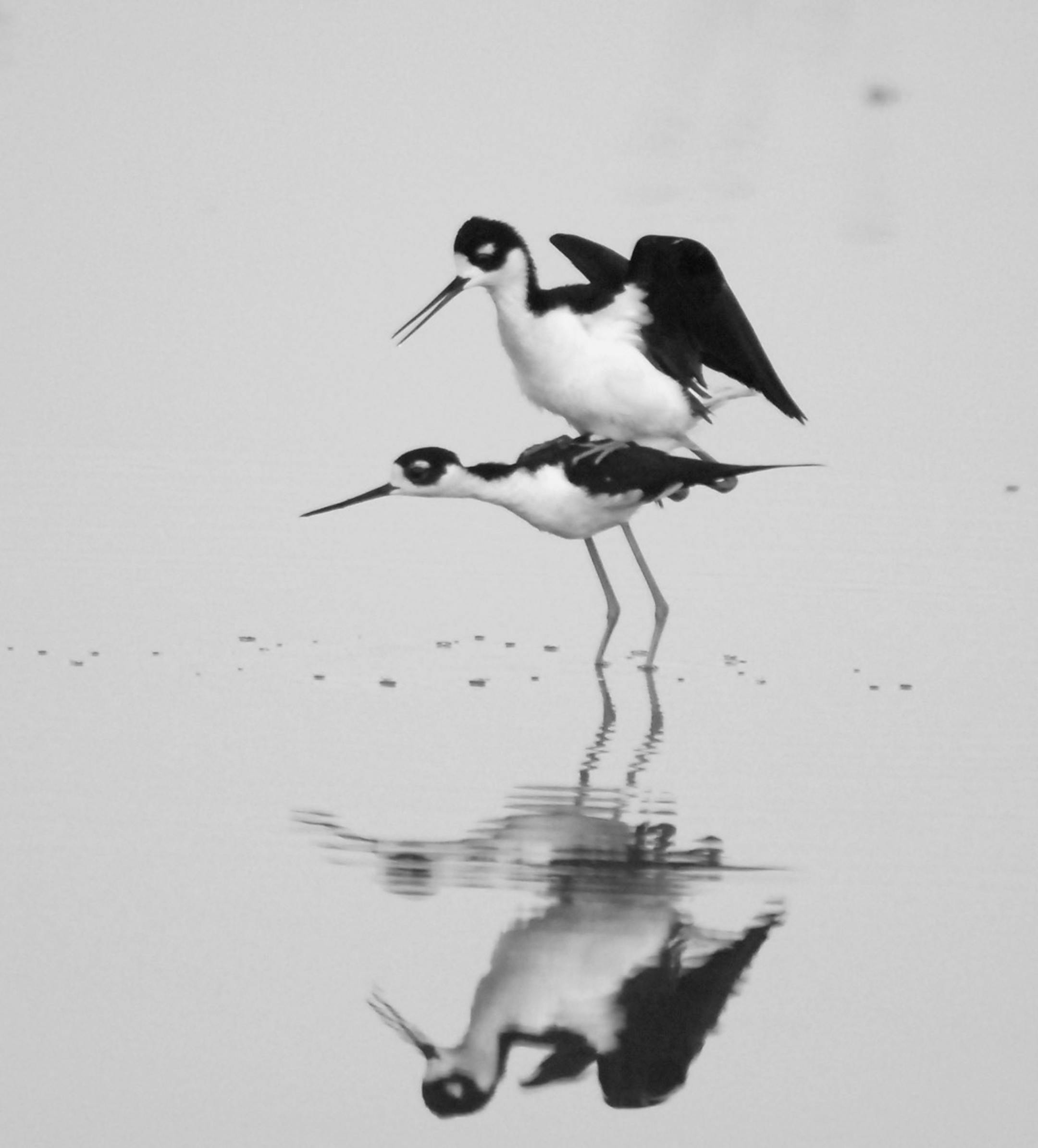
When it comes to sex, birds don't mess around

In spring, the woods are literally hopping with birds courting, mating and defending their nests.

June 3, 2008 at 10:41PM
Black-necked stilts is a species rarely seen in Minnesota.
Black-necked stilts is a species rarely seen in Minnesota. (Special To The Star/The Minnesota Star Tribune)

Six seconds. When you think of all the energy birds invest in courtship displays and protecting their territories, six seconds isn't very long.

When it comes to sex, however, birds don't waste time.

Take the female killdeer I was watching in a prairie on the Sherburne National Wildlife Refuge a few weeks ago. She seemed to be minding her foraging business, walking this way and that, occasionally picking at the ground.

Suddenly, there were two birds. They quickly approached each other. Then the male hopped up and stood atop the hen's back.

Some birds manage the mating maneuver with the female perched in a tree or bush, the male aflutter over her. Killdeer, though, remain aground, with a little teetering and wing flaps to maintain balance.

Each bird cranks his or her tail sharply to one side. This allows the male to place his cloacal opening and what bird biology books refer to as his "protuberance" against her cloaca for transfer of sperm. (The cloaca is the bird's all-purpose vent.)

This need be done only once to provide sperm for fertilization of all eggs the female will lay for the coming brood.

Six seconds later, when my killdeer had finished, the male immediately took to the air, flying a wide half-circle, calling loudly before disappearing. The female resumed her hunting and pecking. Wouldn't you know?

Walk on the wild side

The wildlife refuge was an exciting place that day. On the far side of the prairie, I took a half-mile path that includes a boardwalk over a small cattail marsh. My footsteps on the boardwalk provoked a mighty scolding from a sedge wren. In defense of his nesting territory, he was tolerating intruders of no size or shape.

It wasn't long after my encounter with the wren that I came upon a pair of sandhill cranes. Their cries of concern about my presence mixed with the hops and jumps of crane foreplay. They seemed uncertain of priorities.

Mrs. Killdeer, on the other hand, was not. After mating, she probably found a patch of gravel, where she would scratch a small depression to serve as a nest. When her chicks hatch, they'll be up and running as soon as they're dry. I hate to sound partial, but they're about as cute as birds get.

If you take a walk on a prairie path this summer, you're likely to see birds. If not killdeer, something else interesting will be there. But you'll probably have to wait until next spring to see the acrobatics of mating.

Jim Williams, a lifelong birder, serves as a member of the U.S. National Wildlife Refuge Birding Initiative Committee. He also is a member of the American Birding Association, Ducks Unlimited, Pheasants Forever and Delta Waterfowl. He can be reached by e-mail at two-jays@att.net.

about the writer

about the writer

More from Minnesota Star Tribune

See More
card image
J. SCOTT APPLEWHITE, ASSOCIATED PRESS/The Minnesota Star Tribune

The "winners" have all been Turkeys, no matter the honor's name.

In this photo taken Monday, March 6, 2017, in San Francisco, released confidential files by The University of California of a sexual misconduct case, like this one against UC Santa Cruz Latin Studies professor Hector Perla is shown. Perla was accused of raping a student during a wine-tasting outing in June 2015. Some of the files are so heavily redacted that on many pages no words are visible. Perla is one of 113 UC employees found to have violated the system's sexual misconduct policies in rece