

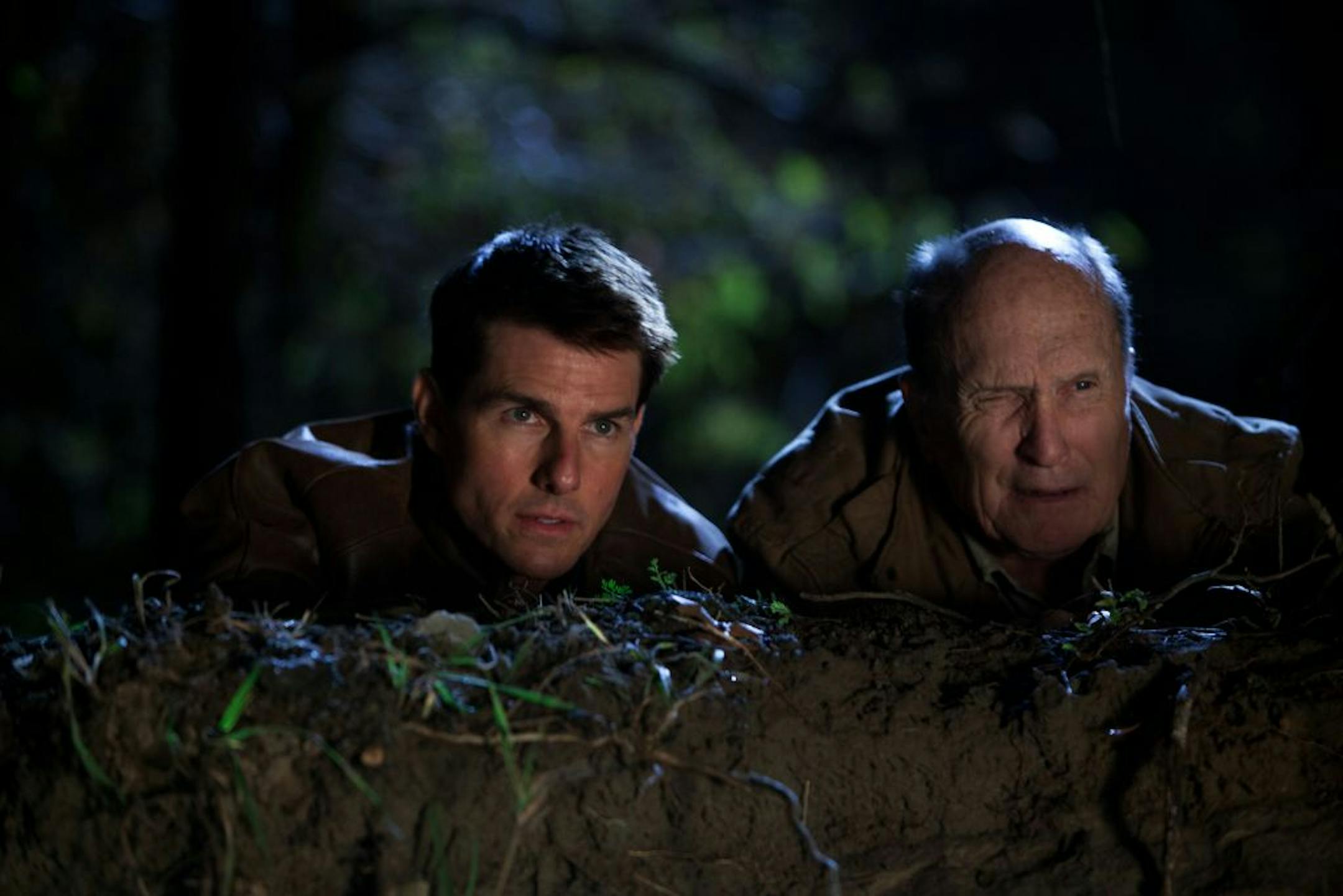
Jack Reacher, the itinerant head-butting hero of Lee Child's best-selling series of crime thrillers, has finally made it to the big screen. An adaptation of Child's 2005 novel "One Shot," retitled "Jack Reacher," written and directed by Christopher McQuarrie and starring Tom Cruise, opened Friday.
What took them so long? The Reacher books have been appearing yearly since 1997, and if ever a literary property seemed a no-brainer for the movies, it's this one. The books have a strong, original central character and taut, linear narratives, full of action and incident; they often feature strong female characters and are surprisingly popular among women; and there are lots of them -- 17 titles so far, outnumbering even the original James Bond novels.
It is a franchise built around a former military policeman roaming the United States utterly without baggage, personal or otherwise, righting wrongs according to his own no-nonsense code of justice. Writing in the New York Times, Janet Maslin called Reacher "one of the most enduring action heroes on the American landscape."
McQuarrie, who has worked on several Cruise-related projects (including "Valkyrie," which he wrote with Nathan Alexander and produced, and "Mission: Impossible - Ghost Protocol," for which he did some revisions), knows his way around Hollywood and has a very simple explanation for why it took so long to get a Reacher film made. "There are no transforming robots," he said in a phone interview. "There is no paranormal activity."
He added: "The problem is that Jack Reacher is not 22, and he doesn't have superpowers. He appears in novels that are detective thrillers, and that's a sort of movie they don't make anymore. How do you market it?"
Child, who worked as a television director and producer in England before becoming a novelist, also knows his way around show business. Not long ago, stretching out his long legs on a coffee table in the New York City apartment he uses as a writing studio, he leaned back in a chair, and, as if giving a PowerPoint presentation, suggested three reasons the Reacher books might be an awkward fit for the movies.
The first reason is -- never mind, we'll come back to the first reason. The second reason is that the books are less eventful -- or less cinematically eventful -- than they seem, because a lot of the action takes place inside Reacher's head. "His thought processes, his quirks, his intuitions are what make him interesting," Child said. "How do you get that out of his head and onto the screen?"
The third reason has to do with the stubborn nature of the character. "In Hollywood they have these unshakable conclusions," he said. "And one of them is that a character must have an arc, must go for a journey and learn something, must be different at the end. But Reacher does none of that. He never changes. He doesn't learn anything, because he knows it all from the beginning."


