

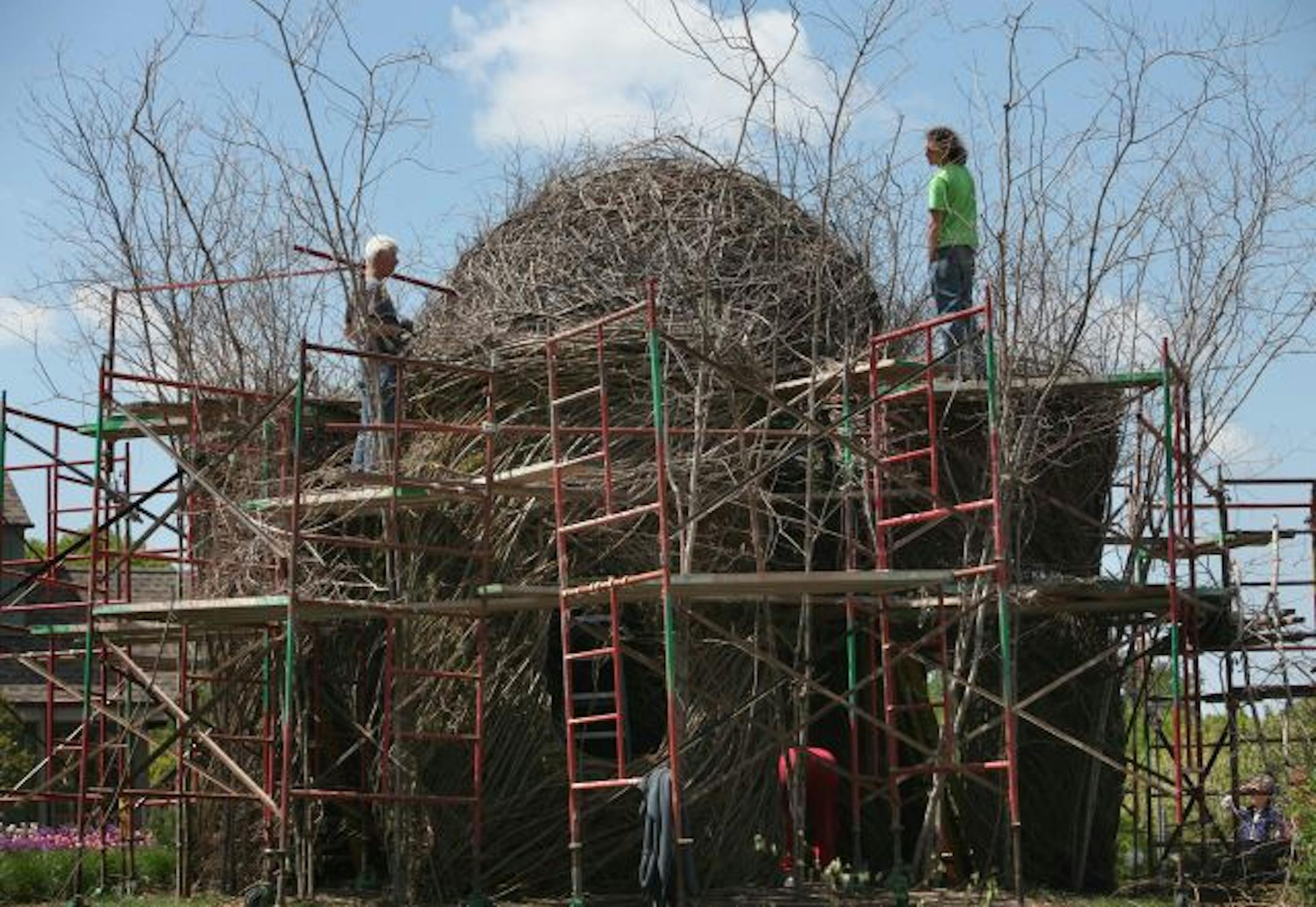
Standing amid huge bundles of willow branches, dogwood cuttings and box elder boughs, Patrick Dougherty tugged on a pair of well-worn gloves and set to work weaving branches into a two-story "castle" on a driveway island in front of the Minnesota Landscape Arboretum in Chaska. For the past three weeks the internationally known artist from North Carolina and about 80 volunteers were on a single-minded drive to make magic out of underbrush -- 6,000 pounds of spring prunings that would otherwise go to mulch. The results of their effort will debut Saturday morning in a ceremony that is a prelude to the arboretum's summer celebration of "Powerhouse Plants." Like all of Dougherty's work, the arboretum project is a fanciful mash-up of sculpture, architecture and botanical dreamscape. The structure is a temporary addition to the arboretum's landscape, expected to last about two years before it disintegrates under the pressure of weather and natural decay. Even so, it is sturdy enough for visitors to enter and explore, dodging in and out of doorways, wandering hallways under twig arches and peering up at the sky through four roofless towers hidden behind the castle-like outer walls.
Dougherty designed the structure on-site after a preliminary visit last summer to scope out possibilities. He rarely sketches his plans or builds models, but instead makes things up when he knows what materials are available.
"I'm always working through things I've thought about, but sometimes the site will change things on me," he said. "In this case I was concerned to have something that will stand against snow. I want people to be able to come onto the island and be able to go in further, to lose the sense of knowing where they are.
"But also it has lots of big openings and views, so you can't get trapped. I don't want any apprehension as you view and go through it."
During the past 25 years, Dougherty has erected more than 200 of his imaginative creations in parks, gardens and art museums from New York City to Honolulu. Abroad he's built them in Mexico, Japan and throughout Europe. His materials vary with geography and season, but there's something primordial about all of his stick structures.
In parks or gardens they look like primitive huts, witch's castles, enormous vases or nests for gigantic birds. Perched beside a reflecting pool, they may crouch like animals or twirl like dancers. For museums and galleries his designs are usually more abstract and conceptual -- wild mats of greenery that drop from ceilings, swirl down stairways and flow outside to encircle trees or embrace the pillars of a porch.
"Inevitably, there's a certain 'Blair Witch' thing going on," said Tom Rose, a University of Minnesota art professor and admirer of the sculptor's work. "Twigs and sticks tap into our unconscious fear of the forest, which is part of the fairy tale fantasy with the gingerbread house and Hansel and Gretel wandering off. You're entering into the wild, untamed aspect of nature. And there's a medieval quality to his odd, labyrinthine buildings. They're very dreamlike."
They're also very much like baskets, said volunteer Sherri West of Shorewood, who spent a recent morning threading leafy box elder trimmings into a tower wall. A basketmaker by profession, West said the random weave that Dougherty uses gives his constructions great structural integrity.


