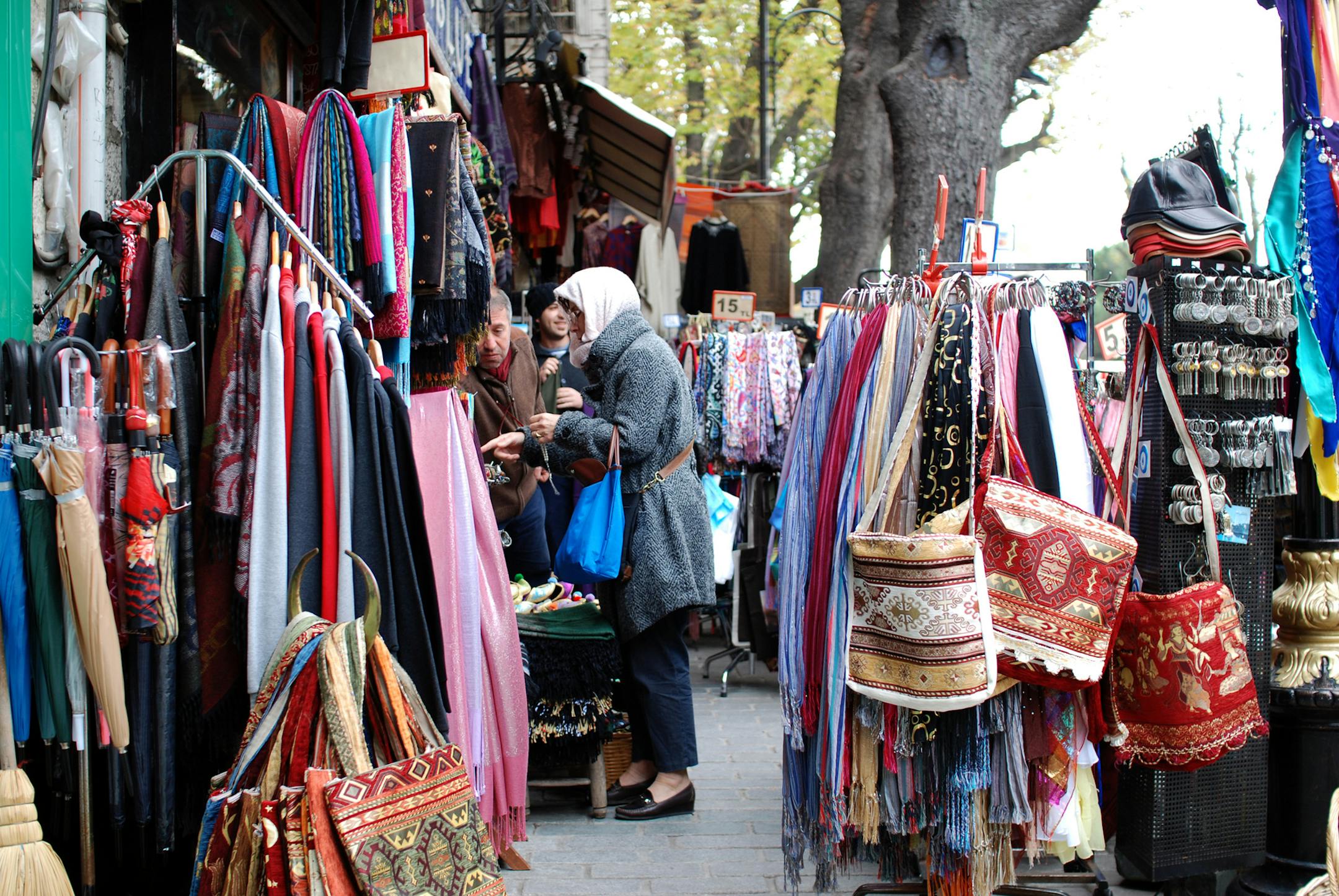
Merchants haggled with shoppers, both tourists and locals. Boys shoved and tugged handcarts that threatened to topple from an overflow of carpets. Cabbies slammed on their brakes and slapped their horns. In the whirl of the action, my husband and I were utterly lost.
Our directions were explicit: We were to meet our guide for a four-hour trip into Istanbul's Grand Bazaar in front of the Spice Bazaar, called Misir Carsisi or Egyptian Bazaar by locals. The entrance was across the street from Galata Bridge on the Old City side of the Golden Horn, landmarks familiar to travelers since the 17th century, during the glory days of the Ottoman Empire. But not to us.
We turned our map around and realized our destination was on the other side of the Grand Bazaar, also known as the Kapali Çarsi, or Covered Bazaar. Here's a smart idea, we thought: Let's cut through the bazaar itself to get to the other side. Inside, the charming shopkeepers, the shimmer of rich textiles, the glimmer of golden objects led us deep into the labyrinth of the nearly 700-year-old original indoor shopping mall. We were dazzled amid its more than 4,000 shops and 61 covered streets, teased away from our objective by the wonders to be seen. The solution was the distraction, so again we headed outside, into the sun-drenched Mediterranean light.
After five days in Istanbul, we still had trouble getting our bearings in the captivating hullabaloo that is the city. Done in by the din and uproar, we searched the piazza for an English speaker who could turn us in the right direction. The tall, blonde woman scanning the environment near the Itimat grocery looked like an Anglophone at the ready.
And she was; in fact, she was Ann Marie Mershon, our waiting guide, and — an even greater coincidence — from Grand Marais, Minn. The 260 miles between our home and hers collapsed in this ancient place.
Touring with a specialist
Ann Marie's role was more than guide to the sights. She was there to share her understanding of the place as part of a network of scholars and specialists employed by Context Travel to offer small groups — no more than six people — walking seminars built around a theme or topic. Context Travel doesn't even use the term "guide," preferring "docent." Our walk was titled "Crossroads of Commerce."
Ann Marie traced Istanbul's two millennia of international trade to its geographic good fortune of straddling Europe and Asia, forming a crossroad with the Bosporus and the Silk Road. Like all good teachers and passionate travelers, Ann Marie taught her lesson by encouraging us to see, feel, touch and taste. As we moved through the marketplace, she revealed the intriguing history behind what is essentially a business story, weaving a chronicle of traders and sailors, religious Crusaders and European adventurers, of harems and evil eunuchs, wise sultans and wily chamberlains.
With Ann Marie at our side, we plunged back into the bazaar. We discussed architecture — sadly, much of the original building has been lost as merchants, stretched for more space, eliminated columns and pushed out walls. We learned that between 250,000 and 400,000 people visit the bazaar daily. We wondered if we were skilled enough to bargain with the masterful shop owners. And we gaped at the cornucopia of leather goods, gold jewelry, silver and copper ware, carpets, antiques or antique look-alikes (more on that later) and aisles and aisles of belly-dancing costumes.