

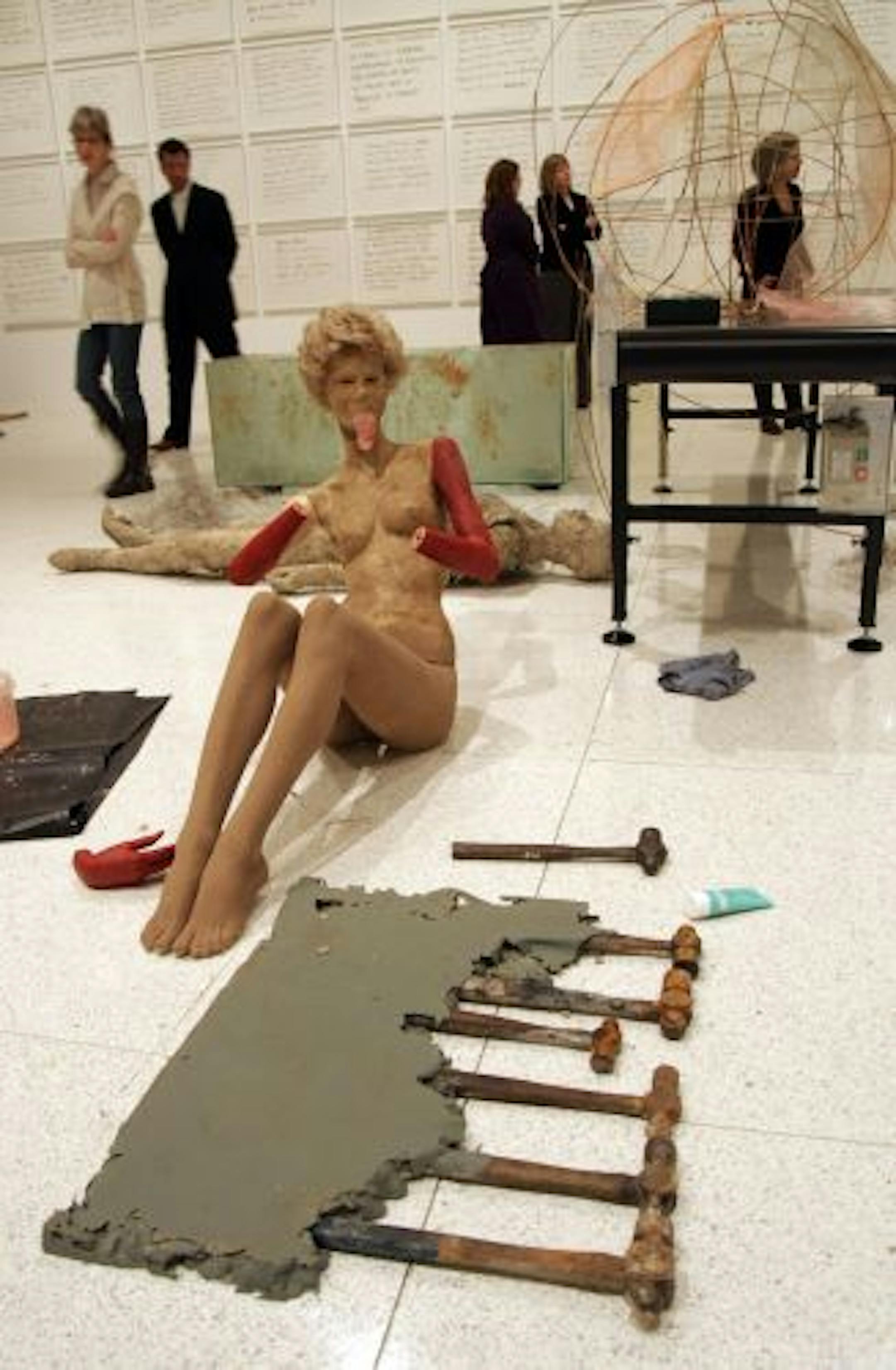
Like encounters with the more ravaged precincts of our dysfunctional planet (war zones, snuff flicks, shantytowns), Walker Art Center's new "Abstract Resistance" show ought to come with a warning label: Unsettling Stuff Ahead.
According to curator Yasmil Raymond, the common purpose that unites the 50-some photos, sculptures and installations is their intention "to destabilize the tyranny of comfort." Fair enough. If you're in search of a fuzzy-wuzzy or a play-pretty, look elsewhere.
"Resistance" is an intensely serious, cross-generational show that operates on many levels -- aesthetic, political, psychological, sexual, intellectual, visceral. It spans more than 50 years but is heavily concentrated in the past 20, a troubled time when the chosen artists seem unusually preoccupied with life's, hmmm, difficult passages. You'll encounter sculptures of a castrated kid and a car crash, photos of a kidnap victim, severed heads, blown brains and roadkill (birds, frog, toad), assorted body parts (adobe, mannequin), videos of a guy acting crazy and another poking his finger into facial orifices (eye, ear, nose), and verbal allusions to rape, genital mutilation, racism, class-ism, self-hatred, despair, rage and Eurotrash.
So, is there any fun to be had? Yes. There's an amusing plumpish block about 6 feet tall sponged with lime, coral, hot pink and other metastasizing tropical colors. It sports a Honeywell thermostat like a lapel pin, and it's called "Al Gore." Another big box splashed with pretty peach paint has a color photo of a partially eaten deep-fried dinner and a little rubber chicken on top. Concocted by Rachel Harrison, they -- and another Harrison sculpture involving a bike, a photo of Mel Gibson and some rock-filled purses -- have a fey, pop culture silliness about them that is rather winning. They offer the possibility of a giggle about such serious issues as global warming, yucko fast food and Hollywood-style celebrity.
Fun is neither a necessary nor even, perhaps, a desirable part of art. But finding a bit of it is something of a relief in this otherwise somber exhibit.
Collection on parade
Most of "Abstract Resistance" comes from the Walker's collection, and much of it has not been shown recently, if ever. The title, adapted from an installation by Swiss artist Thomas Hirschhorn, is multi-layered. In the first gallery it alludes to the resistance, by some artists, to abstraction as the art world's preferred mode of expression. Raymond neatly sets up the "conflict" between abstraction and representationalism by juxtaposing 1950s and '60s abstractions by Robert Motherwell (collage), Lucio Fontana (slashed canvas, perforated paper) and Anthony Caro (sculpture), with a ribald drawing of a woman by Willem de Kooning, a crashed car re-created in fiberglass by Charles Ray, and Andro Wekua's wax sculpture of a spunky but mutilated child standing before a geometric canvas.
Abstraction's stranglehold on the artistic imagination started to loosen in the 1970s when artists began to mock Jackson Pollock's legendary performances as a "drip" painter. Lynda Benglis poured a remarkable 1971 sculpture that is a real Pollock smackdown. Simultaneously abstract, representational and performative, it's a cascade of tarlike "Adhesive Products" that ripples off the wall like a lava flow or a bizarre sci-fi monster. Likewise, in a video Paul McCarthy grunts and rages like a nut case as he slaps and smears paint onto a phone book and the floor.


