

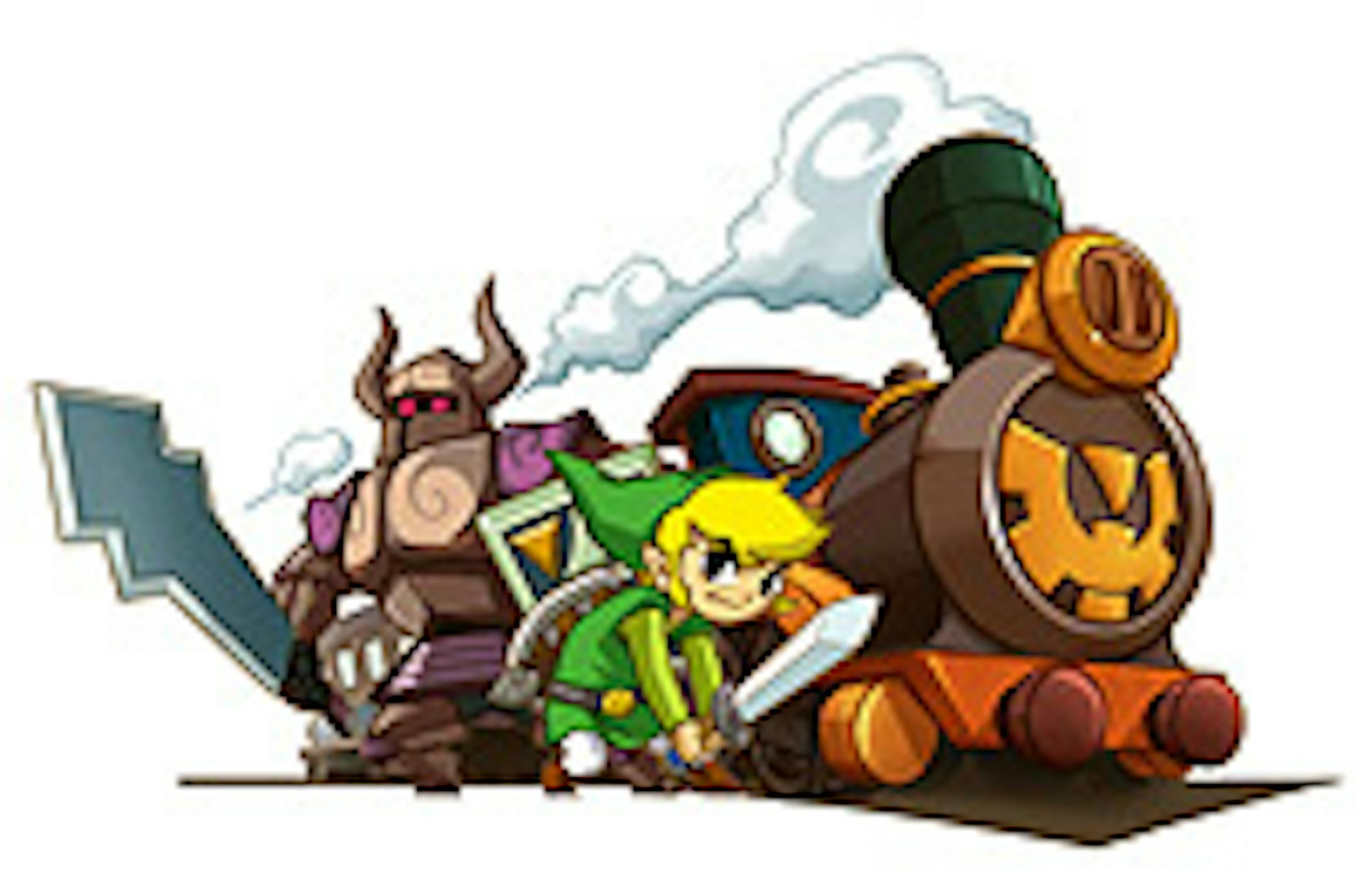
I'll just come out and say it: "Spirit Tracks" is my least favorite "Zelda" title yet and this is coming from someone who fell in love with "Wind Waker," the "Zelda" game most commonly cited as the series' lowest point. If you've made the unfortunate misstep of riding a train across the United States, you'll have a good idea where this game goes wrong. On the railway, Link's adventure embraces lengthy stretches of countryside travel with little in terms of action or variation.
You're probably saying, "this is exactly what I hated about 'Wind Waker' and 'Phantom Hourglass' sailing segments." Thematically they are similar, but the sailing retained the series' thrill of exploration allowing players to veer off of the beaten path to explore any nook and cranny whereas the train is railroaded into predetermined paths. This linearity removes exploration from the "Zelda" equation, making the world and progression feel as sterile as moving from world to world in a "Mario" game.
The train does offer a few standout moments, primarily a clever spin on the series' trademark Lost Woods. The train's touchscreen controls are nicely designed, allowing players to place precision cannon shots while keeping tabs on speed and track switching. You can also lay on its horn as much as you want. While showing a hint of promise, the train doesn't fit with the "Zelda" formula. When it's in play, it saps this journey of its excitement and wonder.
When the conductor hat is thrown to the side, Nintendo shows us that it hasn't lost a step in dungeon and puzzle design. Once again, Link's staple items the boomerang, bombs, etc., are used in ingenious ways.
Adding Princess Zelda as a controllable character further enhances puzzle and dungeon complexity. Players control the princess by drawing her movement paths.
Link's obsession with the worst music instruments in the world continues with the introduction of the pan flute. The functionality of this device couldn't have been better, as you play it like a real flute by moving the pipes to your lips and blowing into the DS' mic to activate a note. Unlike "Wind Waker," this instrument is used sparingly, mostly when you see visual clues.
Narrative-wise, "Spirit Tracks" derails in a peculiar way. The initial story setup is good. The new antagonist, a smarmy chancellor that you'd think was plucked from George Lucas' trade dispute stories, is on screen for only a few seconds before you want to whack him.
In my tenure as a game critic, I haven't come across a game that fluctuates between highs and lows as frequently as "Spirit Tracks." I often found myself taken aback by an amazing puzzle, only to be bored to death on a train moments later. Even though the path is rocky, this is still a good game. Fans shouldn't be afraid of it. The train segments could use a shot of adrenaline, and Zelda needs to shut her trap, but the puzzles and dungeons retain the game's classic charm.


