
Victorian umbrella stands were elaborate

July 24, 2020 at 1:57PM
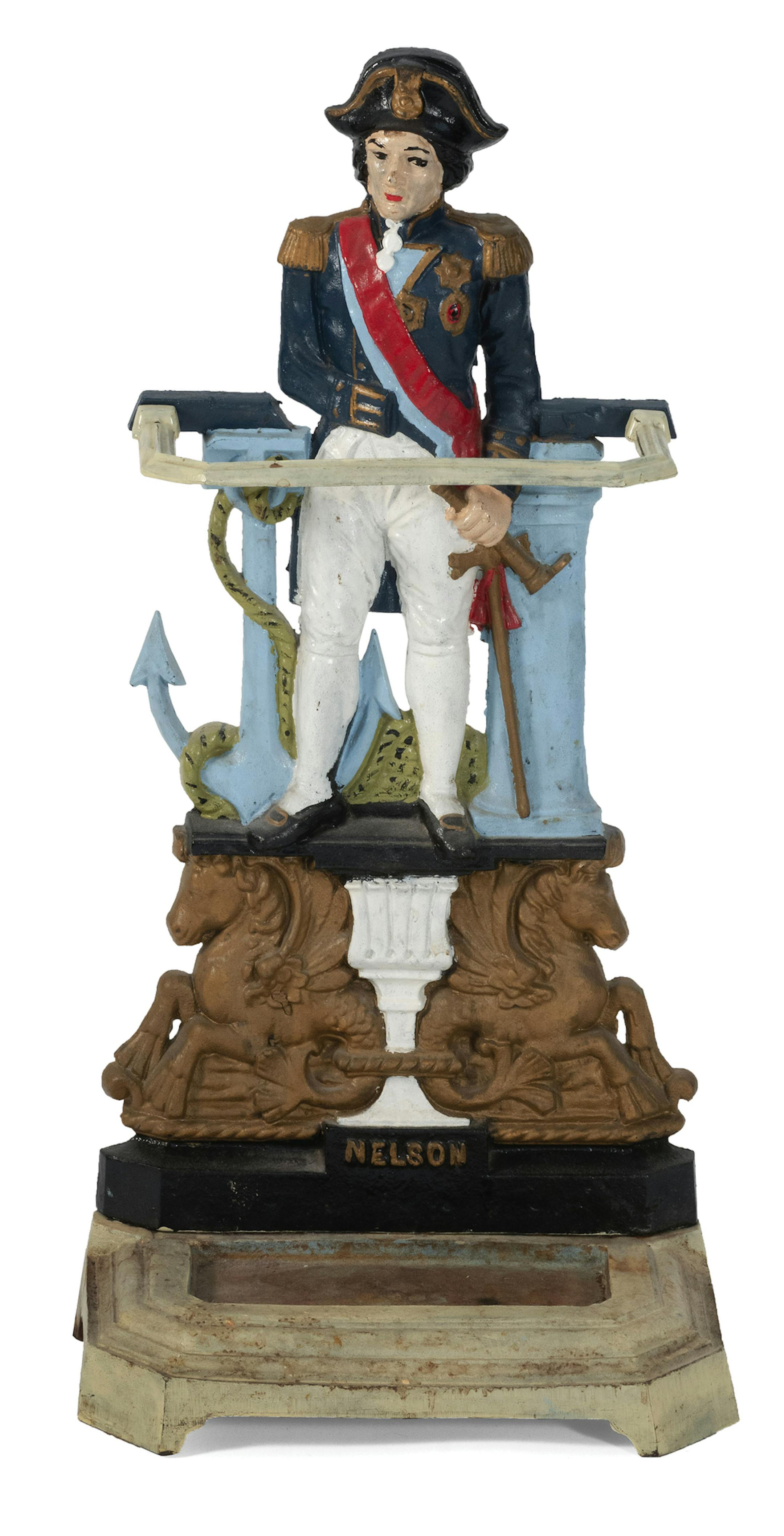
This iron figure representing Horatio Lord Nelson is part of an iron umbrella holder made for the front hall of a Victorian house. Few collectors today would recognize the man as a British naval hero who lived from 1758 to credit: Eldred's Auction House
This iron figure of Horatio Lord Nelson is part of an umbrella holder. (The Minnesota Star Tribune)

Umbrellas were invented more than 4,000 years ago in China. They were used for protection from sun, not rain.

Umbrellas became fashionable in the 16th century, when women made use of umbrellas for sun and sometimes for rain. There were few waterproof coverings.

Umbrellas were hard to store, but they were useful and needed. Large Victorian houses had an entrance hall and a new piece of furniture, the hall tree, was created. It was a tall mirror with a decorative frame with hooks to hold coats, hats, boots and wet or dry umbrellas.

Designers made vases, wire cages and other imaginative holders, shaped like people, animals, tree stumps and more, to store umbrellas. Most were made of iron or ceramics.

The most elaborate wooden stands included carved bears, while those made of cast iron were often statues of famous royalty, military men or representations of nature.

Eldred's Auctions sold an unusual umbrella stand recently. It was cast iron, a platform topped by two griffins holding a higher platform with anchors and a 4-foot-high statue of a man in military uniform. He had a folded jacket sleeve in place of his right arm, shoulder epaulets, medals and a tricorn hat suggesting a high-ranking naval hero.

Horatio Lord Nelson, a famous British admiral, lost his right arm as well as an eye from combat injuries, but still led the English navy to defeat Napoleon's navy and change history. Nelson died in 1805.

This Victorian painted iron umbrella holder depicting Adm. Nelson sold for $600. The white bar keeps the umbrella upright near the admiral.

Panama Canal plate

Q: I'd like to know what an octagonal plate with a map of the Panama Canal in the center is worth. The map is surrounded by a circle with faces of U.S. presidents from George Washington to Woodrow Wilson. It says "Old Glory" above the circle. There is advertising on the back of the plate. It has a little crack.

A: This plate commemorates the completion of the Panama Canal. Work was started in 1904 and the canal was officially opened Aug. 15, 1914, during Woodrow Wilson's presidency.

Variations of this plate were made by several manufacturers in different shapes and with different designs, though most included the map. Some include the year 1915, which was the year the Panama-Pacific International Exposition was held in San Francisco to celebrate the completion of the canal. The plates were often made as advertisements for a store.

If you can read the mark and advertising on the back of your plate, you can find out more of its history. The plates sell for about $10 to $20, but one with a crack is almost worthless.

Tip: How can you tell if a plate is cut or pressed glass? Feel the edges of the design on the glass. Cut glass has sharp edges; pressed-glass designs are molded into the glass.

Write to: The Kovels, c/o King Features Syndicate, 300 W. 57th St., New York, NY 10019. The website is kovels.com.

current prices

Prices are from shows nationwide.

Duck decoy, wood, carved, old mottled dark paint, lead weight, Cleve Dabler, Barnegat Bay, N.J., about 1935, 7 by 17 1/2 inches, $65.

Necklace, pendant, rhinestones, shades of blue, oval center stone, smaller stones surround, silver link chain, Schreiner, about 1960, pendant, 2 inches, $280.

Bank, devil with two faces, cast iron, black paint, A.C. Williams, about 1906, 4 1/2 by 3 1/4 inches, $315.

Advertising clock, Ringling Bros. Circus, Next Free Show, paint on board, stylized sun, rainbow band, white arrow hands, 1960s, 24 by 24 inches, $500.

Cut glass punch bowl, Champion pattern by J. Hoare, notched and scalloped rim, full cut skirted base, American Brilliant Period, 12 by 12 inches, $805.

Moorcroft pottery vase, Leaves & Berries, shaded yellow, red and orange, burgundy ground, bulbous, tapered neck, flared rim, signed, 10 inches, $1,000.

about the writer

about the writer

More from Minnesota Star Tribune

See More
card image
J. SCOTT APPLEWHITE, ASSOCIATED PRESS/The Minnesota Star Tribune

The "winners" have all been Turkeys, no matter the honor's name.

In this photo taken Monday, March 6, 2017, in San Francisco, released confidential files by The University of California of a sexual misconduct case, like this one against UC Santa Cruz Latin Studies professor Hector Perla is shown. Perla was accused of raping a student during a wine-tasting outing in June 2015. Some of the files are so heavily redacted that on many pages no words are visible. Perla is one of 113 UC employees found to have violated the system's sexual misconduct policies in rece