

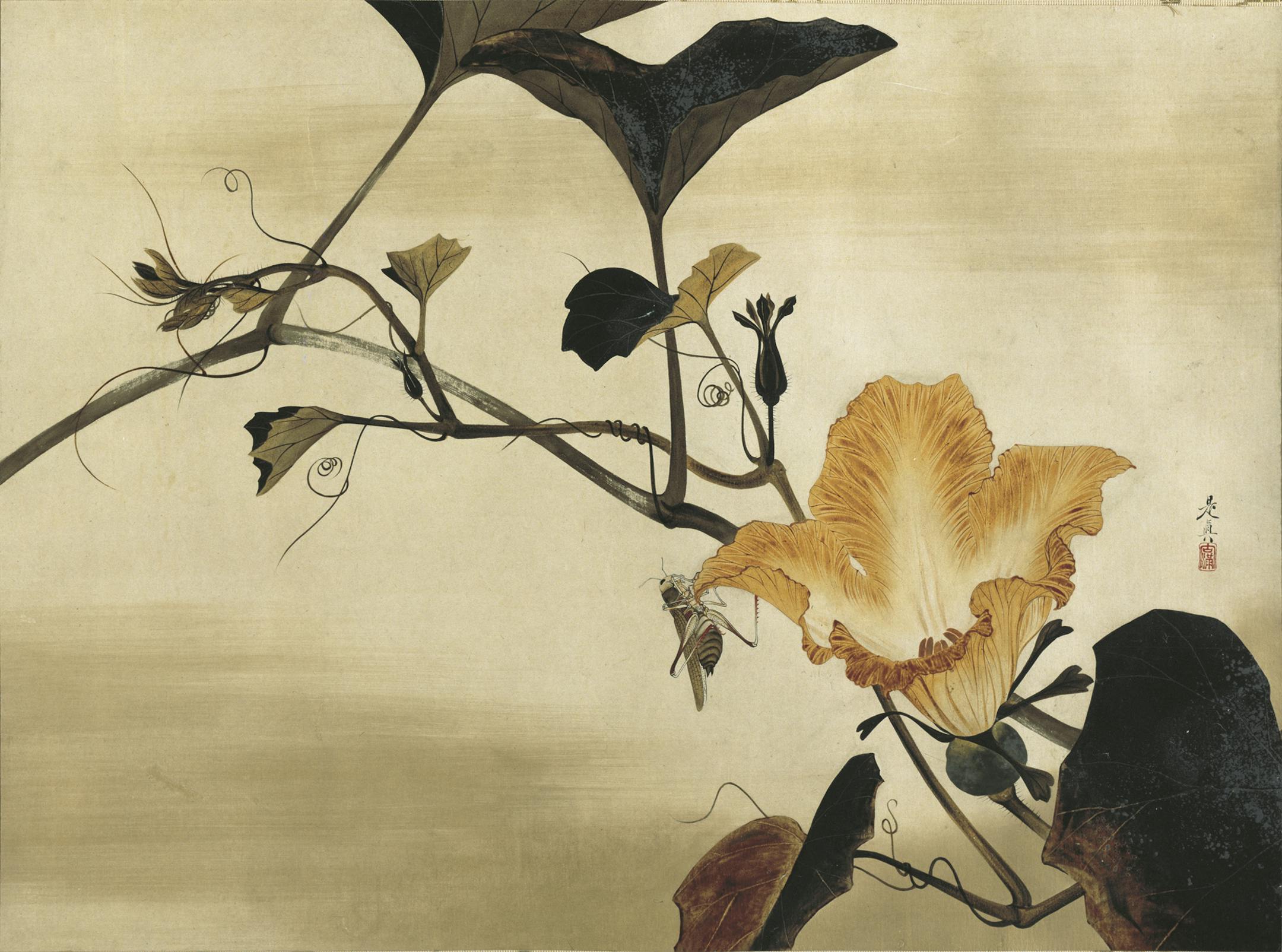
Bring a magnifying glass and an attentive eye to "Zeshin," the Minneapolis Institute of Arts' show of remarkable lacquer ware and paintings on silk, which closes Jan. 6.
Artist Shibata Zeshin (1807-1891), one of Japan's most famous 19th-century craftsmen, is known for extraordinarily subtle effects achieved with great patience, consummate skill and really strange tools. A rat's tooth, for example. Focusing the beam of a tiny flashlight onto an incense box about the size of a cigarette pack, curator Matthew Welch recently illuminated the delicate grain of the box's polished rosewood surface. Streaks of deep red glow in the wood's dark brown skin, which is marked by the whiskery fissures typical of rosewood grain. Testifying to the box's age, an almost imperceptible hairline crack has been repaired with a blond-wood cleat shaped like a bow tie and a little rough-edged metal staple. As I marveled at Zeshin's apparent woodworking skills, Welch explained that it was all a trompe l'oeil illusion. In fact, the box is made of papier-mâché coated with hundreds of microscopically thin layers of lacquer, a resinous varnish made from the sap of a tree native to China and Japan. Zeshin painted the wood, the butterfly cleat and the staple and then clinched the illusion by carving each minute fissure into the damp lacquer with a rat's tooth. "There's a Japanese concept known as iki, which refers to the cleverness and humor you see in this box," Welch said. "It is a very chic, very sophisticated object." Master manipulator
Beautiful objects of astonishing complexity abound in the "Zeshin" show, which features 57 boxes, trays, tea sets, paintings, scrolls, inr and netsuke (carrying cases and toggles), albums and other decorative objects. All are on loan from Catherine and Thomas Edson of San Antonio, whose collection of the artist's work is among the world's most refined and extensive. Organized by the San Antonio Museum of Art, the exhibit will travel to the Japan Society in New York following its Minneapolis presentation. Born in what is now Tokyo, then called Edo, Shibata Zeshin was apprenticed to a master lacquer artist at the age of 11. Unusual for the time, he subsequently trained also as a painter, learning to evoke on silk panels the shimmer of falling water and to accurately portray people, interiors and rustic landscapes. Most of the exhibition's work is undated but comes from the later years of Zeshin's career, about 1860 to his death in 1891. His work before 1860 remains largely unknown, in part because Japan was essentially shut off from trade with the West. After Japan opened to foreign trade in 1868, however, his work was shown at international exhibitions in Vienna, Philadelphia and Paris. By then he was master of his own lacquer studio and had perfected techniques that revitalized the ancient craft. By the early 1800s, Welch said, Japanese lacquer ware had become a luxurious but rather stultified craft typified by pretty scenes and standardized designs lavishly garnished with gold and silver leaf. The gilding was showy but the objects boring and predictable. In a vain effort to curb people's excessive spending on such things, the Japanese government in the 1820s and '30s passed sumptuary laws banning extravagant ornamentation, Welch said. That created a perfect opportunity for Zeshin to demonstrate his extraordinary craftsmanship. Instead of flashy gilding, he dazzled clients with technical virtuosity, turning out lacquer wares cleverly designed to look as if they were made of iron, bronze, leather, coral, wood and other materials. To achieve the effects, Welch said, the artist would sprinkle charcoal dust or powdered metals into the wet lacquer, polish the pieces with special oils or inset almost microscopic bits of mother-of-pearl. "The result was a much more subtle look that required a fantastically expensive amount of labor to produce," Welch said. A stationery box decorated with attributes of the seven gods of good fortune illustrates what Zeshin was up to. Installed in the show's entrance gallery, it is a rectangular box whose dark, greenish-black surface is polished to a dull metallic gleam and ornamented with designs that seem to be floating up from the depths. Light flickers off mother-of-pearl mosaics made of tesserae the size of pinheads and glows from symbolic brushes, mandalas, flames and leaves. A technical marvel
His luxurious inr, all made from lacquer, simulate a miniature ceramic tea caddy, Chinese ink-cakes, a metal gong and plants discreetly picked out with precious metals. He concocted simulated wooden sword sheaths from lacquer and also perfected a way of painting with lacquer on silk. The latter is considered a technical marvel because lacquer normally becomes brittle when dry and flakes off anything but a rigid foundation. Zeshin's exquisite scrolls, however, can be rolled without damage to the images. One of his most dazzling paintings, "Cricket and Flowering Vine," features an insect -- actually a grasshopper, says Welch, precisely detailed down to the patterns on its wings and segments of its belly -- clinging to the edge of a squash blossom, all delicately executed in lacquer. Throughout his work Zeshin often references the now-vanished or endangered craft traditions that still flourished in 19th-century Japan. One still-life painting features porcelain doll heads and the tools of an artist preparing them for a festival. Another depicts cowrie shells decorated with geometric designs -- a talisman often given to pregnant women to safeguard a child's birth. He also indulged in charming animal vignettes, including a cat comically scratching its ear, a rat-like deer and a plump, disgruntled toad with wonderfully scabrous lacquered skin. The show is amply stocked with grand pieces: screens, scrolls, a tea set and a stunning set of stacked boxes on which a waterfall of combed lacquer ripples through a landscape past willow trees, seasonal flowers and a water-wheel whose sails wrap two sides of the box. As dazzling as those items are, it is often the little things that appeal most to modern tastes -- an unadorned lacquer tray that simulates a pewter dish, a black crow flying across a red sake cup. Exquisite. Mary Abbe • 612-673-4431


