

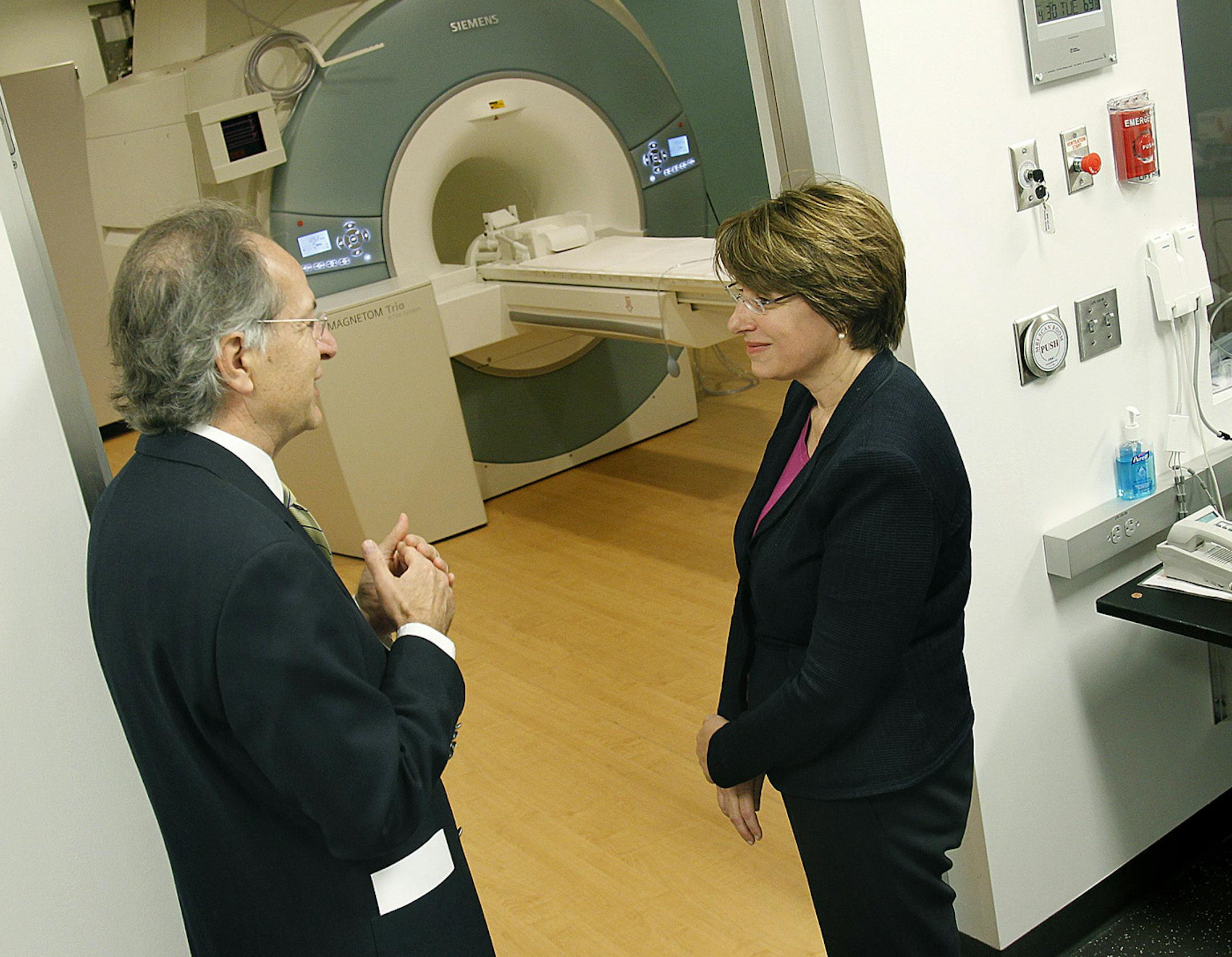
The University of Minnesota will be at the forefront of a stunningly ambitious federal initiative to map the human brain.
The director of the U's Center for Magnetic Resonance Research stood in the wings at a recent news conference in Washington, D.C., as President Obama announced that the government would spend $100 million in seed money to launch the complex, multiyear project.
Kamil Ugurbil didn't get a chance to speak with the president that day. But he and 14 other scientists from around the country will be sharing their recommendations for the initiative with the administration, complete with scientific goals, timetables, milestones and cost estimates. On Sunday, the scientists will meet in person for the first time.
On Tuesday, Sen. Amy Klobuchar, D-Minn., jumped ahead of the game and called a roundtable meeting at the U with Ugurbil and representatives of foundations that raise money for research into epilepsy, autism and Alzheimer's and Parkinson's diseases.
More than 150 people, including some of the top researchers in their fields, crammed into a classroom for a briefing on the National Institutes of Health's BRAIN Initiative, short for Brain Research through Advancing Innovative Neurotechnologies.
It's a daunting task. The human brain is made up of tens of billions of neurons. The U will participate in the initiative because it has designed and built the world's most powerful magnetic resonance imaging (MRI) devices, which allow researchers to peer inside the human body with greater and greater resolution.
"We push the envelope," Ugurbil said.
Magnetic power is measured on a linear scale known as teslas. Most hospital MRIs are 1.5-tesla devices, though some have 3-tesla MRIs that render images in greater detail. The U has two 7-tesla MRIs, and is awaiting arrival of the world's first 10.5-tesla device.


