

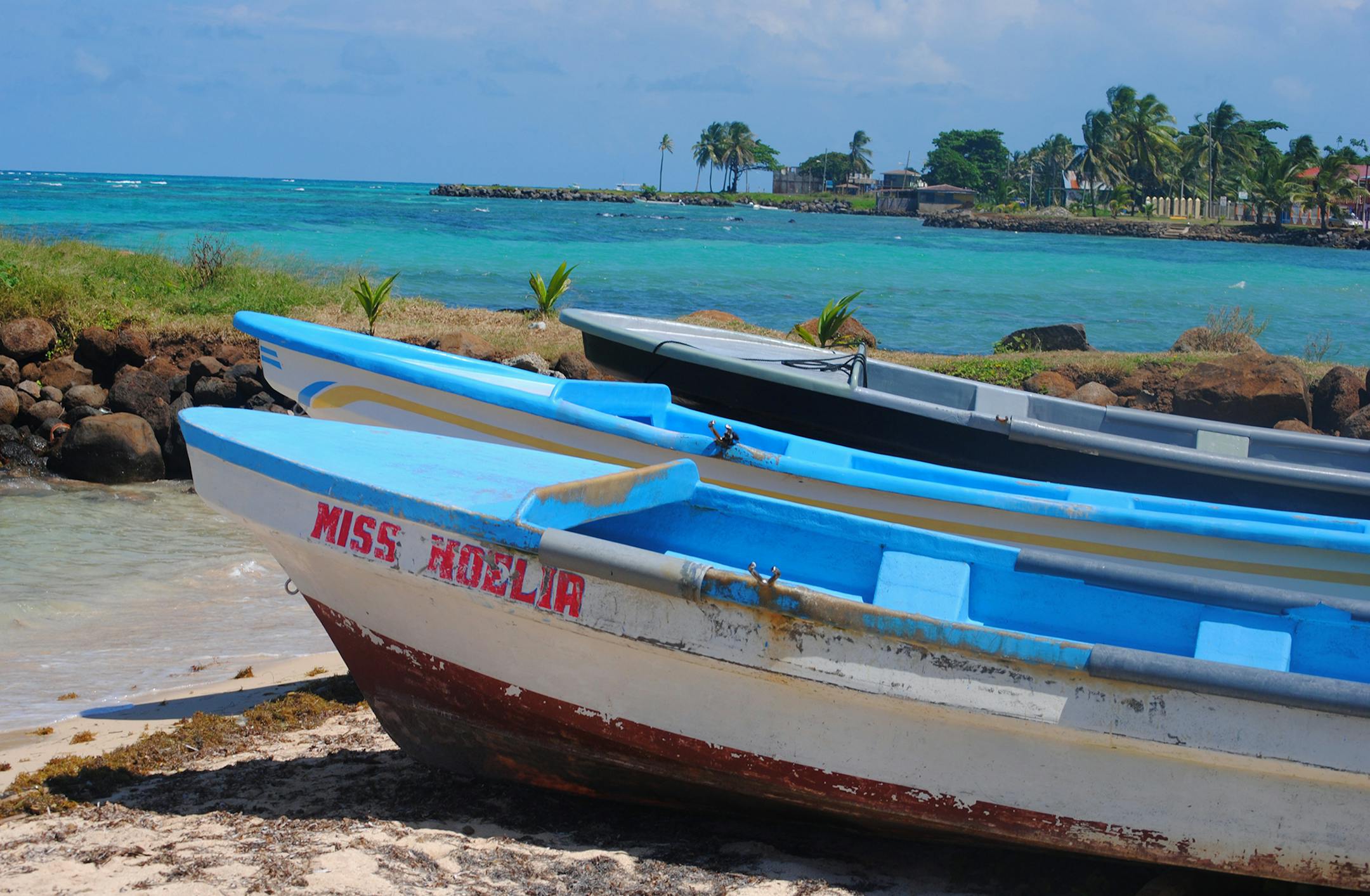
The lobster trawlers bob like toys in a bathtub, tipping to and fro with every swell of gray sea. I watch with a crowd of Nicaraguans about to board the day's last panga, or public ferryboat, wondering whether the storm is as bad as it looks.
The word I keep overhearing is "angry." In Spanish, English and a Creole that sounds like English flipped inside out and set to a beat, everyone's calling the sea — our only highway — angry.
Such is the medley of languages 40-some miles off the coast of Nicaragua, on the Corn Islands. For centuries, these two landmasses had little to do with mainland Nicaragua. It wasn't until 1894 that the country claimed these fringe islands, but with no roadways linking the capital to the marshy eastern coastline, the Corns remained a world apart. To this day, islanders play more reggae than salsa, and every August, around the 27th, the day the slaves were emancipated, they crown another local beauty island queenla at a festival featuring crab soup.
There's a Big Corn and a Little Corn, and the traveler's first quandary is to pick her Corn. I say quandary, because these islands are different in both style and scale ("big" means 6,000 people; "little" fewer than 1,000) and what separates them is about 10 miles of often turbulent sea. My plan was to depart for Little Corn as soon as my puddle jumper landed on the bigger island. The reason was simple: In every story I'd read about Little Corn, the writer sounded a little shocked by how totally the place calmed him. Clearly, Little Corn cast a particular spell.
But watching palm trees bend back in the rainy wind, I wonder: Do I really need to sleep in Eden tonight?
"Hurry!" Our captain cuts off my doubts and sends us all running with fire-drill panic toward our thrashing panga boat. I'm seasick before it leaves the dock.
At last, the captain takes aim at a skinny band of beach, and we're told to leap off the back of the panga, toward the kelp-strewn sand.
There are no cars on Little Corn. No buzz of motorcycles, no throttle or honk disturbs the air. Waves awoke me early, in a cerulean blue shack perched above the southern shore of Little Corn. Such is lodging at Casa Iguana, which borrows well from the palette of Corn Island homes — purple, turquoise, the deep yellow of ripened mango. It's tucked back in a carefully manicured jungle, where hibiscus vines dome over damp dirt pathways. My shack-for-one, rustic and yet so ready for me (flashlight, mosquito net, three novels in a pile), invited the delusion that I could just stay here and live, overlooking an empty beach.


