

Common sense says that you need to head for a major museum to see important work by top artists such as Durer, Rembrandt or Picasso. Or you can go to the Minneapolis headquarters of Thrivent Financial, an insurance and investment advisory firm where 35 impressive pieces by many of the greatest names in European art are on now on view in a handsome gallery.
Called "Faithful Impressions," the show features etchings, engravings, drawings and a few paintings on Christian themes spanning 500 years. An accompanying book, with insightful prose to match its beautiful design, is on sale at Thrivent's website.
The collection was assembled over the past 30 years by the Rev. Richard Hillstrom, a now-retired Lutheran minister who acquired the art for Thrivent, formerly known as Lutheran Brotherhood.
While the 800-piece collection is rooted in the Lutheran tradition, it embraces a multi-doctrinal spectrum of talent including Durer, Rembrandt, Lucas Cranach and their mostly Protestant northern European contemporaries, along with Guido Reni, Guercino, G.D. Tiepolo and other dominantly Catholic Italians of the 16th to 18th centuries. From the 19th century it features English mystic William Blake and French academician J.A.D. Ingres and his compatriot James Tissot, among others. Prints by early-20th-century German expressionists Franz Marc, Emile Nolde and Max Pechstein are included, along with a rare "Crucifixion" painted by American artist George Wesley Bellows.
That all these talents produced "Christian" imagery is amazing, especially such a prominent hedonist as Picasso. In fact, his 1947 lithograph is a vivid interpretation of the Old Testament tale of David and Bathsheba, in which the king peers lasciviously over a parapet to spy on a bevy of buxom ladies in 18th-century gowns. The period costumes give an operatic air to the scene, but Picasso's energetic scribbles and bold black-and-white inking are thoroughly and engagingly modern.
So, too, is Marc's 1912 woodcut "Versöhnung (Reconciliation)," which depicts in a proto-Art Deco style a tender spiritual reckoning between an estranged couple in an exploding cosmos. Along with Nolde's harrowing 1912 woodcut of a gloomy "Prophet," and Pechstein's angular 1921 interpretation of prayer, "Faithful Impressions" updates traditional Christian themes with raw 20th-century attitudes.
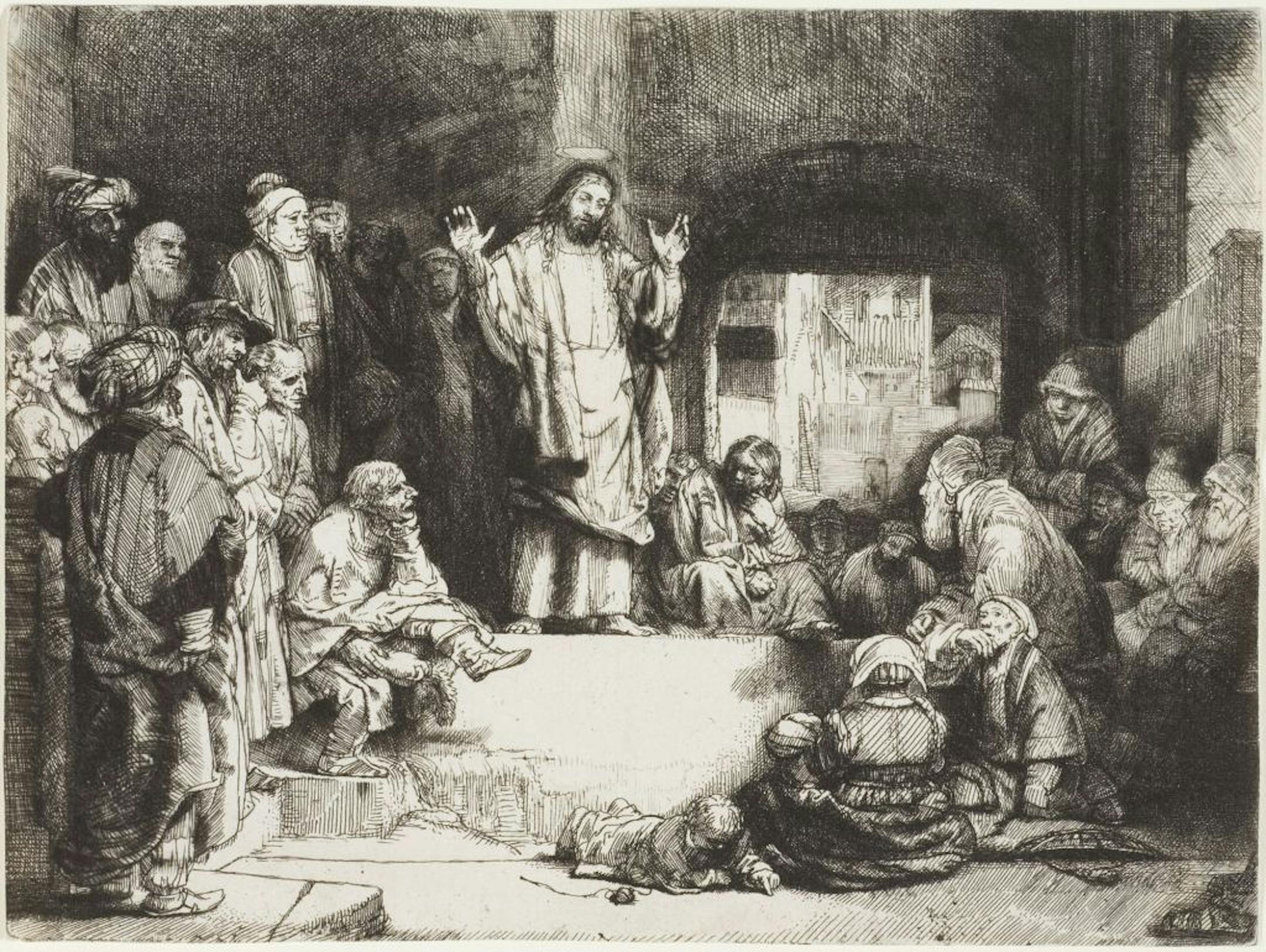
Not surprisingly, Durer and Rembrandt are the stars of Thrivent's collection. Both invested religious imagery with tender human emotions and keen observations of daily life as well as terrible agony. The baby Jesus in Durer's 1514 "Madonna by the Wall" is no heaven-sent cherub but a squirming grump who obviously wants to scramble off, not pose in the sturdy arms of his patient mom, whose fur-lined cloak is exquisitely detailed. Durer's "Four Horsemen of the Apocalypse" is a sci-fi horror of thundering steeds trampling peasants underfoot as they are whipped on by the Conqueror, War, Famine and Death.
The deep and universal humanity of Rembrandt's 1652 "Christ Preaching" is especially striking. Standing on a stoop in a Dutch market town, Jesus is surrounded by a motley gathering of international types in turbans, hoods and bonnets, all -- including a boy drawing in the dirt -- mesmerized by his message.


