

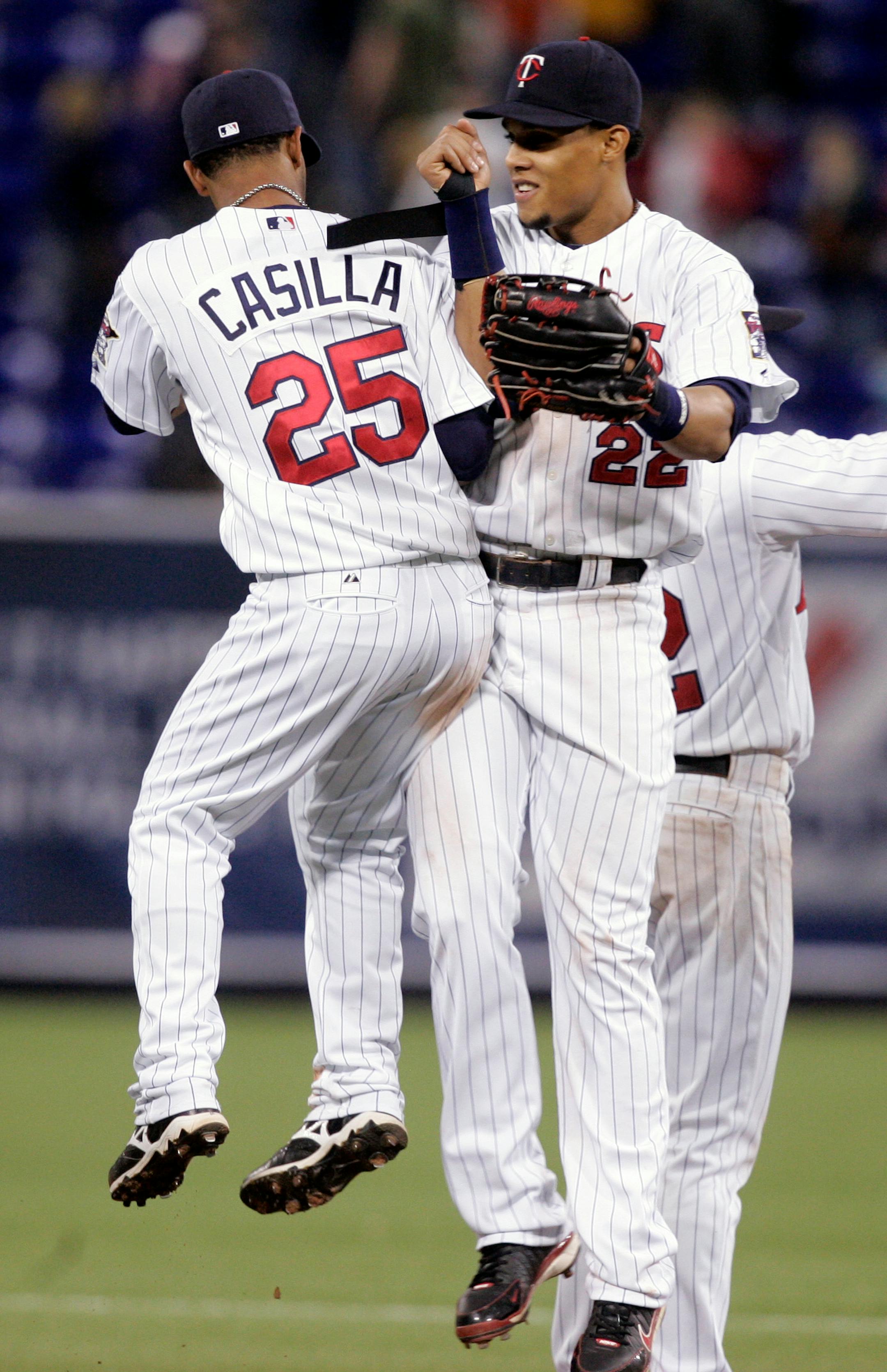
Carlos Gomez took a rip at a Mariano Rivera fastball in the bottom of the ninth inning Friday, looked down and realized most of his bat had evaporated, leaving him with a shard of handle the size of a piccolo. Gomez then struck out, finishing an 0-for-5 night, and the Twins lost to the Yankees, 6-5.
What matters more in the context of the endless season is that the Twins have settled on a top-of-the-order combination that could make fans intent on catching the first inning of every game the rest of the year.
When the Twins returned to relevance early this decade, they did so with a young, athletic group of players. Their speed on the bases and in the field helped offset their lack of power.
As the decade progressed and players such as Doug Mientkiewicz and Luis Rivas were winnowed from the roster, a new group of core players began rising through the system, promising to transform the lineup into an intimidating group of sluggers.
That transformation never occurred. Justin Morneau remains the Twins' only true power hitter, and even he keeps his average healthy by delivering opposite-field singles. To date, Michael Cuddyer, Jason Kubel, Delmon Young and Joe Mauer have failed to produce the kind of power that would alter the Twins' reputation as a slap-hitting team relying on pitching and fielding.
While the shift to power has stalled, the Twins, to conform to manager Ron Gardenhire's ideal, have already begun transitioning back to youth, speed and fielding. In the post-steroid era, youth, speed and fielding might be the way to go.
Gomez is the Twins' most exciting player since the young Kirby Puckett. Alexi Casilla, called up because of injuries to Adam Everett, Nick Punto and Matt Tolbert, is the prototypical Twins second baseman -- a speed player with excellent range, a strong arm and the ability to bunt.
Gomez and Casilla will make mistakes of youth and exuberance. They are also capable of making this a dynamic lineup in the spirit of the mid-'80s St. Louis Cardinals.


