

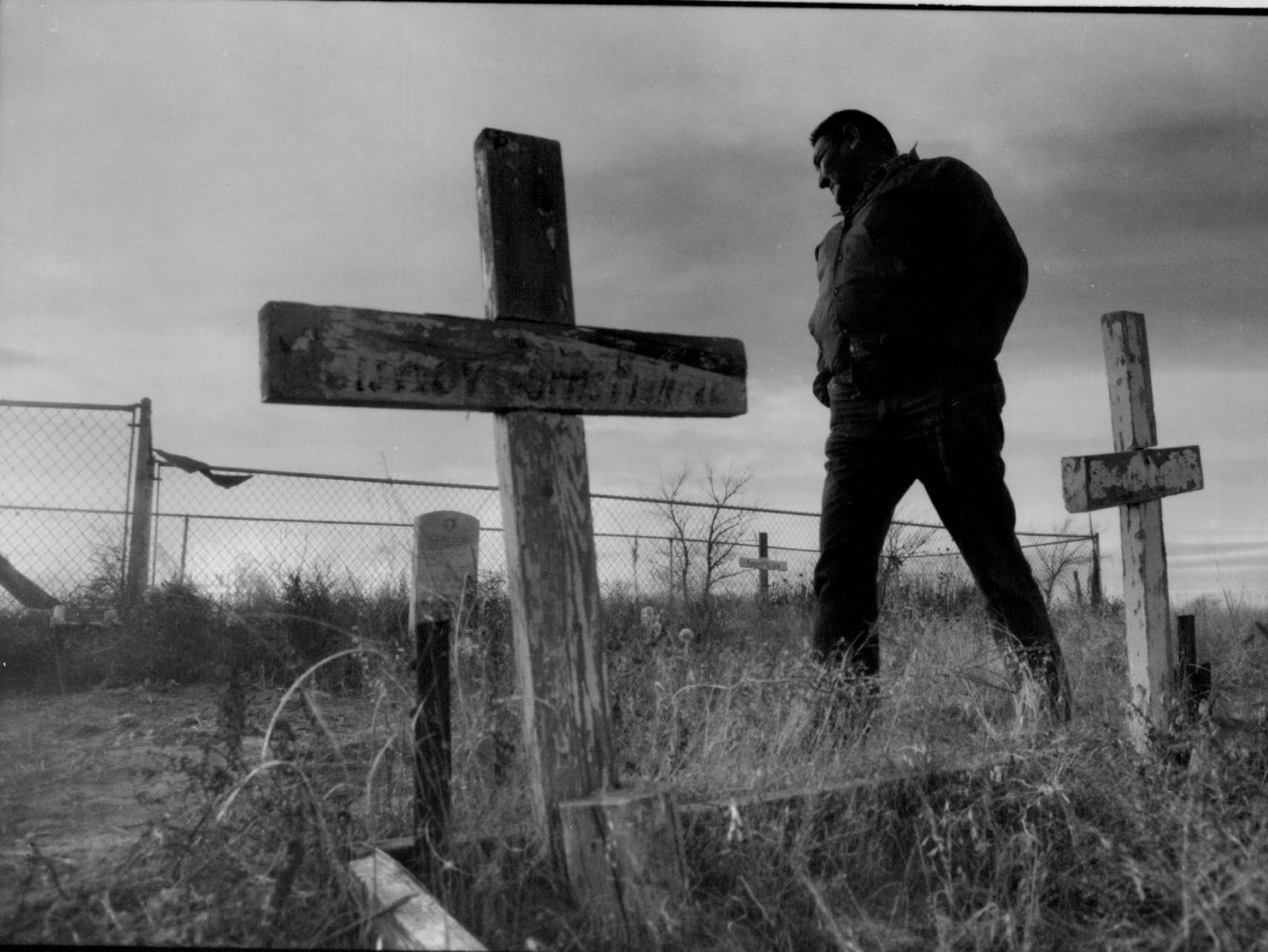
One hundred years after U.S. soldiers killed and maimed hundreds of Sioux men, women and children at the Wounded Knee massacre in South Dakota, Congress formally apologized in 1990 by expressing its "deep regret on behalf of the United States."
On Sunday night, President Donald Trump used that same massacre as a punchline in his latest broadside against Sen. Elizabeth Warren, D-Mass., the Democratic presidential hopeful whom he regularly calls "Pocahontas" in jeering reference to her claims of American Indian heritage.
Alluding to a Warren video, Trump wrote: "If Elizabeth Warren, often referred to by me as Pocahontas, did this commercial from Bighorn or Wounded Knee instead of her kitchen, with her husband dressed in full Indian garb, it would have been a smash!"
Critics found that message jarring, even from a president who has repeatedly ignored calls from politicians on both sides of the aisle, historians and American Indian groups to stop calling Warren "Pocahontas."
"Plus 300 of my people were massacred at Wounded Knee. Most were women and children," tweeted Ruth H. Hopkins, a Dakota/Lakota Sioux writer who has been a contributor at Teen Vogue, the Guardian and elsewhere. "This isn't funny, it's cold, callous, and just plain racist."
Trump's tweet came amid another extraordinary late-night Twitter barrage as the president — battered by public blame for the ongoing government shutdown and new bombshells about his links to Russia — also lashed out at Washington Post owner Jeff Bezos and quoted from a racially charged immigration column by Pat Buchanan.
Attack on Warren
His attack on Warren, who officially jumped into the 2020 presidential race last month, drew perhaps the biggest reaction online thanks to its invocation of a particularly disgraceful chapter of U.S. history.
In late 1890, 470 U.S. soldiers intercepted a group of Chief Big Foot's Sioux, who had been heading south across the Plains toward a refuge, according to an account by Mark Hirsch, a historian at the Smithsonian's National Museum of the American Indian. The soldiers led the Sioux, who had 106 warriors and roughly 250 women and children, to a camp at Wounded Knee Creek.


