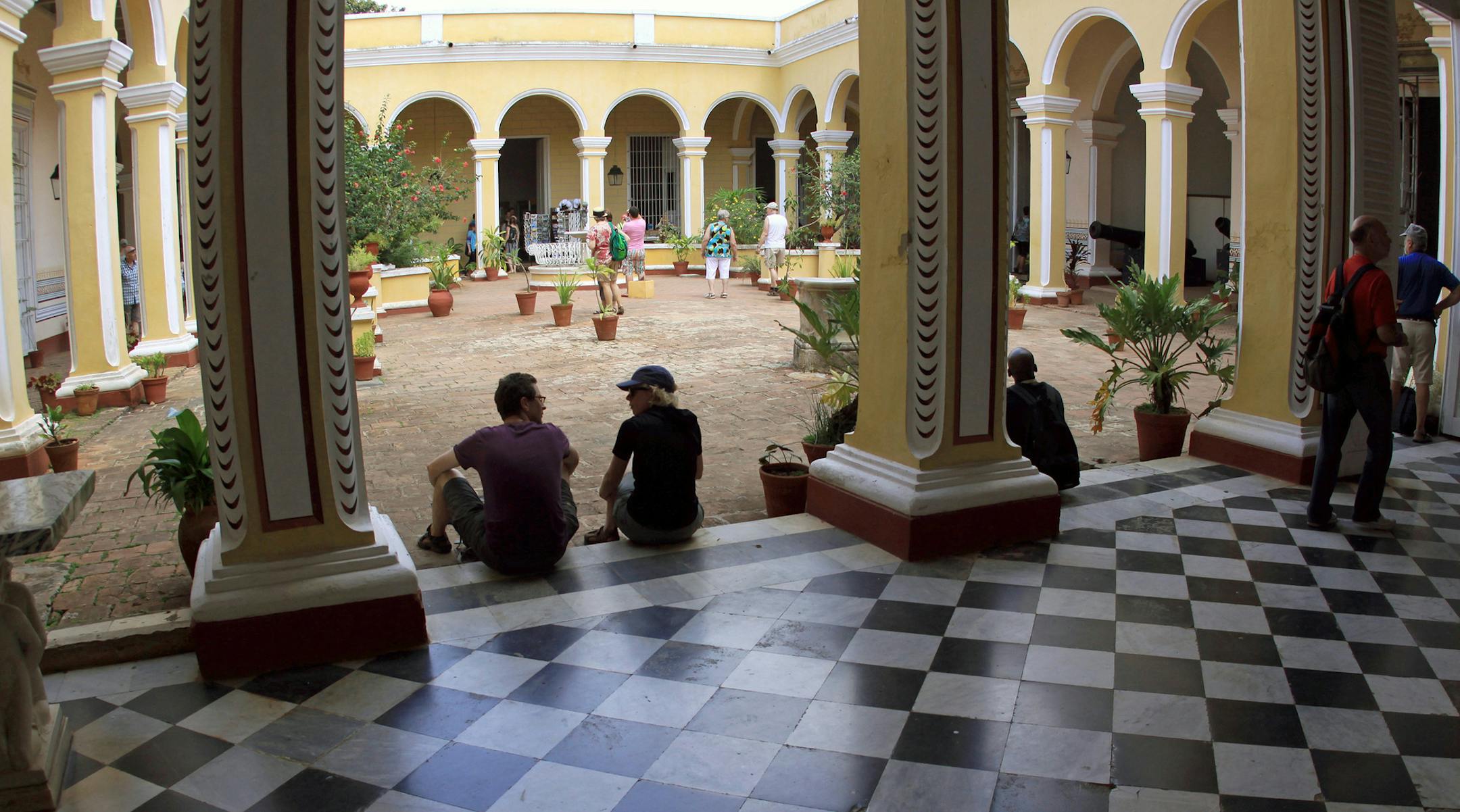
The streets were dark, the cobblestones ankle-twisting as we picked our way through the colonial town of Trinidad, Cuba. The tall barred windows typical of the 18th- and 19th-century houses revealed scenes of domestic life — a child, a dog, an old man in a rocking chair — and of the muraled and tiled walls inside. Doorways opened to restaurants and bars and the music that is everywhere in Cuba — the driving beat of Afro-Cuban here, the swing of salsa there, the lagging rhythm of son (rhymes with tone), the style made famous by the Buena Vista Social Club.
Trinidad is a town that time passed by, blessedly preserving the architectural charms of an earlier day. No roads connected this World Heritage Site to the outside world until the 1950s, so more than a thousand colonial buildings remain, their faded grandeur hinting at the slave economy of the sugar plantations that flourished here until the 1850s. No modern incursions mar the stone streets strewn with horse-drawn carts, pedestrians and a few cars and tourist buses.
But Trinidad is far from fossilized. Inside the stucco and frame walls of the former villas of plantation owners, everyday life thrives. Some now pulsate with the sound of music and the beguiling atmosphere of Cuba's hottest tourist attraction: private restaurants called paladars. In a two-day visit to the south central town as part of a weeklong People-to-People tour, my group of 15 Americans took in the sun, flowering bushes, colorful facades, music and museums that make Trinidad one of the country's most popular destinations.
Traveling to Cuba is much easier since President Obama resurrected cultural tourist licenses in 2011. My husband, Warren, and I had visited Havana in 2009 on the humanitarian license that then was required — which meant we needed to bring a suitcase full of medical supplies. Now educational and cultural tourism is allowed, and Americans are flocking to visit their long-forbidden neighbor. According to Reuters, more than 98,000 Americans visited in 2012, up from 73,500 in 2011.
Trinidad's laid-back lifestyle
Trinidad, one of seven cities founded by the Spaniards between 1510 and 1515, is a frequent stop on the one- or two-week tours that are typical. After two days roaming its narrow winding streets and two nights soaking up its exotic sounds and tastes, I grasped the reasons why.
The five-hour bus trip was not one. I'd been excited about the idea of seeing the Cuban countryside but the mostly uncultivated fields punctuated only by rocks and cows proved monotonous. As we approached Cienfuegos, a larger city an hour northwest of Trinidad, orange groves, sugar cane and rice fields created a welcome order. And traffic picked up — in the form of horse-drawn carts.
On the rutty cross-country highway we saw few of the 1950s cars that lend their color to Havana. What we did see: people walking, riding horses, waiting for infrequent buses or riding ones crammed full. It was clear that having a horse and a cart was a bonanza.
After a quick stop in Cienfuegos, we finally rounded a hilly curve to see the ocean below. We passed coves that were sometimes deserted, sometimes dotted with thatched cabanas. In one cove, a man and his horse — both up to their necks — cooled off.