
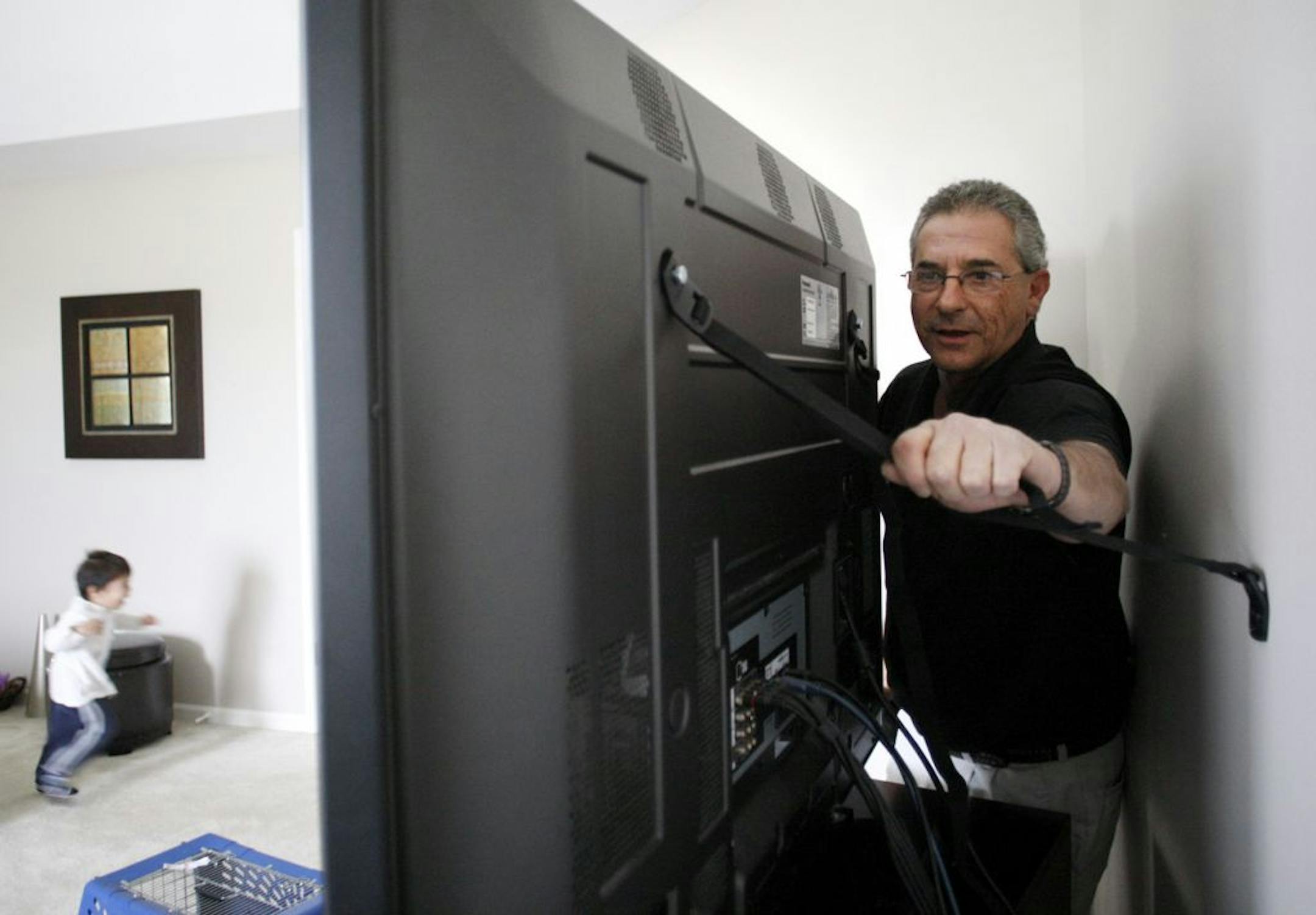
Toppling TVs pose danger to kids

Advocates call for the use of straps on the electronic devices to prevent deaths and injuries to kids.

Chicago Tribune
November 23, 2011 at 8:57PM
Arvey Levinsohn installs an anchor strap to a flat-screen television to keep it from tipping over on a child at a home in Westmont, Ill.
Arvey Levinsohn installs an anchor strap to a flat-screen television to keep it from tipping over on a child at a home in Westmont, Ill. (MCT/The Minnesota Star Tribune)

When parents buy a new TV, they're unlikely to find in the box a simple tool that could save their child's life -- safety straps or anchors to keep the television from tipping over -- because manufacturers aren't required to include them.

And parents who look to purchase the straps after the fact might have to hunt them down, because a number of stores that sell TVs don't offer the straps.

Safety experts are calling for the inclusion of such devices in light of disquieting statistics: More kids were killed in accidents involving falling TVs between 2000 and 2010 than by all other unstable furniture or appliances combined, according to a September report released by the Consumer Product Safety Commission.

On Oct. 30, a TV fell on a Chicago-area boy, 6, who police believe had been reaching for something on top of the screen. They found a juice box on the floor near his body.

"It's a very serious problem that is not going away," said Scott Wolfson, spokesman for the Consumer Product Safety Commission. "These are young children taken too soon."

Nearly 70 percent of fatal tipovers between 2000 and 2010 involved TVs, accounting for the deaths of 169 children, the commission reports. TVs also are the chief culprit in tipover-related emergency room visits, with an annual average of 13,700 injuries, the report states.

The responsibility is a joint one, shared by parents, the Safety Commission and those who make and sell TVs, Wolfson said.

"We want the industry to get engaged in this process," he said. "We want companies to be as active as we are. If the manufacturer doesn't provide [straps], we want the retailers to sell [them] and to do so in a prominent place that's easily accessible to parents."

Underwriters Laboratories, which tests the majority of TVs on the market, sets voluntary safety standards for TVs and stands. Raising awareness on the perils of falling TVs has been a priority, said UL's consumer safety director, John Drengenberg.

Among the UL's safety standards -- most recently revised in 2004 -- is that a TV can withstand a 10-degree tilt and a force of 20 pounds or 20 percent of its weight without tipping over.

Some safety advocates, researchers and parents say that's not enough. They want consumers to be able to leave a store with safety straps in hand when they purchase a new TV. Some advocates have also urged modifications in TV designs to make them more tipover-resistant and a warning label informing consumers of the tipover risk.

"I don't even want to speculate what the mortality rates would be if the UL standards weren't there," Drengenberg said, noting that often the problem comes when a TV is placed on furniture that's rickety or otherwise not intended to hold a large appliance.

Even if UL required companies to include safety straps, there's nothing to ensure consumers will use them, Drengenberg added.

But Rachel Weintraub, director of product safety and senior counsel for the Consumer Federation of America, a coalition of nonprofit consumer groups, said she believes more parents would use safety straps if they were readily available.

"I think if consumers know that it could potentially save the life of someone in their homes, I think they're going to be more likely to do it," she said.

about the writer

about the writer

DUAA ELDEIB

More from Minnesota Star Tribune

See More
card image
J. SCOTT APPLEWHITE, ASSOCIATED PRESS/The Minnesota Star Tribune

The "winners" have all been Turkeys, no matter the honor's name.

In this photo taken Monday, March 6, 2017, in San Francisco, released confidential files by The University of California of a sexual misconduct case, like this one against UC Santa Cruz Latin Studies professor Hector Perla is shown. Perla was accused of raping a student during a wine-tasting outing in June 2015. Some of the files are so heavily redacted that on many pages no words are visible. Perla is one of 113 UC employees found to have violated the system's sexual misconduct policies in rece