
Tolkkinen: Minnesota’s Constitution allows $1-an-hour labor for inmates. Should it?

In two rural counties, that labor is being used to build affordable housing.

Columnist Icon
The Minnesota Star Tribune
October 5, 2025 at 10:00AM
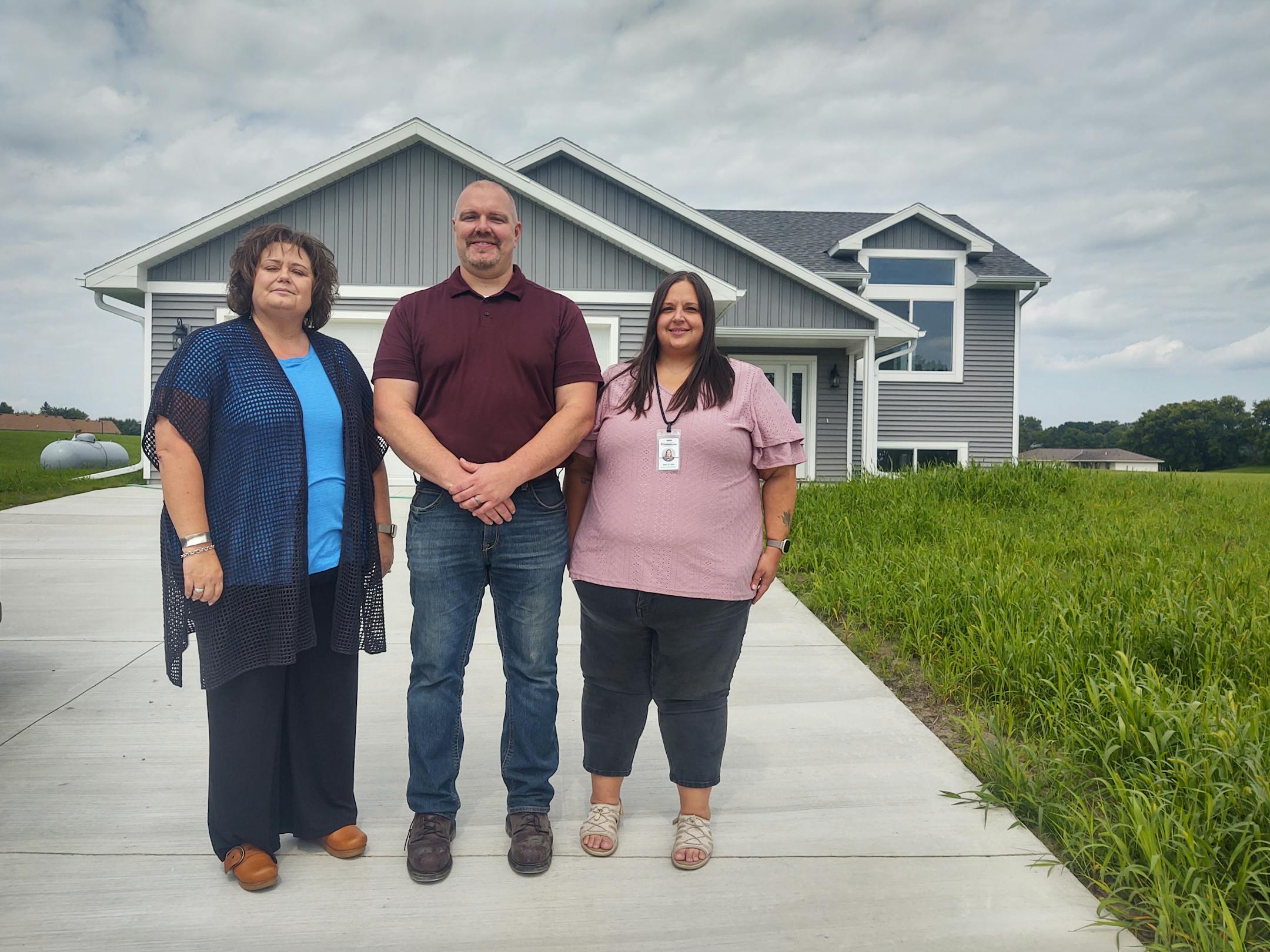
Missy Becker-Cook, left, Joe Niehaus and Danie St. John of West Central Minnesota Communities Action stand in front of a house their agency built in Evansville, Minn., with state inmate labor. It was listed at $223,000 in August, below the appraisal price of $323,000. (Karen Tolkkinen/The Minnesota Star Tribune)

ALEXANDRIA, MINN. - It sounds like a great deal.

And, in many ways, it is.

Douglas County and Grant County need more affordable housing. So why not hire nonviolent state prison inmates to build it?

In the only program of its kind remaining in Minnesota, inmates get to be out in the fresh air, develop marketable skills and contribute to society by providing housing at a level that commercial builders often won’t touch.

After working four 10-hour days a week on construction, they get three passes to leave jail on weekends. Two passes are supervised and restricted to a few activities like attending church or Narcotics Anonymous. The third is unsupervised, when they have four hours to visit family, go fishing or take in a movie. They must apply to be in the program, which only accepts about five prisoners, and only those convicted of nonviolent crimes.

But they earn 1970s wages. In a state where the minimum wage is $11.13 an hour, state inmates earn just $1 to $1.50 an hour, the going wage for incarcerated labor. And much of what they earn is taken to pay off their court fees.

It’s a rate that prisoner advocates say is tantamount to slavery, which, they say, is actually permitted in Article 1, Section 2 of the Minnesota Constitution. That section states that slavery or involuntary servitude are banned except as punishment for a crime.

To put it more bluntly: Minnesota’s Constitution specifically allows slavery or forced labor when it comes to inmates, a relic of the days when offenders would be sentenced to hard labor, before we as a society came to understand that the complexity of crime wouldn’t be solved by forcing inmates to bust apart rock with a sledgehammer.

A group called End Slavery in Minnesota that includes the ACLU would like to remove that wording from the state Constitution, said Paul Sullivan, an ACLU field organizer specializing in inmate advocacy.

“They don’t have the same rights that workers do, especially in jobs that can be dangerous, such as construction,” he said, and argues that “the simple fact of it is that these incarcerated workers are still legally considered slaves.”

Minnesota Department of Corrections Commissioner Paul Schnell called the constitutional language “troubling.” But as is so often the case, when you move one thing, you knock over something else, and he said that paying inmates minimum wage for their work could make that work unaffordable for the prison system. And on top of their wages, they receive housing and meals.

The benefit to local communities is undeniable. Using inmate labor, they can build up the supply of sorely needed housing for area families. A few years ago, Alexandria gained two duplexes and a small house for people who are homeless or facing eviction. Single-family, three-bedroom homes sell to nurses or teachers for $100,000 below market rate and stay affordable forever because they’re in a land trust that restricts resale price.

Paying inmates a higher wage could jeopardize the affordability of those homes.

It’s a dilemma that Missy Becker-Cook, CEO of West Central Minnesota Communities Action, understands well. Her poverty-fighting nonprofit organization is the one that has employed the inmates for decades. Since 2000, the inmates have built some 150 houses in west-central Minnesota for people who otherwise could not buy one. She’s extremely motivated to treat employees well, she says.

“If you knew me at all, you would know I’m always advocating for paying people what they’re worth,” she told me. She has come to terms with low inmate pay because one of her organization’s goals is to provide affordable housing. She reasons that inmates would “rather be out all day doing something for a good cause than be stuck in a cell.”

Her program was once one of many throughout the state. Minnesota has used inmates to build affordable housing since at least 1998, when funding was approved to create the program. The others closed down, largely during the housing crash and Great Recession from 2007-2009, she said.

The program has produced some big wins for the inmates, she said. One now runs his own construction company in Alexandria and has received accolades for his work. Another former member of their program is in the process of buying one of their houses.

But it’s not all sunshine and roses for the workers. The inmates told me they get strip-searched each time they return to the Douglas County jail where they are housed while working for the housing program. It’s standard procedure in jails and prisons, so they’re used to it, but it’s not pleasant.

The two inmates I spoke with, Matt Lewis and Tracy Rohloff, said they were not pleased to learn that even though their wages are the same in Douglas County as in the state penitentiary, the amount they have to pay for soap, shampoo and phone calls is much higher in the county jail than in the state prison.

I checked it out and they weren’t kidding. The county jail commissary, which is supplied by a private company, charges $4.19 for 3.75 ounces of Irish Spring bar soap while the state prison commissary charges $2.84 for 4.5 ounces. Other items were also significantly higher. When you’re making $1 an hour, every quarter matters.

Unsurprisingly, the inmates want better pay, or at least better benefits like more passes or getting released from prison sooner. They do everything on a house except plumbing, heating and electrical systems.

They both said they liked being part of the housing program.

“The reason I took this on is it’s a learning experience,” Rohloff said. “I’ve never built a house before.”

“The freedom we get we’re actually in the community,” said Lewis, who worked as a commercial roof foreman before prison.

It’s a good thing they like the work because if they quit, Rohloff said, they would be penalized by not being allowed to sign up for other prison jobs to alleviate boredom and help them earn money.

This is one of those issues where the right choice is murky. At minimum, incarcerated workers housed in county jails deserve a pay increase to cover the higher cost of living in a county jail, or the state needs to address higher commissary and phone costs in county jails.

Meanwhile, we as Minnesotans need to wrestle with the language in our own state Constitution.

Karen Tolkkinen is a Minnesota Star Tribune columnist focused on the people and issues of greater Minnesota. karen.tolkkinen@startribune.com

about the writer

about the writer

Karen Tolkkinen

Columnist

Karen Tolkkinen is a columnist for the Minnesota Star Tribune, focused on the issues and people of greater Minnesota.

See Moreicon

More from News & Politics

See More
card image
Jp Lawrence/The Minnesota Star Tribune

The Minnesota State Patrol said the driver and passenger in one vehicle weren’t wearing seatbelts.