Form + Content Gallery
Even abstract paintings can carry a story, as Elizabeth Erickson suggests in her luminous show "Now and Then, Kinds of Light."
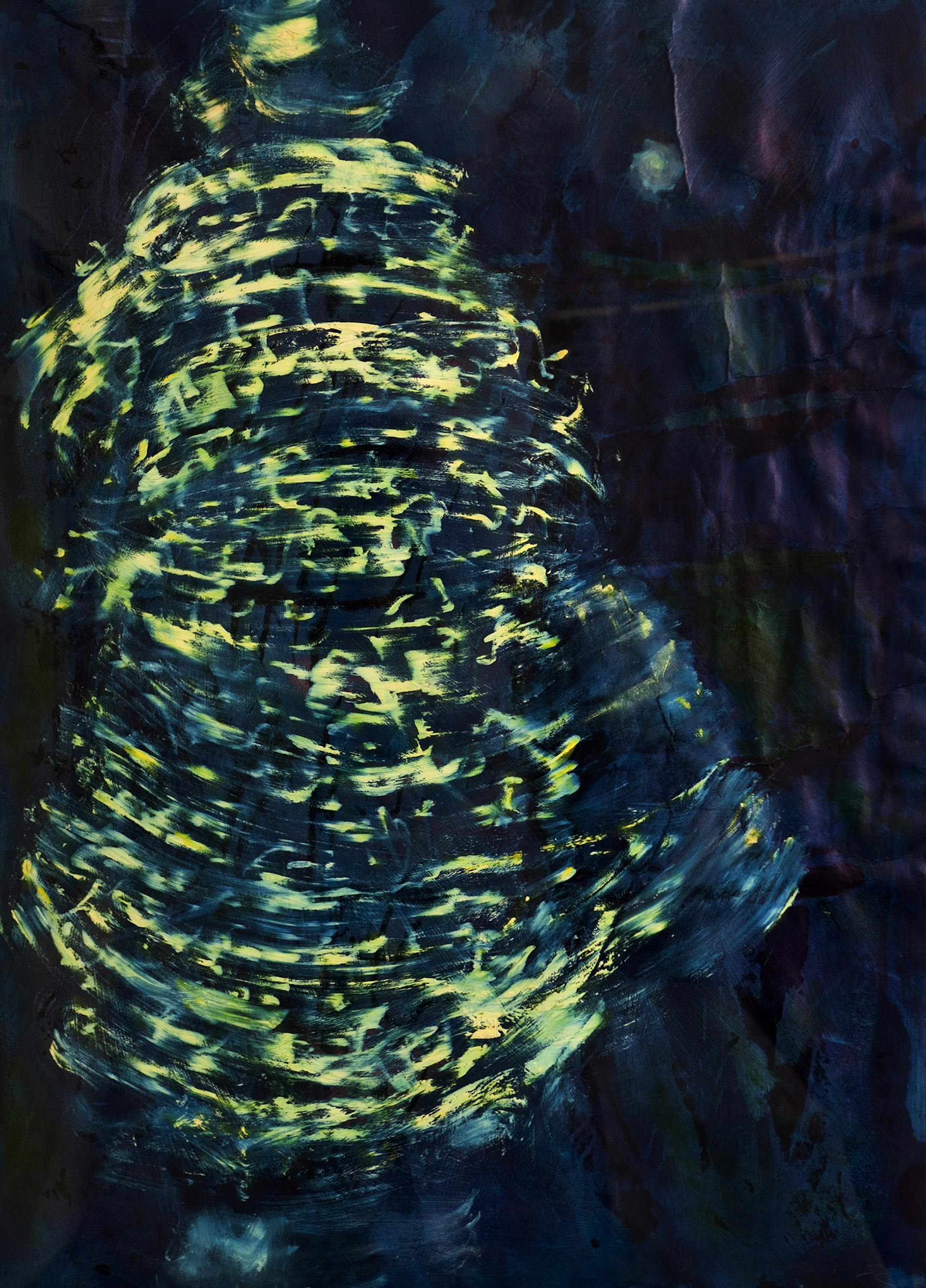
It is more conventional to wrap a narrative in portraits, landscapes or action pictures, but Erickson has successfully presented one in large cobalt blue canvases enlivened with dashes of yellow and gold over swirling undercurrents of plum, violet and shimmering green. It's all pure abstraction but suggests a series of mysterious encounters with ephemeral beings that she represents as flickering light, shadowy form, dissolving orbs and vortexes.
Her glowing, jewel-like hues are reminiscent of medieval stained-glass windows and the gold-flecked pages of illuminated manuscripts, associations appropriate to pieces that she says were inspired by the writings and music of Hildegard of Bingen, a 12th-century abbess, and other mystics and teachers as well as the starlit skies of the Minnesota prairies.
The series begins with "The Meeting (Discovery)," a deep blue canvas in which an encounter is suggested by a shimmering column of yellow light. In "The Dissolving," that vision begins to fragment and fly apart. The same sonorous hues define "The Healer," whose presence is marked by pale orbs and a swirling vortex of blue light, and in a second canvas of the same name, by wine-red stains and hints of a distant horizon across deep water. Not surprisingly, "The Grandmother (Striding Toward the Moon)," is the most literal with swirls of ivory suggesting a blanket-wrapped figure striding through a darkened landscape.
These delicate effects continue in "Cloud and Lily," which hints at leaves flickering over water; "Chrysanthemum," with its cascade of flower petals tumbling onto dark, luminous ground, and "The Messenger (Angel)," a bower of descending light. Even without their suggestive titles, Erickson's abstractions could seduce an attentive viewer into meditative reveries.
Noon-6 p.m. Thu.-Sat. Ends April 12 • Free • 210 N. 2nd St., Mpls. • 612-436-1151 •
www.formandcontent.org
Circa Gallery
In theory, abstraction ought to be timeless. Why would a line or blob made in 2010 look any different from one made in 1990 or 1950? But abstract marks do reflect their time, as seen in the group show "Confiscape."