

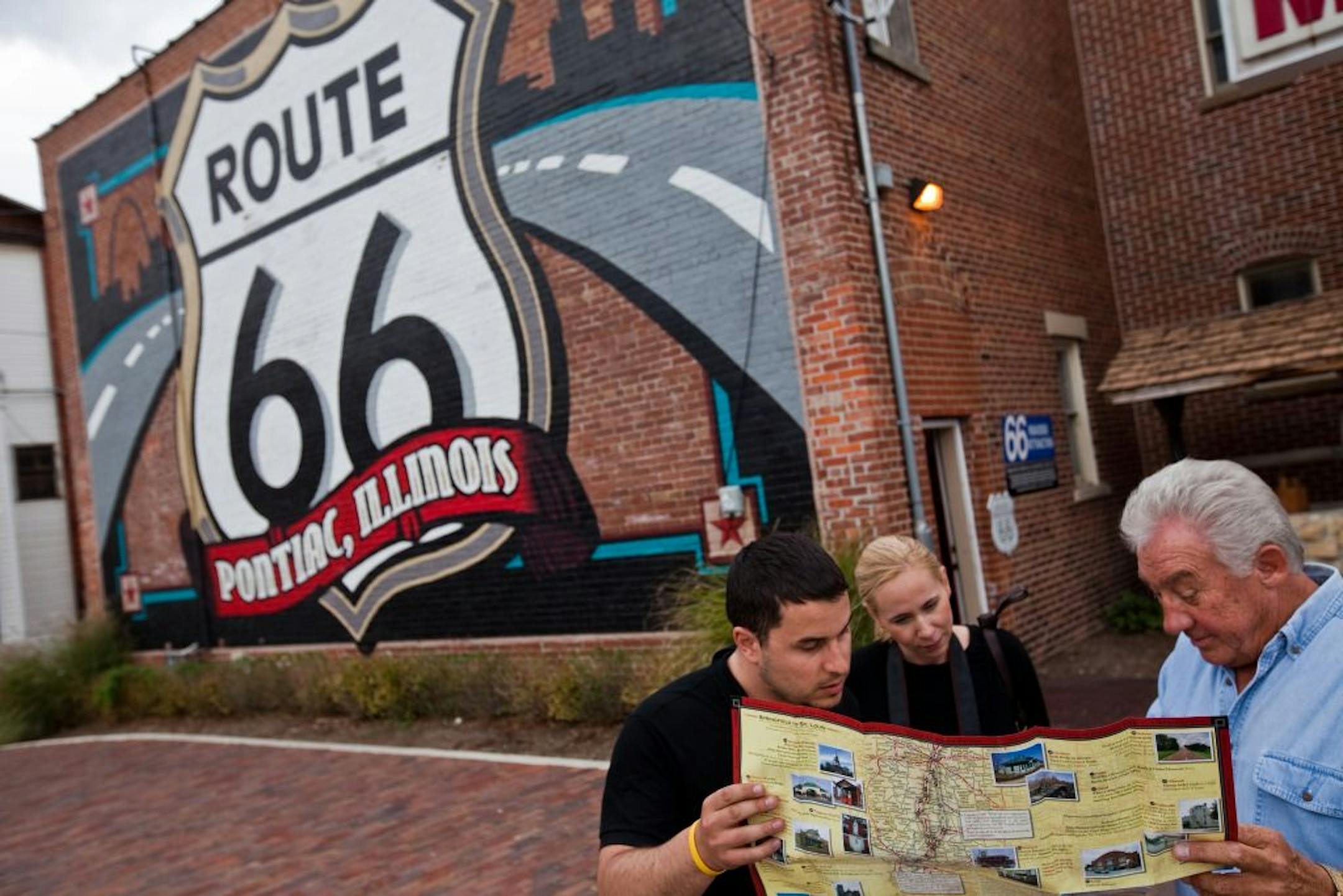
The honeymooners from Spain spoke limited English, but that didn't stop Mayor Bob Russell of Pontiac, Ill., from giving them a hearty welcome.
"How long have you been here?" Russell asked, posing for a snapshot with the newlyweds by a giant Route 66 mural before moving on to greet a busload of French tourists.
While many small towns across the country struggle to keep their downtowns afloat, a string of other Illinois communities scattered along the famed Route 66 are enjoying newfound popularity as foreign tourists roll in by rental car, motorcycle and bus.
"In Europe, it's very much the epic American road trip," said Sonny Dudes, a 31-year-old Brit who pulled a rental car up to a visitor center housed in a restored Texaco gas station in Dwight, Ill., on a recent afternoon. "It's the novelty of a bygone era."
THE BASICS
Anyone familiar with the Bobby Troup song knows that people get their kicks on Route 66, which ran 2,448 miles from Chicago to Los Angeles. The roadway celebrated its 85th anniversary of being named on Nov. 11.
The storied highway began as 300 miles of uninterrupted paved road in Illinois in 1926. By the early 1930s, the entire distance was paved, prompting business owners along its path to create kitschy gimmicks -- giant statues, Indian Trading Posts and neon signs -- to entice drivers to stop and spend money, said John Weiss, a local who has sold more than 10,000 copies of his book, "Traveling the New, Historic Route 66 of Illinois."
The construction of Interstate 55 in Illinois replaced the need for Route 66, and in 1977, the roadway was taken off official state maps. Still, visitors come from Armenia and Ukraine with cameras around their necks, road maps in hand and money in their pockets to head out on "The Mother Road."
WHAT TO DO
Clustered along 90 miles of the highway, towns from Joliet to Towanda, Ill., banded together in 2006 to make improvements and promote their Route 66 attractions collectively as "The Red Carpet Corridor."


