

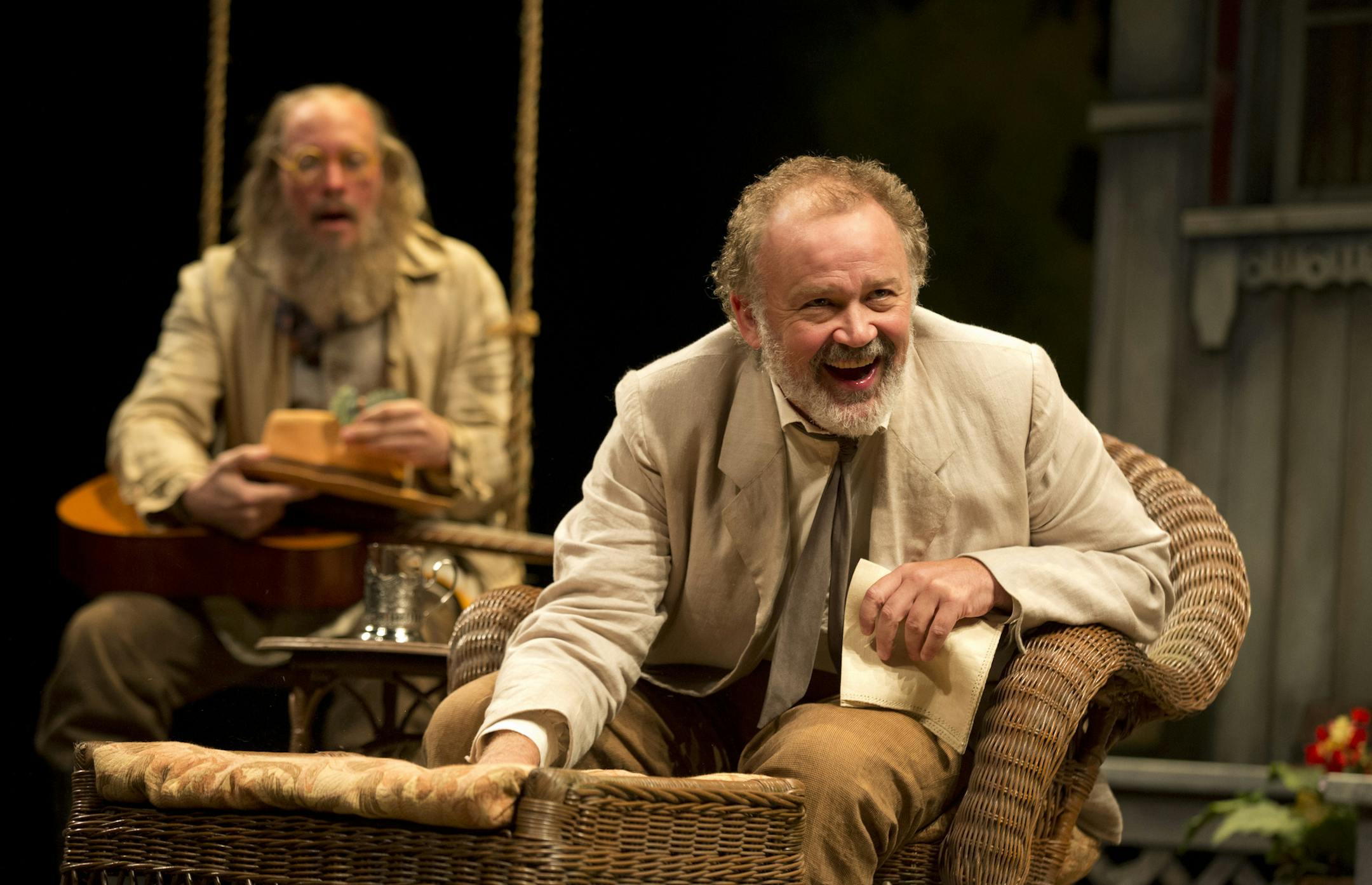
Long before Sam Beckett puzzled us with his tramps waiting for life to happen; long before method actors found character in naturalistic mumbles; long before Seinfeld spun television episodes out of nothing, Anton Chekhov was skimming drama from the ordinary patterns of daily existence.
"Any idiot can face a crisis," the Russian writer famously said. "It's the day-to-day living that wears you out."
Nowhere does Chekhov test that statement more overtly than in "Uncle Vanya," his second major play, which opens Friday at the Guthrie Theater.
Unlike his other plays, Chekhov did not subtitle "Vanya" as "A Comedy in Four Acts" or "A Drama in Four Acts." He described it simply as "Scenes From a Country Life," signaling less of a dramatic structure and more a collection of vignettes within the turgid rhythms of a few lazy days in the Russian countryside.
Chekhov's was a theater of mood, pauses, action hinted at, occasional bursts of absurdity and aching human longing. They were not tragedies, such as those written by Ibsen — with whom he is often paired as the originators of modern drama. As critic Eric Bentley aptly noted, "In Chekhov, the terrible thing is that the surface of everyday life is itself a kind of tragedy."
An old soul
Chekhov died at 44, a relatively young man, but he wrote with the wisdom of an old soul, from his observations: as a doctor he saw how the body worked as a mechanism; as a journalist and historian, he saw how Russian society worked with a cruel severity; as a member of a large family, he saw the dynamic theater of relationships.
"He is without exception my favorite playwright," said Joe Dowling, who is mounting this production, the Guthrie's first Chekhov since Dowling directed "Three Sisters" in 2003. "When you read his letters, he was one of the wittiest men, always seeing absurdities of life. That's what I take away. This was a man who really knew that no one can go through life without a sense of humor."
To that end, Dowling said, he is using a translation by playwright Brian Friel, which emphasizes the comedy. Critics and audiences often have seen the embers of Chekhov in Friel's writing, and it is clear the Irishman has an affinity for the Russian.


